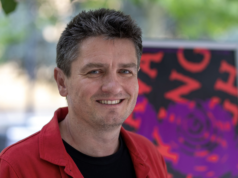
“I guess I have prepared myself to make this film…my whole life,” is how Finnish director Virpi Suutari describes the many years of work and reflection that have fed into Aalto, her documentary about the legendary architect and design guru Alvar Aalto (1898-1976), screening in Göteborg next month.
The film, sold by Autlook, will be screening in the festival’s Nordic documentary competition (see sales so far below).
This has been a true passion project for Suutari with roots way back into her childhood when she first encountered Aalto’s buildings. “I am from a small town called Rovaniemi, which is by the Arctic Circle in the northern part of Finland. There are quite a few Aalto buildings there. There was one really special for me when I was a child in the 1970s. That was the Aalto library, which was built in 1965.”
Almost every day after school, Suutari would go to this library. Even as a child, long before she knew much about art or even dreamed of making documentaries, she realised the building possessed some kind of magic. “It was such a good place to be and I liked to touch all the materials. It felt quite luxurious because, in the 1970s, homes were very modest.”
The Aalto seed was thus planted early in Suutari, who is now 53. In her 30s and 40s, she didn’t concern herself that much with Aalto. His designs are so familiar in Finland that people sometimes take him for granted. Wherever you look, you’re likely to see furniture from Artek, the company that Aalto founded with his wife Aino in 1935. Every city has its Aalto buildings.
As she approached her 50s, however, Suutari began to think more and more about the architect and his legacy. Four years ago, she began work in earnest on the film.
“The reason was that I wanted to learn more about his architecture and I wanted to learn who were all these other people involved in the Aalto architecture and design,” the director explains. “But also I wanted to learn who he and Aino were as humans…as contradictory human beings.”
In her home town, which had been destroyed by the Germans during the Second World War, Aalto was simply regarded as a hero. He had helped rebuild Rovaniemi. His achievements spoke for themselves, through his work, and nobody thought about him in a critical or complex way.
The director knew there would be a market for her film on which she is also one of the producers. The doc was made through Euphoria, the company she set up with her husband Martti Suosalo in 2012. Other movies had been made about Aalto in the past but they were smaller in scale than what she planned and also tended to be “a bit pompous” from today’s perspective.
“I am not an architect. I have been making documentary films for 25 years but I’ve never done an architecture film before,” Suutari notes. “I really had to start from scratch. I had this feeling of Aalto architecture in my heart but then I had to start studying and also creating a web of researchers and of people who had deeper knowledge about the Aaltos.”
Little by little, the director and her collaborators gathered together material. She got to know the Aalto family. She also won the support of the Aalto Foundation which allowed her access to the archives.
“The decisive moment was when I got hold of the letters written by Aino and Alvar; also when I got hold of the family photo albums and some family 8mm films.”
Some of this material was very intimate but the family members trusted her to use it “in a wise and sensitive way.”
The director remembers vividly the moment Aalto’s grandson turned up at her office with brown boxes full of letters and photo albums. She realised, as she puts it, that she could now “get a little closer to these iconic personalities.”
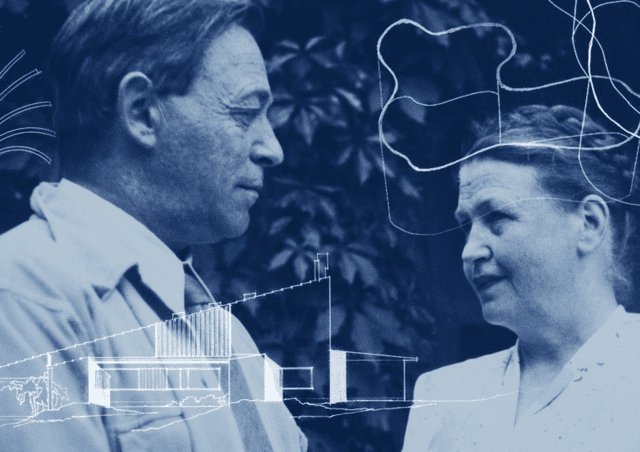
Having made the film, Suutari has become quite an expert on Aalto herself. Her film casts new light on the great man’s technique. “Of course, no-one is a genius by himself or herself. There were lots of other people [behind the success), Aino had a really equal relationship with Alvar in creating this more human modernism. They were two young architects working side by side and creating the Aalto vocabulary together.”
The film also acknowledges the contribution of Aalto’s second wife, Elissa Aalto, a formidable figure in her own right.
Like almost every other Finnish citizen, Suutari has her share of Aalto objects at home. She is the proud owner of many Aalto lamps which she likes because “they are not very demanding…you can put them almost everywhere.” She also has an iconic Stool 60 seat and covets various other Aalto chairs…but says they’re outside her budget for now.
In the meantime, the director is supporting the roll-out of the film which has been selling briskly and has shown at various festivals. It also received a successful theatrical release in Finland in breaks between lockdowns. “It is circulating very nicely but the bad thing is I can’t go anywhere. Most of the screenings have been online,” the director laments.
Autlook sales so far: Madman (ANZ), Just Wanted (Italy), Doma (Japan), Beat Films (Russia), Xenix (Switzerland), FilmIn (Spain), Salzgeber (Germany), Artcam (Czech/Slovak Republic) and broadcasters ARTE (Germany/France), SVT (Sweden), AVROTOS (The Netherlands), Yes (Israel), NRK (Norway), HRT (Croatia) and RTV (Slovenia).