Camilla Nielsson, whose new film President premiered in Sundance World Documentary Competition to rapturous reviews this weekend, never thought she would be going back to make a second film in Zimbabwe.
In 2014, the Danish director had shot Democrats. This was her highly acclaimed documentary about the drafting of the new constitution. At that stage, Zimbabwe had been ruled by the dictatorial Robert Mugabe for over three decades.
In a roundabout away, Mugabe’s government paved the way for Nielsson’s new doc President. The censorship board had banned Democrats, treating it in the same way as if it had been a piece of violent pornography. Lawyers suggested to Nielsson that she “test” and “challenge” the ban through the court system in Zimbabwe. She therefore returned to the country. By then, Mugabe was no longer in power, his long rule having ended in late 2017.
Nielsson had flown to Harare to present her side of the case in court. “We won, rather surprisingly,” she says. “I think the regime at that time, about two months after the fall of Mugabe, needed to showcase its new democratic agenda.”
The very night the ban was overturned, one of the protagonists from Democrats suggested to Nielsson that “now was the time to make the sequel.”
The director felt she had unfinished business. Mugabe had signed legislation passing the new constitution – but that constitution had not yet been implemented. Now, at last, it looked as if true democracy was on the horizon. An election had been called for 2018. She thought she would be able to film this election without the “pressure, surveillance and constraint” she had experienced while making Democrats. The new film would make the perfect companion piece to its predecessor.
“There was a sense of the democratic space having opened after Mugabe had fallen in a military coup. People were speaking more freely. In cafes, people were, I think, for the first time ever, able to discuss politics openly and without whispering,” the director observes of the optimistic mood she encountered when she returned in the spring of 2018 to apply for a permit to make President.
The hitch, though, was that many of those who had tried to keep Democrats banned were still involved with the Ministry of Information. They weren’t at all keen to have Nielsson back.
Four weeks before the elections, the director finally got her permit. Her cinematographer arrived the next day and they immediately began shooting, non-stop for three months.
And, yes, it was as uncomfortable as ever. They were under constant surveillance just as they had been during the first film. Time was so tight that the production (made through Danish production outfit Final Cut For Reel) didn’t have time to secure extra financing. Nielsson was shooting an epic with a tiny camera crew.
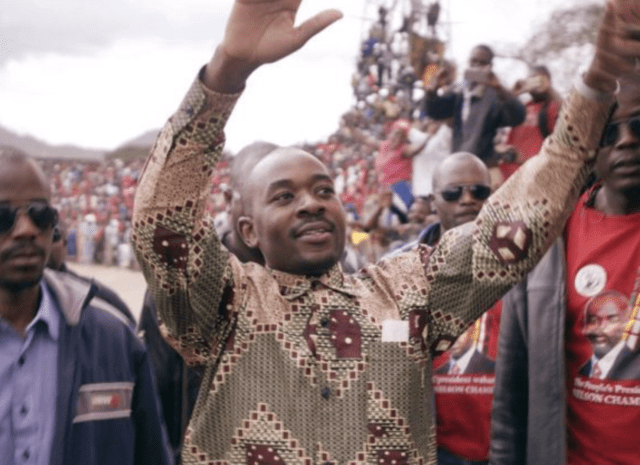
As it turned out, the election was bitterly disputed. The opposition MDC (Movement for Democratic Change) candidate Nelson Chamisa was taking on the ruling Zimbabwe African National Union-Patriotic Front (ZANU-PF) and its leader Emmerson Mnangagwa. ZANU-PF won. Chamisa challenged the result but was unsuccessful in having it overturned.
The filmmakers had approached Mnangagwa to request permission to film him. His advisors initially felt this was a good idea but, as the election came nearer, communication with the government suddenly stopped. After an assassination attempt, Mnangagwa became ultra-cautious about who he would let near him.
Chamisa was far more open and “took about a split second” to agree to co-operate with the filmmakers. “He was a young political prodigy known by everybody…he represents not just the opposition but also the youth, the young people in Zimbabwe, who had all grown up under Mugabe and really are desperate for change.”
The director describes the making of President as “a three-month physical marathon.”
On one level, this was a very pure piece of documentary making. Nielsson is an avowed admirer and follower of the cinema verité work of directors like the Maysles brothers, DA Pennebaker and Richard Leacock. She has reverence for their political documentaries ranging from Primary (1961) to The War Room (1993), which were “injected intravenously” to students at NYU film school when she was there.
“A two hour and 10 minute movie about a presidential election in Africa – I can see how that somehow seems like a dinosaur code of communication! But I do think it’s a very complex story we tell,” the director reflects. This was a subject with so “many layers” and so much “nuance” that it wouldn’t have been possible to tackle in a shorter format.
The 2018 Zimbabwe election was like a distorted reflection of the US Presidential election in 2020. Both were disputed but, in the case of Zimbabwe, evidence of fraud was actually found.
“It was like an exact mirror of our story – ballots, observer teams, stolen elections,” the director says of the US election and Trump’s refusal to accept its result. “The beauty of the Trump saga is that the American democracy system worked. The democratic institutions were free and independent. The Zimbabwean story can be an example of what happens when they are not free and independent.”
The danger, she adds, is that some could interpret Chamisa’s allegations that the elections were stolen as being as baseless as those claims made by Trump.
President has been called “extraordinary” and “remarkable” by reviewers in Sundance but its director still sees it as a chronicle of failure.
“For me as a European filmmaker, having made this film in Zimbabwe, in terms of our engagement, in terms of the international community’s engagement in the presidential election, I think we’ve failed,” the Danish director states in stark fashion. “There was a lot of interest and a lot of hype…I’ve never seen as much press at an African election.”
International observers were out in force. Nonetheless, she believes that “they didn’t dig deep enough.” They had hoped for “a clean winner and a swift move into constitutional democracy.” When that didn’t happen, they swiftly moved on – and didn’t stay behind to explore in depth what had turned out to be a flawed and very contentious election. “I feel that we, as the international community, let the country down by getting involved and then […] not finishing the job,” she concludes.
Does that mean Nielsson is ready to go back and film a third documentary? “Any time,” she replies instantly of what now might turn into her Zimbabwe trilogy. “I would love to be there the day that a strong constitutional democracy happens.”
As for when that might actually come to pass, though, she is not naming any dates.