At the root of Who We Were is a rejection of the ostensibly Western notion of the self that has dominated philosophical thought “since Plato,” and the promotion instead of a sense of ‘collective’ which goes beyond the realms of the humankind to accord equal status to the animal kingdom and the environment.
The film, and Bauder’s personal viewpoint, is very much informed by the writings of German author and academic Roger Willemsen who denounces humankind’s acquiescent 21st Century attitude of “teaching ourselves to plead ignorance in the face of knowledge, acting as if we don‘t know, even though we do.”
In his notes for the film, Bauder further stresses how, as a species, we seem to be powerless participants in our own demise, as we observe the effects of globalization and unsustainable growth. “Instead of witnessing a broad social awakening, there seems to be mostly resignation and helplessness,” he writes.
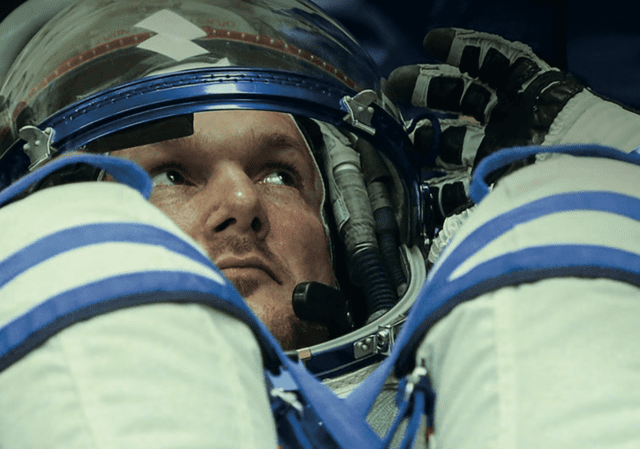
And so Bauder takes a multi-disciplinary approach to the dilemma, enlisting the support and wisdom of six contemporary thinkers and scientists to explain the world as they see it, in the process encouraging us to recalibrate our own thoughts and attitudes. These are Alexander Gerst (astronaut), Dennis Snower (economist), Matthieu Ricard (molecular biologist and monk), Sylvia Earle (oceanologist), Felwine Sarr (economist, sociologist and philosopher) and the philosopher and critical posthumanist Janina Loh.
“I tried to translate their specific knowledge into a broader perspective…to be an ambassador for them, to open up their knowledge,” explains Bauder.
In so doing we are taken on a fantastic journey into outer space and to the bottom of the ocean, from Nepal to the desolated nuclear site of Fukushima, from the seat of German democracy (where even Angela Merkel puts in an appearance) to Senegal, where Felwine Sarr observes how the world he encounters these days is not only affected by anthropocene factors, but more significantly by the destructive reality of “capitalocene” influences.
The film starts with a rocket launch into space and ends with the astronauts’ re-entry into the Earth’s atmosphere. Bauder was certain of this framing device from the beginning. “I always knew this would have to be a journey,” he says. “Sometimes you have to leave your normal setting, your normal surrounding…like a holiday, when you come back you realise that your reality changed because you have a new perspective.”
The scenes in the ISS (International Space Station) are both remarkable and moving as astronaut Gerst sits (and floats) and contemplates the Earth beneath his feet. He looks at clouds that cast shadows thousands of miles long and recognises country shapes, remarking how atlases don’t lie. He can take in the Brazilian rain forest in a single glance, “the lungs of the Earth”, and the “cancerous grow” of destruction at its edges.
Earth is the only known place in the universe where people exist, he observes, “and we human have nothing better to do than destroy it.”
That said, Bauder’s doc isn’t a doom-laden and hopeless treatise on the inevitable demise of us as a species and the planet we inhabit. Rather, it strikes a clear note of optimism, such as when the smiling monk/molecular biologist Ricard explains to economist Snower the inevitability of flux and change, and the eventual failure of the forces which exert their negative impact on the planet.
“What is high will fall, what is gathered will be scattered,” he says. “That is not pessimistic.”
In Bauder’s notes for the film, he expresses his joy at introducing the two men in the shadow of the Himalayas. “I’d say it was mostly a gift because it was a conversation between the two of them where they met on their own intellectual level, were curious about each other, and constantly readjusted their perspectives. I had asked Dennis Snower if there was a person outside of his context with whom he would like to exchange ideas. He named Matthieu Ricard, who in turn was very interested in meeting Snower. So I just built the bridge.”
Just as cinematic is the undersea world introduced to us by oceanologist Sylvia Earle, one that we are nowhere near understanding either in terms of its vastness or its complexities, she argues. “Just to be in the skin of any fish with sensory systems – that, we can only dream about” she ponders. And why is the planet called Earth, she asks, and not Ocean, given that its surface is mainly water?
But even if we know little of the ocean’s complexities, we are aware of our species’ destructive impact on it, as well as on the Earth’s land masses. Bauder’s documentary sets out to challenge/combat this sense of willing acquiescence or our part.
“It is not a question of information, we know everything, we have all the information,” he tells Business Doc Europe. “It’s a question of connecting information, putting it together. So my focus of this film is to show people on the move, people already doing and connecting and trying to bring people together from different perspectives, to show on one hand that there is an old world of finance guys, white angry men, and on the other that there is a plurality of genders, of nations, of races and cultures.”
He adds: “We may think that we’re simply not capable of understanding the increasingly complex problems of our planet, but for these charismatic scientists, that’s not enough. Whether it’s on the top of the world, in the depths of the ocean, inside the human brain, at the G-20 summit, or in the heart of the International Space Station ISS, they are searching for practical ways to save our world.”
The film is being sold at EFM by Films Boutique, will be released in Germany by X-Verleih and Warner Brothers, and has a special Screening at Berlinale. It is therefore made with a large audience in mind. It is a documentary, Bauder adds, located “at the intersection of arthouse and mainstream, and is 100% cinema.”
“When I started the film there wasn’t any pandemic, there wasn’t any interruption in our way of living, but I think that the film can help us now to restart thinking in a post-pandemic life, without forgetting where we came from, [but] to change who we will be.”
“This film has to be seen by a lot of people. I think it’s time to really reflect on who we are,” Bauder ends.