

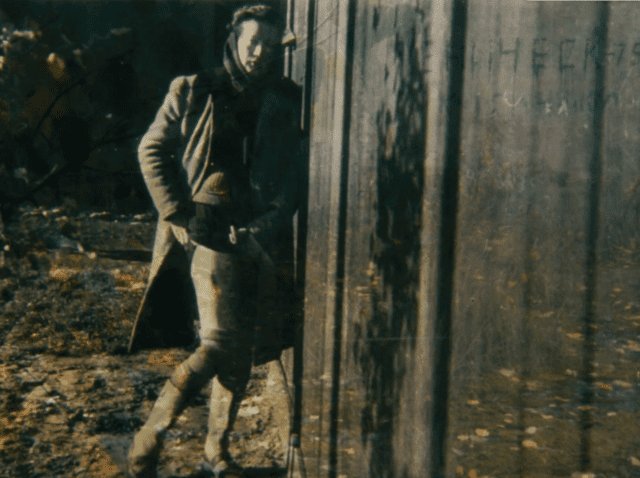
“Since they have worked so hard to pass these images on to us, we must look at them,” Christophe Cognet tells viewers in his new film À pas aveugles (From Where They Stood), premiering in Berlinale Forum (and sold at the EFM by MK2). Cognet is talking about photographs taken by inmates from inside Nazi death camps.
The French director describes the documentary as the second part of a “diptych”, following on from his 2014 feature Because I Was A Painter. In the first film, his subject was artworks secretly created by prisoners in the camps. In the new project, the focus is on the photographs these prisoners managed to take, some from within the gas chambers themselves.
While he was researching and making Because I Was A Painter, Cognet discovered many of the photos featured in the new film. “At first, I hesitated about whether to use them or not,” he says of the images taken at Buchenwald, Auschwitz and elsewhere. “I realised that drawing and photography are not at all the same thing. I decided just to stick with drawing.”
With a sketch, you can witness something and then draw it later, in safety. Photography, the director notes, is “exactly the opposite.” You need to be there, even if your gaze isn’t fixed on the event or person your camera is capturing. Many of the pictures featured in the documentary were taken blindly by the prisoners, “from where they stood.” (Hence the title). They were almost always in extreme danger and had to conceal their cameras.
When Claude Lanzmann was making his masterpiece Shoah, finally released in 1985, he didn’t use archive material because (he thought) images of death in the gas chambers were non-existent – and it would have been indecent to include them even if they were.
“Often, people say that Claude Lanzmann was against images. That’s not it. He was against archive images, and it’s important to clarify that. When he made Shoah, these four main photographs that I use in my film, the most important ones including the women undressing to go into the chambers, there wasn’t much knowledge about them,” the director explains.
Now, these pictures, referred to as the “Sonderkommando photographs,” are far better known. They’ve been studied in depth.
Cognet emphasises that he has not made a historical documentary. His interest is in the act of seeing, or “micro-perception,” that “fleeting perception when you view something through a pinhole.” In the film, he explores how the pictures were taken and tries to recapture the point of view of the photographers.
Audiences may be startled by some of the images in the film. Camp inmates are shown at leisure, even smiling for the camera. In such pictures, the expected horror doesn’t register.
“What these images show us is there was contrast between the different camps and the different situations [of the inmates],” Cognet reflects. “They also strike us because the images [of the camps] we are used to seeing are almost exclusively those produced by liberation armies and the journalists that were embedded with them in 1945. This was a very specific moment.”
The photographs taken when the camps were liberated were intended by the Allies to provide irrefutable evidence of Nazi crimes. The pictures the inmates took themselves in 1943 and 1944 sometimes had different purposes. There is another obvious reason why the subjects in many of the pictures seem relaxed. The photos were taken when the prisoners felt (relatively) safe. For instance, French prisoner Georges Angeli took his pictures “on a Sunday, when the bodies had already been removed. People weren’t working. They were resting.”
“We must not forget that an image is a fraction of a moment. It only represents that very specific instant,” the director continues. The fact that the prisoners seem relaxed at the given moment they are captured on camera doesn’t lessen the hellishness of their predicament.
Cognet highlights another paradox regarding the four most notorious photographs. “This was the safest place to take the pictures, from inside the gas chamber because the SS almost never went inside,” he points out.
Making the documentary was ghoulish work. Early on, in the grounds outside one of the camp sites, the director is shown what seem to be little stones washed out of the ground in the rain. In fact, they’re tiny shards of human bones.
How could he make such a film without being overcome with grief and disgust? Cognet answers simply: “I’ve visited these places many, many times. I’ve been going to them for over 20 years, sometimes alone, sometimes with historians, sometimes with my teams. That helps me become familiar with the places. The second point is that making a film protects you. It allows you to transcend your emotions – you have a mission. The third point is that I was guided by the victims…”





