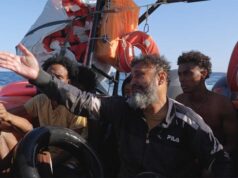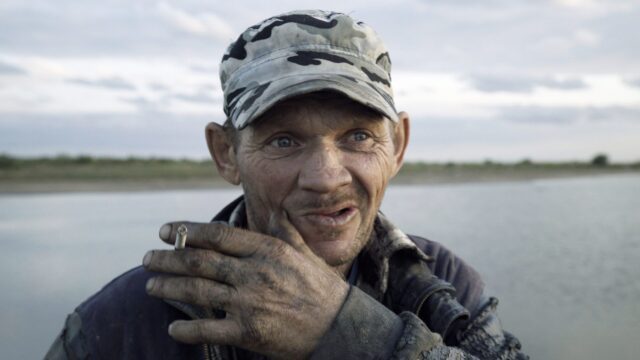
It’s the island that time passed by. Once a thriving community in the Soviet era, it is now largely abandoned by the Russian government. The islanders have neither electricity nor other basic utilities. Men like Ivan eke out an existence by fishing but they’re unlicensed and face continual harassment by the coastguard who regards them as poachers.
This is the setting of Ostrov – Lost island, the feature documentary receiving its world premiere this week in Feature Competition at Visions du Réel. The film is directed by Svetlana Rodina, a Russian filmmaker now living in Switzerland, and her partner and husband, Laurent Stoop.
“It all started with a photo made by a friend of mine…some ruins in the fog in an abandoned place,” Rodina remembers how she first discovered the island. “It was so beautiful and so strange that I felt there was a story there.”
Rodina was told that the photo was taken on an island in Russia. Her curiosity was whetted. She wanted to know what the island meant to its inhabitants, “freedom or kind of a prison?”
This was three years ago. Rodina had just left Russia herself. “I had emigrated from my beautiful and strange country, to safe and stable Switzerland. This topic of the island became a very strong metaphor for me.”
That was why Rodina and Stoop travelled there. She emphasises that Ostrov – Lost Island is intended as a “poetic, metaphorical and philosophical film,” not a story about politics and social trends. She wanted to explore the mixture of love and despair with which the locals regarded their island.
The name Ostrov means ‘island.’ The filmmakers don’t reveal the place’s exact setting or geographical name. All that they let the audience know is that the island is “somewhere in Russia, somewhere in the Caspian Sea.”
It’s a real place, though, and the dilemmas facing the inhabitants as they try to survive are very familiar.
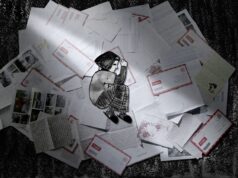
Ivan may be in a constant battle with the coast guards and may complain frequently about corrupt local politicians but he still regards the Russian President as a magical figure. Vladimir Putin is a constant presence in the documentary, watched on flickering TV screens whenever he makes an address to the nation. Ivan even writes a handwritten letter to him, hoping the President can solve all the island’s problems with a dash of his pen.
“He (Ivan) believes in Putin,” Rodina explains. “It is very important to understand that for Ivan, Putin is not just a politician. In a moment of despair and hopelessness, most of us try to escape into an illusion that there is somewhere some absolute justice. For some, it is God…(but) there is no church on this island. It was destroyed during the Soviet Union. For Ivan, it is Putin!”
Rodina suggests this attitude is commonplace across Russia. The President is seen as a benign father figure, not as the representative of a flawed and corrupt State that sometimes treats its own citizens very badly.
The islanders remain deeply patriotic. They always celebrate Victory Day in May, marking the end of the Second World War.
It took Rodina and Stoop time to convince the islanders to allow them to shoot the documentary. “They were very suspicious of us at the beginning,” Rodina recalls. Some even thought that the two documentary makers might be spies sent to snoop on them by the authorities.
“We spent a lot of time there without filming and almost losing hope that they would open up to us,” Rodina notes. The documentary maker made half a dozen separate expeditions to the island, staying at least a fortnight every time.
Gradually, the attitude changed. “Step by step, Laurent and I became real people for them. And, at some point, the island became a very important part of our personal lives.”
After much deliberation, Ivan decided he liked the filmmakers. When he invited them into his life, all the other residents also became more open with them. Since the filming finished, the directors have remained in constant contact with their subjects.
For the first time in 30 years, the authorities have now started to invest in the island. They’ve built a fish warehouse and opened up the possibility that fishermen like Ivan may be given licenses – so they don’t need to poach to keep their families alive. There are promises of electricity and medical support. After many false promises, the islanders are hard-bitten and sceptical but their lives may be about to get better. Some believe Ivan’s letter to President Putin is responsible for the change in their fortunes.
Ostrov is premiering in Visions Du Réel and will then head to Hot Docs. The two directors are very keen to go back to the island – not least because they left some of their equipment there and haven’t been able to retrieve it since the pandemic began. No, Ivan hasn’t seen the film yet. Wi-Fi is very sporadic on the island and he would have to travel to the capital city to have proper internet access in order to watch a link. However, the trailer has been watched on the island and the doc itself will eventually be screened there.
Rodina and Stoop are now planning another doc in an equally far flung location. They are planning to head to the Republic of Tuva in southern Siberia to make a film about nomads who were settled in cities during the Soviet times. After the collapse of the Soviet Union, they returned to their old ways of life. The main focus of the new doc will be on “hybrid children” who have grown up with modern digital technology but also still have the ability to live like nomads. The two main protagonists, a 13-year-old and 16-year-old girl (who is a shaman), have already been chosen. The project’s working title is Planet Of The Children. Covid-permitting, the duo hope to start shooting later in the year.