

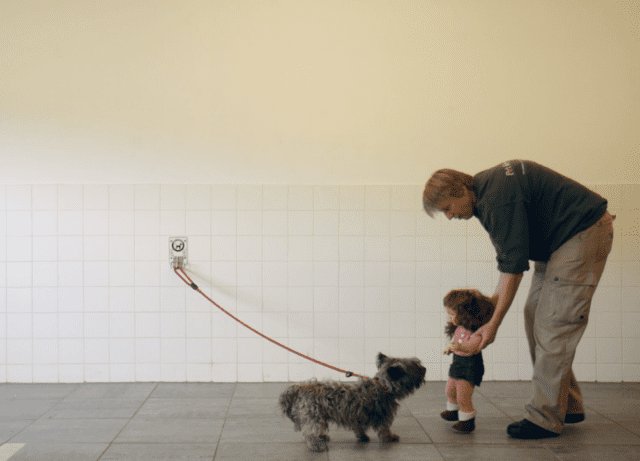
Saskia Gubbels’ Sheltered is a paean to love for our furry four-legged friends. But set in the Amsterdam Animal Shelter, it is also an indictment of the human species and our frequent propensity towards cruelty. The director explains all.
It is obvious that Dutch director Saskia Gubbels is an animal lover, telling of a happy pet-filled childhood that segued into an equally blissful domestic set-up with her own kids (and cats). It’s not surprising therefore that the folk that she films in her feature doc Sheltered are an equally dedicated bunch when it comes to dealing with creatures on four legs.
“The largest animal shelter in the Netherlands is much more than a shelter, it is a mini society but focused on animals, with a grooming salon, veterinarian, physiotherapy, behavioural therapists, team aftercare, team socialization and a medical team,” says Gubbels.
“While walking around the shelter I saw, at the back of the building, a transport coming in with 30 neglected and abused animals,” she clarifies. “Inside I saw people who were saving a cat’s life and people crying next to a dead dog, and at the front very happy people with their adopted animal. So it was this circle of life that fascinated me. A small world in one building, with extremes.”
But human nature, of course, has a sickening flipside, and the reason why many of the animals are in the sanctuary is because they have been subjected to horrendous brutality by their owners, such as the cat that has to be put to sleep because the skin on one side of its body has been flayed, or the 9-month old dog forced to produce a litter of puppies to meet market demand. “I saw a world that is a reflection of human cruelty and that’s what I wanted to show,” Gubbels underlines.
Gubbels articulates a particular benefit of filming animals – you never have to ask their permission to point your lens in their direction. “When I started this film I became aware that while filming I never had to be afraid that an animal would say to me, ‘fuck off with your camera, are you here again? I don’t want to be filmed anymore, go away.’ So I would definitely recommend filmmakers to make a film about dogs once in your life, it gives you enormous freedom!”
But she adds a rider to this. “Of course I felt sometimes guilty about that because I realized that I was no better than all those people, who just use animals for their personal comfort just because we can.”
Whether for reasons of size or variety, or that they fill a larger emotional space in humans than other pets, it is dogs who are the star of the show. Canines are, in the main, what most prospective owners come in to see. And it is dogs that make for great cinema when they are being trained for pet readiness, or when they gaze dolefully into the camera. And sadly, it is their eventual death, be it by illness or behaviour-motivated euthanasia, which pulls most at the heartstrings, whether those of the audience, the staff in the shelter or indeed the filmmaker herself.
“Intellectually I understand very well why he [one of the dogs in the film, no spoilers] couldn’t live anymore, as he is a danger to society, but it’s so clear he doesn’t want to die,” says Gubbels. “He’s fighting for his life. It makes me very sad when I think that he had to die because we humans cannot handle these types of dogs that need specific care, specific training, specific attention. And if you as an owner know exactly what these types of dogs need, if you are able to ‘read’ your dog, it does not have to get out of hand – and that’s a sad conclusion to this death.”
That said, such small tragedies have an upside from a filmmaking perspective. “If I get emotional while filming I am very happy about it,” the director concludes. “Then I know that it also affects the viewer.”
Gubbels further expands on our (not so inexplicable) fascination and regard for our furry friends. “New studies also suggest a genetic basis for animal love, so when people look at an animal, especially a young animal, something deep within us is touched,” she says.
“It has also been scientifically researched that animals have an absolutely positive effect on the physical and mental condition of humans. we love an animal so much because the love he gives us is unconditional. An animal does not judge, it always accepts you as you are, it is always fair,” she suggests. “He asks for love and gives back attention. They dispel loneliness, they provide tremendous social support, they provide security. I think especially dogs because they are able to tune in to our emotional state of mind.”
“I live in a neighbourhood with a lot of vagrants, and every one of them has at least one dog. They are people who lost everything in their lives, coping with debts and disappointments and their last straw of human dignity seems to be their dog. It has been researched that people are willing to give up everything except their animal,” Gubbels ends.





