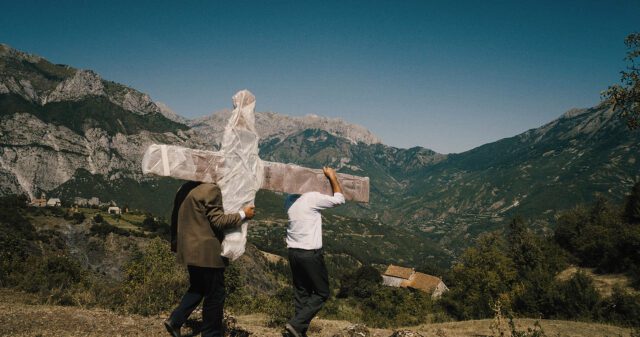
“It was all triggered when an Albanian scholar told me that this subject had been done a thousand times and never correctly,” Slovenian director Marija Zidar recalls to Business Doc Europe of the circumstances which led to her making Reconciliation (a premiere at CPHDOX in Next Wave Award this month).
The subject in question was blood feuds in Albania and the country’s ancient code of law, the Kanun, which can allow for reconciliation rather than revenge.
In 2013, a young woman of nineteen, Gjyste Paplekaj, was shot dead in the Albanian highlands. This was a part of the country in which the Kanun, banned in Communist times, was being revived. It rules that reconciliation between warring parties can occur “if the family of the person killed forgives and refuses to take revenge upon the family that owes blood.”
Like many other old traditions, the Kanun is often misunderstood and misrepresented by outsiders. In her film, Zidar was determined to move beyond the stereotypical portrayals in western media of blood revenge, honour and primitive violence, complete with “women and children crying and ethnic music in the background.”
Prior to shooting, the director (whose background is in journalism and sociology) conducted extensive research. She quickly understood what the scholar had meant when he talked about the story never being told properly. In most western media accounts, the Albanians were treated as if they still lived as they had hundreds of years ago.
Zidar quickly discovered that the reasons behind the revival of Kanun were “far more complex than just old laws surviving intact in the present day.”
She has described her film as a “slow-burning observation of both the tragedy and absurdity of a male conflict in a highly patriarchal Balkan society.” However, she is telling the story from the inside and trying to move away from the clichés. She is looking at how modern constitutional law “collides” with ancient codes of behaviour.
The reason she chose this particular story was that the death of Gyste Paplekaj hadn’t yet been covered by the media. She had been taken to meet the dead woman’s family by a bishop.
“I found an incredible twist on the stereotype which I felt was needed for the story because the father had a theological debate with the bishop – and he basically defeated the bishop. I found it very different to how it [the subject of blood feuds] was covered before where an enlightened westerner comes to the rescue of these savages.”
When Zidar later met the brother of the man who had shot Gyste, he quoted Dante, Lorca and Rilke to her.
Not that the enthusiasm for poetry and philosophy meant the protagonists were progressive in their politics or their attitude toward gender. ”Being cultured never stopped anyone from holding problematic views,” the director notes.
The filmmakers were clearly frustrated by some of the self-appointed mediators who often intervened in these disputes. “The gatekeepers for Western filmmakers and media are organisations such as Gjin Marku. And they have a vested interest to keep the myth of blood revenge alive,” she says. “They take journalists and filmmakers to safe cases, and at any given period the same cases rotate in the media.”
In her documentary, Zidar is depicting a deeply patriarchal society. As the menfolk of the rival families discuss the possibilities of reconciliation, the voices of the women aren’t heard.
The director points to double standards that apply to female documentary makers too. “There is this trend within the industry that we are expected to focus on women characters in our films. I find this incredibly problematic. Just as we started entering filmmaking in greater numbers, we are already limited at what we can gaze.”
When she was pitching and presenting the project, Zidar was often asked “how is this a female perspective [in the documentary] if you are focusing on men?”
Reconciliation has a lot of scenes of men talking to each other. “It was incredibly distressing and emotional even for me. I didn’t take a side,” Zidar remembers what it was like to be in the room with the rival parties in this heated family conflict.
The director would be standing there in the corner with her DOP Latif Hasolli, observing. “There was so much jostling for power, so much manipulation going on within the story,” she recalls. “People get accustomed to your presence.” The filmmakers did their best not to draw attention to themselves, communicating with “a blink of an eye.” They knew that they had to stay in the background. They were, though, always ready to react to events. For example, at one stage, the bereaved father left the room. They didn’t know where he was going but followed him. It turned out he was walking to his daughter’s grave.
Although the discussions were fraught, they were also often “pretty ordinary and banal.” The arguments tended to go round in circles.
Reconciliation was made over a period of several years and 250 hours of material were shot. When Zidar and her DOP first contacted the family and started filming, they didn’t yet have a producer and invested their own funds. Eventually, Slovenian outfit Vertigo, run by Danijel Hočevar, came on board. The film was put together as a co-production with support from Slovenia, Serbia, Montenegro, Kosovo – and with backing from both Eurimages and Creative Europe – MEDIA. It was further developed at dok.incubator in 2018.
Zidar has already shown Reconciliation to the family in Albania. “They needed to see it first, before anyone else.” Some of the family members hadn’t been allowed into the discussions and were seeing them for the first time in the documentary. “This is how it was,” the father said in approval of what Zidar had achieved. “Yes, that is how it was,” agreed the mother, the one who hadn’t been allowed to speak.