

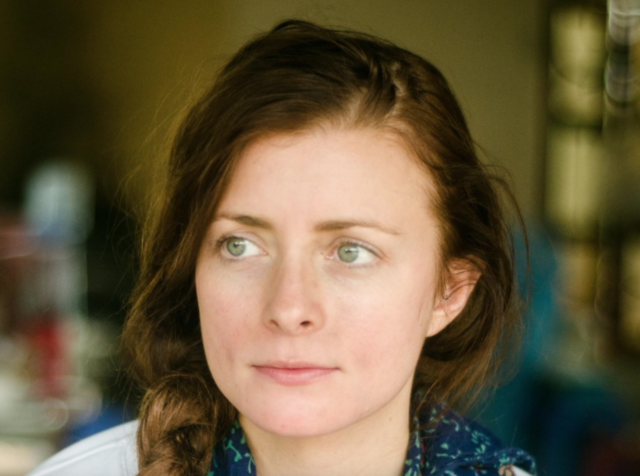
Sasha Joelle Achilli
Last year, London-based filmmaker Sasha Joelle Achilli was in a hospital in Cremona, Italy, filming the medical staff as they tried to cope with the first wave of coronavirus. Her film about their daunting and traumatic experiences, Italy’s Frontline: A Doctor’s Diary, was nominated last month for a BAFTA.
Now, Achilli has launched a new production company, Miss Guided Films, together with fellow directors, Poppy Edwards and Charly Wai Feldman. The new company already has three feature docs in development.
One, Sexual Honesty (working title), is about the life and work of American feminist and sex educator, Shere Hite (author of ground-breaking book ‘The Hite Report’), who died last year in London.
“She actually ended up dying in a council estate block in Tottenham. She had been very ill for 10 years,” Achilli says of Hite. “What is really surprising is that women of my generation don’t know who she is and yet, when you speak to feminists of the 70s, 80s and 90s, they all talk about her work and her contribution to the second wave of feminism.”
Poppy Edwards will direct with Achilli as co-director.
Meanwhile, Miss Guided is also pushing ahead with Bird Song Of Bandra (working title), about a 13-year-old girl from the slums of Mumbai who in the past year has become an Instagram sensation. The idea is to follow her for five years until she is 18 and to document her life as it evolves.
“We’re looking at how the life of a child can be shaped by social media in a place like Mumbai [when] she comes from the slums, with no formal education.”
The third doc, which will be Italian-set, has sensitive subject matter. Its details are yet to be revealed.
Speaking to Business Doc Europe, Achilli talked of the the philosophy behind the new female-led company.
“All three of us are either mothers or mothers to be,” the director, six months pregnant herself, stated. “I guess out of fear of what it is like to be a working mother in the film industry, we decided to set up a company not only so we could have more ownership over our ideas and the development slate but also be there for each other; help each other develop these ideas and films – and get them made.”
Achilli added that Miss Guided will be “setting up a working culture that is suitable for parents.”
The hope is to inspire other companies to look at “more sustainable ways” in which mothers can work in the documentary world. “I think in fiction…there are better systems in place whereas in the TV documentary world, it is not an environment where it is easy for parents to work.”
On certain documentary projects, directors have no choice but to immerse themselves entirely in their work. Making Italy’s Frontline, Achilli herself was working 20-hour days for weeks at a time, far from home. However, she points out that a “lot of documentaries that are being made don’t necessarily have that newsworthiness. It’s more about setting up budgets that can include childcare, schedules that are less rushed so that people can also take care of their families.”
The company is already having “serious conversations” with potential co-producers including Mongoose Pictures (whose Creative Director Dan Edge was an executive producer on Italy’s Frontline) and Passion Pictures. Another goal is to collaborate with partners in Europe, the US and Asia.
The idea is that the company founders will produce each other’s films – and sometimes co-direct them as well.
After finishing Italy’s Frontline, Achilli went on to make another Covid-related documentary, 54 Days – America And The Pandemic. This was the second episode of a two-part series for BBC2, executive produced by Sarah Waldron and broadcast at the start of the year. The first part, directed by Jane McMullen, dealt with events China in the days leading up to the lockdown in Wuhan at the very start of the Covid crisis. Achilli’s film, meanwhile, looked at the bungling and power jostling during the early days of the pandemic in the US. The film showed on BBC Select in the US.
“That was a complete shift. I was directing that entirely remotely from here [in the UK],” Achilli contrasted her experiences on 54 Days with those she faced in the Italian hospital in Italy’s Frontline.
At one stage, Achilli was in her flat in London with six different crews working under her instruction in six different states across the Atlantic in the US. “I would do all the interviews through Zoom connections but I had actual crews on the ground, filming the interviews. They would connect the camera to Zoom and then I would see the frame as if I were there. Then they’d position the laptop right next to the lens and I would be on the eye line of the interviewee,” she explains the complex logistical arrangements which allowed her to direct a film from a distance of several thousand miles.





