

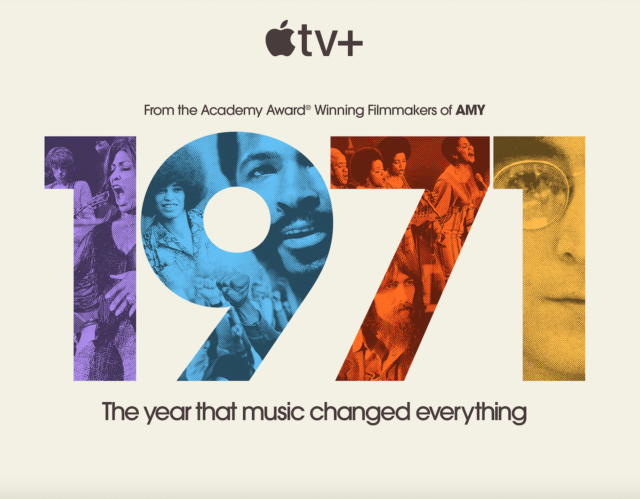
1971 was the year that everybody in the music world seemed to be at the very top of their game. From Marvin Gaye to Joni Mitchell, from Carole King to John Lennon, from The Who to David Bowie, from T Rex to the Rolling Stones, from Bob Marley to Gil Scott-Heron, veterans and newcomers alike were producing classic albums as if by rote.
This was also the height of the Vietnam War, a time of seething social and political turmoil and generational tension in which musicians often led the anti-war protests.
Now, the annus mirabilis is the subject of an epic, eight-part series, 1971: The Year That Music Changed Everything, made for Apple TV Plus by Oscar-winning documentary maker Asif Kapadia [as series director] alongside fellow directors Danielle Peck and James Rogan, and with James Gay-Rees as executive producer. Another regular collaborator, editor Chris King, was again involved. The project is inspired by veteran music journalist David Hepworth’s 2016 book ‘1971 – Never a Dull Moment: Rock’s Golden Year.’
“The series became a development of the work that a group of us had been doing for many, many years with Senna,Amy and Maradona,” Kapadia explains how the hugely ambitious project picks up where their previous award-winning films left off. Again, 1971… comes without any talking heads or voice-over narration. He talks of “the process of using archive, trusting archive to tell a story,” and of “going into a moment – telling the story in the present as opposed to people now, looking back in time.”
“It’s set in 71. We want to feel like we are in 1971. We want you to know what it is like to be there,” Kapadia continues. Research was paramount. The filmmakers were as much “journalists and investigative reporters” as “creative artists.”
Exec producer Gay-Rees was only four years old in 1971 and so doesn’t “have a huge recollection” of the historical moment but he is a passionate devotee of much of the music, fashion and film of the late 1960s and early 1970s. When Hepworth told him about the sheer richness of this one extraordinary year, he had a “visceral reaction” to what he was hearing. He knew that the archive material from the era was bound to be fantastic. He also had a hunch that it would be “fun” and “a great exercise to dive into that world.”
“Mick Jagger looked the best he ever looked at that time and so what could possibly go wrong,” Gay-Rees jokes about his state of mind as he set about securing rights to Hepworth’s book. Danielle Peck came aboard as series producer and director of four of the films, with James Rogan directing the other four.
The Hepworth book tells the story of 1971 in chronological order, month by month. Rees-Gay, Kapadia and their colleagues took a different approach. “We didn’t want to do a normal music documentary going into the chord changes of [John Lennon’s] Imagine or which bass player is playing on [Marvin Gaye’s] ‘What’s Going On.’”
Their solution was to come up with a thematic structure and to look for links between the different strands of the story. For example, Peck might spot a way of connecting a song like Black Sabbath’s ‘Children Of The Grave’ with the trial of the editors of underground magazine Oz in the summer of 1971.
“We didn’t really know about those things coming together until we started editing,” she remembers. “The first three to six months was really quite a deep dive in research and thinking and talking…and talking. But once you get into the edit, you’re working with brilliant editors and they make these connections visually, with audio-archive and with interviews we were conducting, this wonderful thing began to emerge.”
There were nervous moments along the way. The filmmakers’ refusal to use talking heads meant they couldn’t leap over gaps in the archive by having some expert on screen explaining what was happening. David Bowie features prominently in the series and ’71 was clearly a pivotal year in his creative development. His career had slowed down after ‘Space Oddity’ (1969) but he was hugely inspired by his first ever trip to the US, on a promotional tour in early 1971. The hitch was the lack of available footage. Previous documentaries had skirted over this period because, beyond a little material of him visiting Andy Warhol at the Factory, there was so little available. To Peck’s relief, the filmmakers found stills which had never been published before as well as audio recordings which had rarely been heard.
“By finding these little fragments and weaving them together, we found a really strong story to be told across two films, but it was one of the hardest ones because it was piecemeal,” Peck remembers.
Kapadia, meanwhile, likens the entire series to a “mosaic” comprised of pieces of material from all over the world. “You try to join them together.”
“We did dozens and dozens of original interviews both here and in the States,” Gay-Rees reflects. “Obviously, in the films that Asif and I have made before, we use a mix of archive interviews and original interviews…sometimes the original interview done in 1971, listening to Mick Jagger then, is better than an interview with him now because he isn’t in the moment.” Testimony from 50 years ago also has a rawness and honesty that anecdotes which are shared today (and which have already been told too many times in the intervening years) often lack.
Peck mentions one interviewee (she won’t disclose which one) who asked her to explain what had been happening in ’71 because “he was out for the count.” However, others startled the filmmakers with their accuracy and detail of their recollections. Chrissie Hynde (lead singer of The Pretenders) had been a student at Kent State, Ohio, and had painfully vivid memories of the massacre that took place there in 1970. Elton John, meanwhile, seemingly had near total recall. “He had recently been through the writing the biography process and Rocketman [the film about him]. He remembers everything to an unbelievable level, that guy,” Gay-Rees says. “It’s extraordinary. He can remember blow for blow the experiences on landing at LAX [Los Angeles Airport] and going to Tower Records for the first time, to the minute. He was a joy to interview.”
The filmmakers deliberately don’t highlight which of the interviews they conducted themselves and which are taken from the archives. “It’s all part of the universe of telling the story,” Kapadia says.
“Also, what’s brilliant about working in this way is that the people who are now dead, like David Bowie and Marc Bolan, you can integrate them in the film alongside those who are still alive. It’s seamless because you’re not doing it in vision,” Peck adds. “It creates this whole tapestry of belief that you are there at the time.”
1971: The Year That Music Changed Everything premieres Friday, May 21 on Apple TV+





