

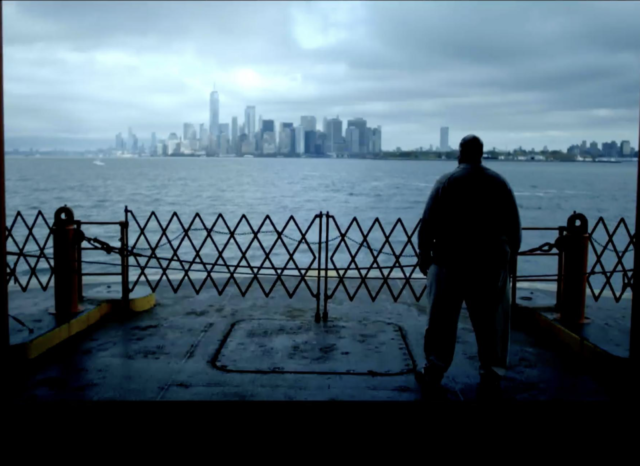
It was a day that shook the world, and 20 years on its reverberations are still being felt. Now, Arthur Cary has made Surviving 9/11 (Working Title) for the BBC that will be broadcast in the early autumn to mark the 20th anniversary of the terrorist attacks on the World Trade Centre.
Cary’s documentary starts far away from the carnage of 9/11 with Scottish artist Vanessa Lawrence running across the Ayrshire beach. It’s a damp, grey day and she is all on her own.
Lawrence, as she tells the filmmakers, had been an artist in residence on the 91st floor of the North Tower of the Twin Towers. She had risen at dawn that day to work on a painting of sunrise over the city.
Lawrence left New York shortly after 9/11 and returned to Scotland where she remains based. However, even now, as the documentary reveals, she is still working on a painting of the Manhattan cityscape at dawn to replace the one she lost in the flames 20 years ago. It’s a view that no longer exists but she had been there that morning and she is determined to recreate it.
“It didn’t feel to me as a filmmaker enough to make a film purely about the past. It is much more interesting to see the impact of the past on the present. Something I try to do in my films is make the characters relatable,” Cary says of his approach. He adds that he was trying to find “a slightly different angle to a very familiar subject.”
The director has spoken to a huge cross section of those caught up in the terrible events: the wife of the pilot of United 93, a woman who miraculously survived despite horrific burns, New York firefighters and ABC journalists. He has talked both to survivors and relatives of those who perished.
“It’s all built on trust and also being very transparent about what I am trying to do,” Cary says of the close rapport he establishes with his subjects. “I spent over a year talking to most people in this film and getting to know them very well before filming started.” He makes sure his subjects are content that he won’t misrepresent them and he gives them the chance to see the footage of themselves in the editing room.
The dozen or so main interviewees often found it cathartic to talk. Many of them are figures you won’t have encountered before in official narratives about 9/11. They’re generally “ordinary” people, not politicians or well-known media figures.
“I did gravitate toward people who hadn’t really spoken much before [about 9/11] and, if they had, maybe it was just a short interview that didn’t get to the heart of their experience,” says Cary.
For these interviewees, the memories of 9/11 remain “very alive” within them. “There was an emotion just beneath the surface which I could get to through my conversations with them so you would feel it was something they were still working through.”
Throughout the documentary, Cary will include big close-ups of the eyes of his subjects. “We talk about images that are scorched on the retina, that you can’t unsee once you’ve seen them,” he says of these shots. “I thought it would be quite powerful to reflect some of what these people had seen in their eyes, as if they were witnessing it for the first time.”
Twenty years on, many of those caught up in the chaos have come to terms with their experiences. They have moved on, rebuilt their lives. These, though, are not the ones featured in Cary’s documentary. His focus is on men and women still working through the events of that day. “I’ve moved forward but I have not moved on,” one told him, an observation that any of the others could also have made.
As the director acknowledges, 9/11 is one of the most exhaustively chronicled moments in recent history. His documentary has a revealing shot of some of the books that Max Thomas, brother of Reuters employee Geoff Thomas who died in the Twin Towers, has collected about the tragedy. He has hundreds of them.
“His way of dealing with unresolved grief has been to bury himself in all the information you can find about 9/11 because so much has been written. But, actually, having read everything there is to read and watched everything there is to watch, he can’t come up with an answer of how he gets over the loss of his brother. Instead, he disappears down probably unhelpful rabbit holes about conspiracy theories and whether the true facts about that day have ever fully emerged.”
The director sees his film as a companion piece to one of his earlier films, The Last Survivors, in which he gathered together testimony from the last Holocaust survivors living in Britain today.
The 9/11 film will be showing on BBC1 so is likely to reach a huge audience on a channel that only rarely shows feature length documentary. It has also been bought by the Discovery Channel and will therefore reach US viewers too.





