Five years ago, when the Emmy award-winning journalist Sorious Samura was preparing the documentary Sing, Freetown, he talked of “getting people to understand that there is another Sierra Leone.”
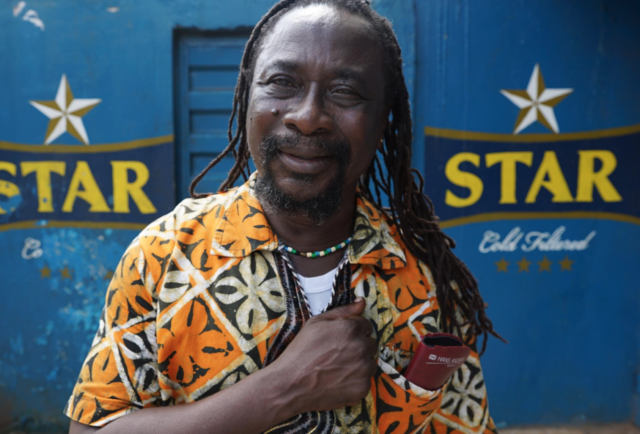
The film, directed by Clive Patterson and world premiering today in Sheffield, would celebrate the immense richness of the country’s culture and history. This, after all, used to be known as the “Athens of West Africa.” The contemporary western media may focus on the Ebola, the cholera, the violence, war and corruption but Samura knew there was another story to be told. The idea would be to follow Charlie Haffner (pictured), a theatre director and playwright, as Haffner staged an epic play exploring the country’s identity.
Samura is London-based but he and Haffner go back a very long way. They had first met many years before, when Samura had been a pupil the Methodist Boys’ High School in Freetown and Haffner an inspirational young teacher. They had stayed in touch ever since.
The aim now was for them to give viewers, especially those in the west, a new, more positive vision of Sierra Leone. Samura hoped that the film could attract tourists and business investors to the country. “But it didn’t go exactly 100% how we set out to do it.”
As it turned out, the process of making the documentary was far more challenging than either Samura or Patterson could have envisaged. Time and money pressures, moments of tension between Samura and Haffner, and the situation within the country itself all contributed to what became a fraught process.
At least, the upheavals and setbacks make for compelling viewing. “What was exciting was that it was very fluid. We couldn’t quite predict what is going to happen,” Samura says. “It’s that fluidity that makes it exciting…we didn’t plan for all of that.”
Patterson has worked with Samura for 12 years. They had done many different projects together but never one like this. They weren’t just filmmakers, recording what was happening. Samura was intimately involved in the stage production himself.
“Ultimately, the three of us were on this journey together,” Patterson says of himself, Samura and Haffner. “When things started to go awry, it became quite stressful.” There had been huge optimism starting out but, at times, relations between Samura and Haffner frayed. Haffner accused his colleague of trying to impose western values on the project. Samura, meanwhile, worried that Haffner was holding on stubbornly to ideas and attitudes that hadn’t worked in the past.
Patterson was desperate for them to overcome their differences and to get the play finished. “Ultimately, you really wanted them to succeed. That is what comes through in the film I hope, that you are rooting for both of them. The nobility of their aspirations and the quality of their intentions is what shines through in the end, I hope.”
The documentary was shot over a period of a year and a half. It wasn’t easy to structure or edit. “It was pretty difficult. It became a bit of a running joke that somebody should make a film about me struggling to make a film about Charlie struggling to make the play,” the director notes.
Samura can’t help but lament the way that Sierra Leone currently seems permanently to be caught in one crisis or another.
“Let me tell you, this was a country that had everything. We had people coming all the way from Zambia, Zimbabwe, the whole of East Africa, and of course West Africa, to come and educate themselves. Some people were coming to live. Some people were coming to work in this country,” he remembers. “This was a beautiful place, it was a great place; Just seeing this country go down was very, very depressing…”
Samura admits that many in Sierra Leone “still hold onto that myth” that their country is somehow cursed. He doesn’t see it that way at all. “It’s nothing other than mismanagement,” he says of the ongoing chaos and social deprivation. He cites “the lack of proper leadership,” the failure of citizens to accept responsibility as well as misinformation and education. Now, the people are “desperately, desperately poor…”
“It is not a curse. It is us,” Samura suggests.
The film highlights the beauty of the country. “When you get there, you are genuinely struck by the place,” says director Patterson. “What really stands out is just that notion of potential. Freetown is an incredible city – the peninsula, the mountains, the beaches, the rivers, the architecture, the history,” he rhapsodises. “There is so much there. It was, of course, important to convey that incredible richness the country has. But, of course, it is all laced in a certain sense of tragedy because of the contemporary circumstances.”
Samura and Haffner are reconciled. They spoke together at the end of the process and cleared the air. “We ended up shaking hands,” Samura remembers. “We learned a lot about ourselves. We learned a lot about the country…it’s all fine now between Charlie and I.”
The world premiere is today (Friday) in Sheffield. The hope is to show the film in Freetown after the rainy season, in the early autumn. In the UK, Picturehouse is releasing the film later this month and some bookings have also been secured at Curzon DocHouse.
Samura was recently back in Sierra Leone. He loves being there but says that, for all its beauty, this “is still a very difficult place even for visits because people are so desperately poor.” The circumstances which caused the civil war in the early 1990s haven’t really changed. “Social injustice, economic injustice, abject poverty, corruption, the fact that a lot of children haven’t got decent education,” he ticks off the problems that continue to afflict Sierra Leone. “It’s a feeling that saps my energy because it is not as hopeful as I would love it to be.”