

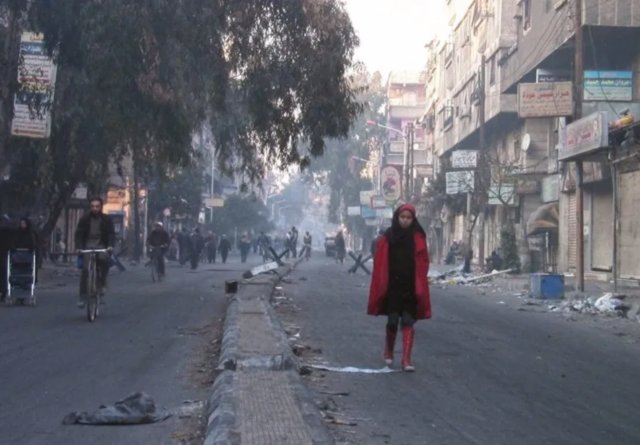
When he came to assemble his documentary Little Palestine: Diary Of A Siege, Abdullah Al Khateeb discovered he had around 500 hours of material. He had shot and shot and shot. “Most of the footage was not made in order to make a documentary,” the director remembers to Business Doc Europe.
The film (sold by Lightdox and supported by the Doha Film Institute) shows everyday life in the biggest Palestinian refugee camp – Yarmouk, in Damascus, Syria – from 2011-2015 when the community is under siege by Bashar Al-Assad’s forces. Assad regarded it as a hiding place for insurgents. This was where the director grew up and lived until being forced to leave by Daesh in 2015.
When he decided to make his feature-length movie, Abdullah had to work out how to winnow down his vast treasure trove of footage.
“Another challenge was how to build a narrative from this material,” Abdullah remembers. He features in much of the footage himself. His mother is also one of the most prominent characters. At times, he worried that he was far too closely involved in the story he was trying to tell. He needed to “develop distance” between himself and his material in order to develop the narrative.
That is why his editor Qutaiba Barhamji was so important to the creative process. Barhamji is a vastly experienced figure, a renowned director and producer in his own right whose work has shown all over the world. He was able to look at Abdullah’s images with an outsider’s eye.
Audiences watching Little Palestine are likely to be taken by surprise by how cheerful and resilient the inhabitants of Yarmouk are, even when they are under bombardment and food is short. In spite of the monotony, danger and increasing hunger, they laugh with each other. The kids still go to school.
“To be honest, I was not surprised,” the director says of their stoical behaviour. “This might be because, as Palestinians, they have really long experience with wars and sieges.” He cites all the upheavals that have faced the community since 1948, when so many lost their homes. “For me, the resistance you saw in the siege was a natural extension of the continuous attempts by Palestinians to not be erased.”
What surprised him the most, though, was the ability of children living in such awful conditions still to play, laugh, have fun, study and to analyse what was going on around them with surprising maturity.
When you’re living under siege, the film makes clear, time can hang very heavy. The Palestinians would go on long walks simply to distract themselves.
How did Abdullah spend his days? No, he says, he wasn’t walking when away from filming. His priority every day was to find food for his family. “This was how each morning started, to find a way that my loved ones and I could have enough to eat.” He was heavily involved in “civil activism,” supporting the most vulnerable and hardest hit during the siege. He also worked with the children. (The filming would only take an hour or two each day.)
Little Palestine premiered in Visions Du Reel earlier this year and is now in Cannes, screening in the ACID programme. The film has also been invited to several other festivals. The director has shown it to some of the friends who helped him shoot its footage. He also organised a screening for some of the kids shown in the film (and who are now living in Europe).
The next step is to show the doc to his mum. She hasn’t yet seen it on the big screen. She is an inspirational figure who always intervenes to help others and is very deeply involved in the life of the community.
“If there was anything clear to me from the very beginning, it was that my mother would be one of the personalities in the film. That was not because she is my mum but because she, as a female activist, was part of the reality in Yarmouk…”
There was another side to it too. Through his mother, he could tell the story of an older generation who have fought to preserve the memories and traditions of the Palestinians even as they have been forced to live far from home. “We have quite a close relationship and have worked together…we rather have a comradeship than (just) being son and mum.”
Abdullah may be a Palestinian but he lived the early part of his life in Syria. In some ways, he feels Syrian too. “To be Palestinian is part of my political identity but I myself actually feel quite Syrian,” he reflects.
Abdullah has been living in Germany for several years now. He is active in many different fields. He wants to carry on studying. He continues to write analytical pieces about the plight of Syrian Palestinians. And, yes, having had a taste of filmmaking, he is keen to keep going with that too. He doesn’t want to share too many details about the next documentary but does reveal the basic subject matter. “It’s still a little early but it will be related to the children who grew up in these circumstances in Syria [during the siege] and are now living in Europe, continuing their lives.”





