Like the great surrealist himself, Spanish filmmaker Javier Espada was born in the town of Calanda in Aragon and was a teenager when he first discovered Buñuel’s work. He sneaked into a screening of one of the director’s movies and was immediately beguiled. The movie he saw featured drumming music very similar to that played in his home town at Easter.
“The film ends with the drums of Calanda (very little known at the time), and listening to them felt like a joke by Buñuel, because the drums sound at Easter and a character appeared with the appearance of Christ, who alluded to the Marquis de Sade. That’s how I suddenly discovered Buñuel’s cinema and surrealism to the transgressive rhythm of the drums of my village,” says Espada.
Now, the filmmaker is in Cannes with his new documentary Buñuel, un cineasta surrealista, (Buñuel, a Surrealist Filmmaker) a selection in Cannes Classics and whose screening is being held (appropriately enough) in the Salle Buñuel, the festival cinema named after the doc’s subject. International sales are handled by Latido.
Espada had the good fortune to enjoy a lasting friendship with screenwriter Jean-Claude Carrière, one of Buñuel’s most trusted collaborators in the latter part of his career. Carrière, who died in February, first worked with Buñuel in the early 1960s on the film Diary Of A Chambermaid. He went on to write six screenplays for the Spanish master during his so-called French period. These included such cast-iron classics as Belle De Jour and The Discreet Charm Of The Bourgeoisie. It was also Carrière who prompted Buñuel to write his memoir, ‘My Last Breath.’
“I invited Jean-Claude to give a screenwriting workshop in Calanda,” Espara remembers how he first encountered Carrière. He gave Carrière a guided tour of the Buñuel Centre which he had himself designed and launched. Obviously highly impressed, Carrière responded by inviting Espada to come with him and film in the places where his own movies with Buñuel had been made. The footage Espada shot formed the basis of his very first documentary (The Last Script: Remembering Luis Buñuel, 2008). It was, as he puts it, ”my cinematographic baptism in cinema.”
Espada loved to talk to Carrière about the surrealist movement and was fascinated by the stories Buñuel’s old screenwriter told him, not just about Buñuel himself but about such legendary figures as André Breton. Espada shares an anecdote. Buñuel, he recalls, once gave Carrière a book that Breton had given him, and which Jean-Claude kept with “great affection,” showing Breton’s admiration for Buñuel and the admiration in turn that Buñuel felt for Carrière.
“Jean-Claude had invited me to his home in the south of France last summer to discuss this documentary project, but unfortunately his health and the pandemic did not allow it. Nevertheless, my documentary is the result of many conversations, many memories. The documentary is dedicated to him along with other friends who are no longer with us.”
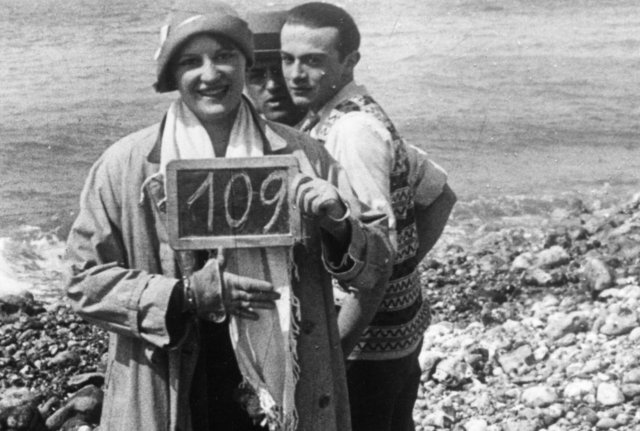
Buñuel, un cineasta surrealista is full of very intimate and revealing photographs of Buñuel’s childhood – of his family and of the rugged, rural Spain in which he grew up. Many of these images have been lovingly restored. They are presented on screen in pristine condition, thereby allowing viewers to appreciate details that had previously gone unnoticed.
“Without the support of Buñuel’s sons, Juan Luis and Rafael, and the Luis Buñuel Film Institute, this documentary would not have been possible. They lent me their father’s family’s photo albums including the delicate stereoscopic photographs on glass plates,” the director explains. He describes this as “magical material” that allowed him access to the lost world of Buñuel’s youth.
For Espada, ‘My Last Breath’ is more than just a director’s autobiography. It is a reference book to which he can always turn when he wants new insights into Buñuel and his life and career. “It interested me from the moment it was published in Spain. I lent it out to share my excitement and I never got it back. But it is a book that many friends have given me in many editions and in several languages. I think it shows that Buñuel was not only a filmmaker but an intellectual, a good writer with a great sense of humour.” He cites a sentence from Buñuel that he particularly cherishes: “a day without laughter is a day lost.”
For all his towering achievements and brilliance, Buñuel has sometimes fallen out of fashion in Spain. When Espada was designing the Buñuel Centre, which opened in February 2000, the master’s cinema was seldom known. It didn’t help that he had lived in exile for many years during the Franco era and that much of his work had been banned. However, over the last two decades, that work has again become better known and, Espada would dare to say, “even popular.”
For Espada, making the new documentary was clearly a labour of love. He claims that all the knowledge about his subject that he has assembled over so many years is condensed into the new film. He is not sure what will happen to the doc now. It has been invited to many other festivals after Cannes and should receive distribution in Spain once cinemas are properly re-opened post-pandemic.
“Buñuel is part of my life and my personal history,” he reflects on the profound influence the filmmaker from his home town continues to have on his career.