

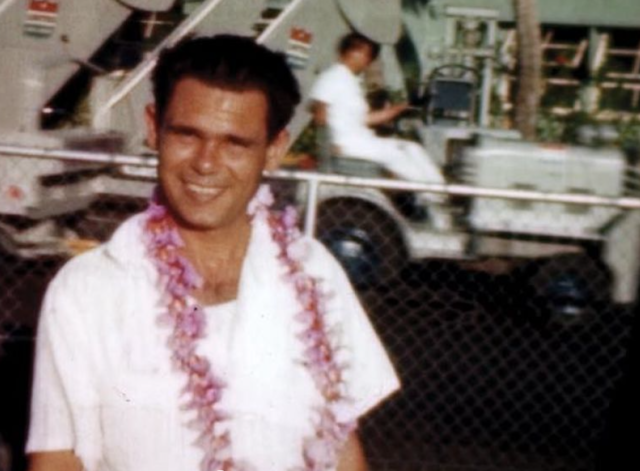
At the beginning of the Doc Alliance Award-winning The Blunder of Love which tells of the relationship between director Rocco Di Mento’s maternal grandparents, we are immediately primed for what is to come: “I had no idea what abyss this dazzling thing we call love would pull me into,” says the filmmaker.
The multi-faceted story, made as a master graduation work at the Konrad Wolf Film University of Babelsberg, is ostensibly derived from the Super-8 films, letters, photographs and unpublished novel of Di Mento’s grandfather Constantino, an inveterate romantic. He is a man who was away from home a lot, sailing the high seas as a captain for the Nigerian Gulf Oil Company. But he was always devoted to his one true love Atty, the director’s grandmother, to whom he maintained an astonishingly high level of contact.
But Atty, it seems, was not so enamoured of her husband’s excessive displays of affection and loyalty. She was made of sterner stuff, or maybe she was just a lot more brittle. She certainly wanted a lot less love. If you love to the extent that her husband did, then “you lose track of who you are,” she says. Did she feel trapped? Certainly. “The thing is I shouldn’t have fallen in love at all,” she confesses. That said, she did fall in love once, with the elusive (and unseen) Nazareno. But Atty didn’t come from good enough family stock, it was reckoned, and so the romance was short-lived. Constantino was subsequently a “submissive” alternative. She accepted him as a “compromise.”
But the unfolding story of Constantino and Atty isn’t one that has always existed in an archive vacuum. They were living, breathing fixtures within the family, even if aspects of their relationship has been the stuff of mythology and speculation for generations. What’s more, Atty’s tendencies towards ambivalence or derision seem to have in some way informed the development of the family DNA, as discord seems to have lodged at the root of many subsequent relationships.
Di Mento’s mother Antonella, a ballet teacher, remains unsmiling and continually critical throughout the film, as evidenced in one scene when she tears her son (also named Constantino) to shreds for poor grammar as he recites a moving and highly personal school essay that he wrote. Furthermore, an emotional gulf has existed between Antonella and her sister Marcella (a musician) for years. Their kids (the cousins) may see eye to eye, but the sisters retain a frosty distance.
Bearing all this in mind, Di Mento decides to call time on the family feud and as Christmas approaches determines to ease all sense of rancour with a policy of familial detente…
Back in the noughties, Di Mento left Italy to live in Germany, having fallen out of love with his homeland, feeling a “grudge” for a place then ruled over by Prime Minister Berlusconi. But the future filmmaker was out on his own, his family remaining at home. “But I realized I wanted to connect to [them] again and connecting to my family meant also understanding their conflicts,” he says. “It made me feel really sorry [living] within…this family constellation.”
The initial driver for his film was finding his grandfather’s novel The Blunder of Life, which is instructive in revealing Constantino’s inner state. From a young age, love and beauty were the two foundations on which his grandfather had constructed his world, says Di Mento. But Atty’s present day reaction to what her husband wrote decades before is altogether more dismissive. “I don’t like mushiness,” she says sniffily on camera.
During a core scene which comes exactly half way through the film, grandmother Atty reveals how the potential lesbian tendencies that she felt towards a nun at her boarding school were snuffed out at source by the school authorities (“sexual deviance,” as she explains it), and that she subsequently developed a tendency to torture small birds. “If due to love I am going to suffer all this abuse, I’m going to be cruel,” she tells her family at the lunch table.
Di Mento further stresses how emotional concerns that he may have had about revealing such intimate family secrets were assuaged as he saw the wider story unfold in the edit.
“It was like giving in to this chaos of reality, so that you find in the material a precise [dramaturgical] order, then you know and [then] everything makes sense,” he says. “As a student, I was just, you know, jumping into cold water. But I didn’t know at the moment when I jumped in, I wasn’t sure from the beginning what kind of result I’m bringing… So in the editing room when you realize everything makes sense, everything could be seen by your audience as a universal story for human beings, then you feel relieved because you say, okay, I actually reached [achieved] what I wanted to, but I wasn’t sure until this point.”
That said, as to whether Di Mento actually succeeds in uniting his family at Christmas at the film’s end, you’ll have to wait and see (remembering of course that for many families Christmas can be as divisive as it can be joyous). But his decisions to force a familial reconciliation were always made from the heart.
“We [the family] are all used to this conflict going through 50 years, let’s say, and we don’t know why exactly. I mean, we can mix theories about why this conflict started, but all of the family members, including me until around 10 years ago, we accepted blindly this condition, you know, and it’s a condition that made you suffer,” says Di Mento. “Then at some point I felt like I am going to emancipate myself from this status quo. And then I tried at least to change something. I tried to make them aware of things, especially I wanted to make them aware of love. I wanted to make them aware that we all come from a dream of love that you basically find through the pages of my grandfather.”
Di Mento elaborates further on Consantino’s legacy and the body of archival testimony that he left to the world. “I would like to say [to my grandfather] that you have done all of your suffering, all of your life, all of your movies, all of the moments you want to capture, and you know, all of the letters you have written, and they are not forgotten. I made something out of it and I made it also for you, you know, because I felt like you had to be celebrated,” says the director. “At the end of the day, I empathize so much with this guy. I come from this guy, I come from his love dream. And at the end I didn’t forget him… I inherited something from him. And I didn’t fuck it [up]. I just, you know, I gave some sense to this great thing that he has done.”
The Blunder of Love by Rocco Di Mento was nominated by DOK Leipzig for the Doc Alliance Award and was produced by Valeria Venturelli at the German Filmuniversität Babelsberg Konrad Wolf.





