© Vincent Munier
Speaking to Business Doc Europe a few hours before the world premiere (Special Screening) of her feature doc The Velvet Queen (La Panthère des Neiges), director Marie Amiguet jokes that she felt more nervous about walking up the red carpet than she ever did when she was high in the mountains of Tibet making the film.
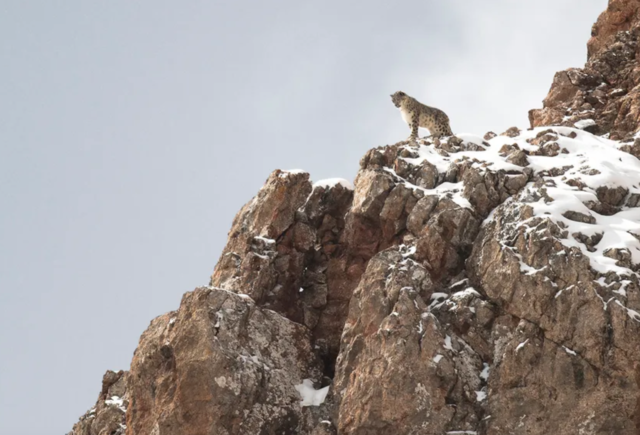
The Velvet Queen (sold by Le Bureau) sees Amiguet travel high up onto the snowy peaks to film renowned wildlife photographer Vincent Munier, and his travelling companion, adventurer and novelist Sylvain Tesson. They’re in pursuit of the snow leopard, one of the most elusive animals in the world, but they also observe and photograph wild yaks, Tibetan antelopes, grey wolves, Tibetan foxes and many other rare and beautiful animals.
Munier had travelled to Tibet many times and had shot plenty of stunning material of the animals and landscapes. Amiguet’s job was primarily to concentrate on Munier and Tesson. Munier had seen her work on an earlier documentary, The Valley Of Wolves. They had gone on to collaborate on the film, Silence Of The Beasts, which drew attention to the devastation caused by lynx poaching. Munier decided she would be the perfect chronicler of his and Tesson’s journey. Not only is the Franco-Swiss director a brilliant filmmaker. She is also very discreet. He knew she wouldn’t get in the way.
“The idea for this movie was Vincent’s,” Amiguet acknowledges.
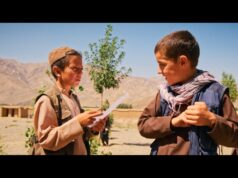
The travelling companions had a very harmonious relationship. During their travels, they came across some nomad children who briefly appear on camera. That was in 2018. When the filmmakers returned in 2019, they met these kids again by chance and were able to show them some of the footage they had already shot.
Tesson wrote a book inspired by the journey, ‘La Panthère des Neiges,’ published in late 2019 and which has already been a big success. However, it has taken some time for Amiguet’s documentary to reach the screen. That is largely because she hadn’t originally intended it to be shown in cinemas.
The film was made through Munier’s company Kobalann, which also publishes his exquisitely photographed books. “He put a lot of himself in this movie,” Amiguet says of Munier whose first trip to Tibet was way back in 2010.
Amiguet’s first cut was a little over an hour long and was intended for TV. However, when producers from Paprika Films saw it, they immediately recognised its cinematic potential. The film has haunting, mesmerising music from composer Warren Ellis (known for his collaborations with Nick Cave). Ellis calls this “one of the most beautiful films we have ever worked on.”
The editing, though, was very gruelling. Amiguet talks of spending nine months on her own, going through the material. Munier is not only the subject and originator of the film. He is also her boyfriend. “I live with him. I was working on the computer [editing] for 10 hours a day and sometimes I was totally lost. I knew what I wanted to do but…”
The pandemic slowed matters down but, even before that, she had come close to burn out and had spent three weeks in hospital recovering.
Eventually, another editor, Vincent Schmitt, came aboard to help her finish the movie. “It’s very strange to be here today rather than to be six feet under!” she jokes of the toll the film took on her.
In Cannes, the doc has been showing as part of the festival’s Cinema for the Climate section. Amiguet feels this is the perfect section for it.
“What are we talking about but love of nature and animals?” the director asks. Thanks to human interference, “biodiversity is disappearing very fast. (But) everything is linked. What we wanted to talk about in this film is the love of nature and of its beauty. If we want to take care of nature, we have to know it and love it. That is the beginning of everything.”
Munier is now planning a film about his father who has looked after the forests of Vosges for 40 years. As for Amiguet, she is hoping to make further films as well as to write. “But I need a lot of rest. I am very, how do you say, ‘epuisé,’” she falls into French to describe just how overwhelming and exhausting it was to complete The Velvet Queen.
The French release of The Velvet Queen is being handled by Haut et Court and is set for early December.