

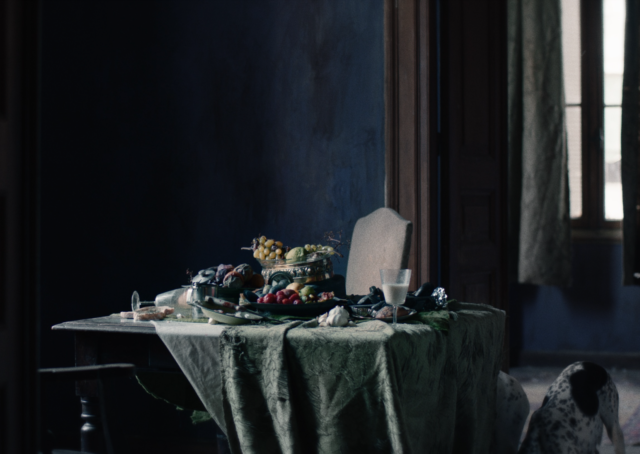
Janis Rafa’s visually stunning, borderline grand guignol short film Lacerate, set in a neglected aristocratic house that contains both a dead body and a pack of feral dogs, was made in response to a commission from the Italian Fondazione In Between Art Film for its project ‘Mascarilla 19 – Codes of Domestic Violence.’
The film, supported by the Amsterdam-based Mondriaan Fund, features a series of astonishing tableaux vivants, redolent of Caravaggio’s still lives of splendour and decay, Titian’s ‘The Death of Actaeon’ and especially, from the perspective of director Janis Rafa, biblical works such as Artemisia Gentileschi’s ‘Judith Slaying Holofernes.’
In the film, amidst the squalor of a formerly splendid, now neglected aristocratic house, a man lies naked, his throat cut, almost certainly dead. He is covered by a cloth and is surrounded by the hounds that have wreaked their vengeance on him, their former master, for the violence he meted out to the woman we meet at the film’s close. As she walks out of frame, as viewed from above, the dogs are once again calm, but now they are loyal to her.
To underline to us the crimes of domestic violence the man has committed, we see slain fowl, pheasant, pigeons, even a swan whose broken wing hangs languidly from the sink in which the dead birds have been discarded, with a running tap to reinforce the indignity of their death, and which continues to flood the kitchen and the floors below.
Interestingly the man’s prone form is situated beneath a painting of vibrant birds in flight, animals that are very much alive.
“I didn’t want to make a work where the female has to talk about this subject of domestic abuse, where the female is portrayed in a way that shows she is a victim of a situation,” says Rafa. Rather, she wanted to “empower” the woman’s sense of “presence” within the film.
All the time, the framing of the mise-en-scéne is exquisite, whether the action is shown from the front or the top, and Rafa’s use of fish-eye lens is as distorting to the image as the placement of convex mirrors within 16th Century Flemish paintings. We are even offered a sumptuous still life of a table replete with emblems and symbols, fruits (fresh and rotting) and shells, even a contemporary glass of milk to replace a 16th Century goblet of wine.
The film was shot in lockdown in Greece in a house that could as easily been located in Scotland or in Northern France, given its decayed glamour and the numerous clues we are offered of its use as a hunting domicile.
“Yes, it has this Northern European feel to it,” agrees Rafa, who is herself Greek and has spent the past eighteen months in her homeland. “I kind of liked the fact that it became less for me like my background, less so in the cultural references I was using, less of a Mediterranean or Southern European location. And it transformed my idea of the film, from it being a narrative driven fiction with real time sequences into something more symbolic, more dreamlike, with its own sense of time and space.”
“It was really bringing these layers of elements, whether the dogs or the hunting, the man, the woman, the physical space, the cinematography, the table with all these still-life elements on it, all within the context of the house and see how they merge during shooting,” Rafa adds. “It was a very risky but liberating experience. And satisfying in the sense of seeing it again after a little while, looking back at it and wondering how it all emerged.”
This article was first published in See NL, published by Eye International and the Netherlands Film Fund.





