It is one of those delicious confluences of (or indeed divergences within) language, the contranym that offers itself up seamlessly to opposite interpretations depending on the tongue in which is applied, or the location in which it is used.
Hier, the title of Wendelien van Oldenborgh’s short film selected for FID Marseille International Competition, means ‘here’ in Dutch but ‘yesterday’ in French, which adds enormous potency to a work that in large part deals both with The Netherlands’ colonial past and its implications for the Dutch sense of ‘here and now.’
In her complex, lyrical and gently profound work, Van Oldenborgh weaves together the artistic endeavours and personal testimonies/histories of five young Dutch women, all of whom reflect on the film’s core theme.
Pelumi Adejumo is a writer of brilliant fiction, poetry and drama who performs, within the film, a personal and evocative text drawn from the themes of life, love and identity.
The band FRED comprises Lyana Usa, Thirza Hiwat and Josephine Spit (the first two of whom are of Indonesian and Surinam descent) who, throughout the course of the film, master the Indo European kroncong, which is a form of song that is both joyous and deeply melancholic.
Lara Nuberg is a historian of Indo European heritage who researches, writes and speaks about the colonial past of the Netherlands and Indonesia, all the time reacting to the music she hears and the building where the film is located.
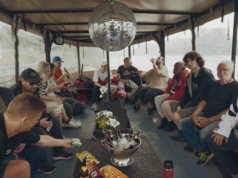
Director Van Oldenborgh shoots Hier within the Museum Arnhem, built in the late 19th century as a club for former residents of the Dutch East Indies. These were folk who were denied the social status that would elevate them to membership of the all-white, all-male Groote Sociëteit. Throughout the film the building is undergoing a (perhaps metaphorical) process of renovation, from the ground up, “and stripped down to its foundations,” as director Van Oldenborgh puts it.
Hier is not a polemic, far from it, rather a beautifully measured film in which young women who are very happy in their own skin are asked to interpret what is, for them, a very particular and personal period of history. “I find also one of the reasons I wanted to work with these young women from this generation is that they really formulate a strong presence which is political but not militant,” says Van Oldenborgh. “I find it interesting how they are totally aware of their position in society, but they don’t in any way have a manifesto.”
Nor is it a film ostensibly about identity politics, the director underlines. “I think it’s so important that we don’t get stuck on this idea of pure identity. I wanted to broaden this and to talk about non-binary things that are much broader. And actually a mixed identity is anyway far broader than that. It’s not something that is either this or that. That was one of the motivations as well.”
The film was made following an invitation from Bonaventure Soh Bejeng Ndikung, artistic director of sonsbeek20→24 (based in Arnhem), for which the director/artist made the installation Hier for the ‘Force Times Distance: On Labour and its Sonic Ecologies’ exhibition in 2020. “Since Arnhem is a city where a lot of Indo Europeans settled after the war,” says Van Oldenborgh. “I thought it was only natural that I try to focus on it, but I didn’t want to do it through identity explanation, or anything like that. I decided to do it through the musical form of the kroncong.”
Despite the sense of control that the work exhibits, Van Oldenborgh points out how she likes to work in a very spontaneous way. “I don’t do any storyboarding or anything like that because I don’t know what is going to be the situation,” she says. “But when we react to the situation, especially within such a condensed shoot, it really does turn into something. With all the people that were there, which was not a huge group, but a group that could actually hold itself together, we found we were doing something super together. And that really works for me. It just feels how it should be done.”
This article was first published in See NL, published by Eye International and the Netherlands Film Fund.