

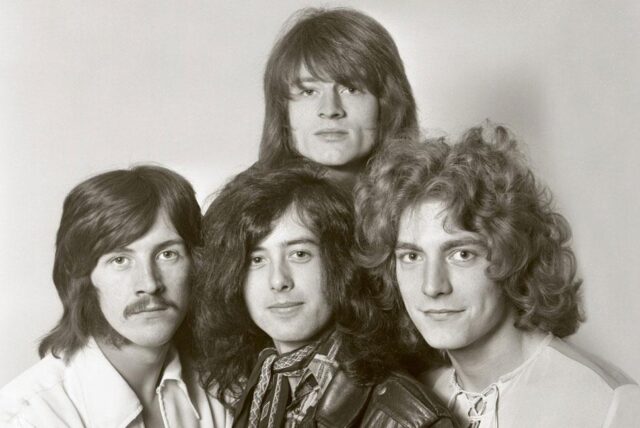
When Bernard MacMahon was a kid growing up in London, his mum used to sell antiques. Every so often, a big, imposing man would visit, looking for bargains. He’d come to their semi-detached house in Streatham to “buy the best stuff” before she would take it to her stall in Camden Passage.
“He was always haggling with my mum to buy our fireplace and sometimes I would sit on his knee,” the filmmaker remembers. “That’s not for sale,” Bernard’s mum would always tell the man. “Knock on someone else’s house down the street and see if they will rip out theirs. You’re not having it.”
Many years later, his mother saw a photograph of the rock group Led Zeppelin. Standing behind the musicians was the man who used to visit their house. It was none other than Peter Grant, the band’s notoriously intimidating and controlling manager. Grant was ruthless in protecting the band’s interests. So were the band members themselves. Over the years, countless filmmakers have requested permission to make an official documentary about Led Zeppelin. They’ve all been turned down.
Why, then, have MacMahon and his producer Allison McGourty of Paradise Pictures been given the keys to the Zeppelin kingdom when so many others before them have been left locked out on the outside?
The answer is straightforward. Jimmy Page, Robert Plant and John Paul Jones, the remaining members of the band, all trusted Bernard. They had seen and admired his earlier documentary series American Epic, about roots music and the birth of electronic sound recording in the US during the 1920s. They knew he would take their artistic achievements seriously and not make a lurid movie about groupies, excess and rock and roll madness.
That is how MacMahon came to direct Becoming Led Zeppelin (which premiered out of competition at the Venice Festival). Sales on the film are handled by London-based Altitude).
“After American Epic, we wanted to do one more music documentary before we moved into features and Bernard was looking for what would be the next big technological leap after the birth of sound recording,” remembers producer McGourty.
“What is the next seismic shift where technology and the arts combine?” MacMahon remembers the question he posed himself. His answer was 1968/1969, with the advent of multi-track recording and the mass industrialisation of the selling of music. There was a sudden cultural “hurricane” driven by FM radio and the underground music press and, at the centre of the storm, there was Led Zeppelin in all its decibel-defying, eardrum bursting glory.
“It [the documentary] is totally with their blessing but it is entirely independent,” the director says. Astonishingly, he and McGourty had scripted and storyboarded the entire film before they even spoke to the band members. They had also done huge amounts of archival research.
“When we knew we had a story, we approached the band,” McGourty says.
Guitarist Jimmy Page was the first member of Led Zeppelin that the filmmakers met. They spent seven hours with him at the Royal Garden Hotel in London, going through the project scene by scene. “Jimmy was kind of testing to make sure we knew our stuff,” they remember. He’d set them little questions. Did they know the band that singer Robert Plant was in when he and Plant first met? Hobbstweedle, they came back with the correct answer. Page grew ever more excited about the project. “I want you to make it!” he soon told them.
“It was like he was giving us Excalibur and going ‘here it is, protect it.’ They were unbelievably helpful. Nobody tried to tell us what to do. But they opened up their personal archives as well.
The film explains how Led Zeppelin came together. It shows Page and Jones as top session musicians in the mid 60s, playing on everything from Petula Clark’s ‘Downtown’ to Shirley Bassey’s ‘Goldfinger’. The documentary also looks at their influences, everything from the outrageous showmanship of Little Richard to the driving rock of Bo Diddley and the skiffle of Lonnie Donegan.
MacMahon wanted to make the kind of movie he himself would have loved to have seen as a 16-year-old. “I wanted to be transported back to when that music was happening,” he says.
“It takes you back in time. It [the documentary] is for those people that could never go to those events in the 60s and will never see a Led Zeppelin concert. It’s closest we will ever get to being there,” McGourty suggests.
“I don’t want to tell the audience want to think. I want to show them the music,” the director continues. “It is about how this music was made, who were the guys who made it, what did they learn that allowed that [to happen]. Why did the rehearsals in Gerrard Street work? Why did John Paul Jones, who was doing four sessions a day making a lot of money, jack it all in to go in a group playing in a club? How did he know that was going to work? If you show the real story why this group was successful, through the music and the artistry, it will allow young people to replicate that.”
Jimmy Page joined the filmmakers in Venice for their premiere last weekend. Those expecting a hell raiser were surprised by the courteous, softly spoken, silver-haired man who turned up on the Lido in tow with MacMahon and McGourty. He admitted he was nervous when he first met the filmmakers but “the conduit was the storyboard.” Page realised they had done their research.
“It was a wonderful experience,” the guitar hero said of his participation in the documentary.
Yes, Led Zeppelin had been approached by many other directors but the previous suggestions for films about the band had been “pretty miserable…they had wanted to be concentrating on anything but the music,” adds Page. “Consequently I’d recoil from that sort of thing. But with this one, it was everything about the music, what made the music tick and the performances and the complete versions of songs. That was the other thing. It was not just a little sample of it and then a talking head. This is something in a totally different genre!”





