

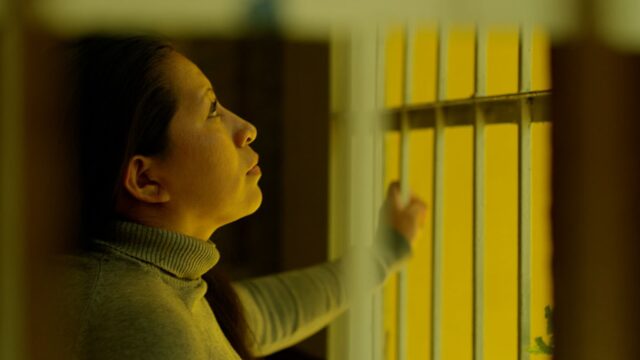
“First, I am Salvadorean. I am also a feminist and a documentary director,” Celina Escher establishes her credentials at the start of her interview with Business Doc Europe.
Given her nationality, her politics and her profession, it is little surprise Escher was immediately drawn to the story of Teodora Vásquez, the subject of her new film, Fly So Far (screening in Nordic Panorama, New Nordic). Vásquez was one of the “Seventeen,” the group of women in El Salvador imprisoned for obstetric emergencies.
Under laws enacted in the late 1990s, the Salvadorean Government strictly forbids abortion. There are no exceptions made for women whose lives are in danger or for victims of rape or incest. Its laws, which state that life begins at the moment of conception, often result in mothers who lose their children because of medical complications during pregnancy being held directly responsible for their deaths.
“When I heard about this, I got very angry. I couldn’t believe it. I thought how is it possible,” the Sweden-based filmmaker says of these women’s predicament. She decided to go back to El Salvador to visit the prisons in which the women were incarcerated.
El Salvador is a Catholic and conservative society. “It is one of the most violent places to be a woman or a girl,” Escher says. “Every day, women and girls get raped…the patriarchal system really oppresses women in their sexuality and how they lead their lives.”
Teodora Vásquez had the misfortune to lose her baby when she was nine months pregnant. She had been assaulted by robbers who had hit her in the stomach. Alone and bleeding, she called the police for help. The authorities reacted by arresting her and then sentencing her to 30 years in jail.
“One thing that is really important to say is that all the women who have been criminalised for having an obstetric emergency, they are only women who live in poverty. There is no woman with money who is in prison for this,” Escher highlights the hypocrisy and class prejudice surrounding El Salvador’s abortion laws.
Double standards apply everywhere. Women who can afford to attend private clinics are rarely prosecuted. Their doctors don’t call the police. However, women with no money and whose pregnancies go wrong will often wake up and find themselves in handcuffs. Evidence against them may be skimpy but they won’t be able to afford lawyers. When their cases come to court, they will therefore be charged with aggravated homicide. It’s cruel and unjust and there is nothing they can do about it.
Fly So Far was produced through Swedish production outfit, Pråmfilm. “I told them about this story that I really wanted to do because it was so important and they agreed,” Escher explains how her four year journey to complete the documentary began. She was shooting in El Salvador and editing in Sweden.
On her trips to South America, the director witnessed at first hand the terrible conditions in which the women were living. The jails were overcrowded and lacking in basic facilities and sanitation.
Teodora had emerged as a spokesperson for the imprisoned women. “At the beginning, I was really angry about this situation and I decided, OK, I have to do this film. Then I met Teodora and the seventeen inside prison. Then, all the feelings I had changed to something else, more to admiration for how they survived and supported each other inside the prison, and the sisterhood they have in prison.”
Eventually, Teodora’s case came to trial. Although the judge upheld the original, absurd ruling against her, her 30-year sentence was commuted and she was freed in 2018 after 10 years behind bars. By then, her case had become an international cause célèbre. 100,000 signatures had been collected calling for her release. News media all over the world had covered the story. Human rights lawyers had questioned the Salvadorean legal system.
Even as they belatedly gave Teodora back her freedom, the judges refused to accept that they were wrong to have imprisoned her in the first place. If they had done so, they would have had to release all the other women imprisoned for the same reason.
Since her release, Teodora has campaigned on behalf of these women. Many have now also been given their freedom. However, they still have criminal records and it hasn’t been easy to pick up the threads of their previous lives after spending a decade or more away from their families.
Meanwhile, the Salvadorean government continues to uphold its draconian anti-abortion laws. The issue is still regarded as a vote winner for the ruling party.
“It is really outrageous that they (the politicians) are using their rights to decide over our bodies as women to be an instrument to get more votes,” Escher observes.
Fly So Far was a complicated documentary to structure. “So many things happened during this time that I didn’t expect that I had always to re-think or re-write how we were going to tell this story. I had to adapt to reality. It was a really difficult process.”
The director wasn’t just close to Teodora but also to other imprisoned women. “I know their families. I have a commitment to them,” she says. “These women are survivors. They have been victims of this misogynistic, patriarchal system that oppresses them and that takes away all their rights but, at the same time, they have survived all these horrible things…they are survivors of physical violence, of sexual violence, of state violence, of police violence, of obstetrical violence. They have survived all this.”
Her documentary pays tribute to these women’s resilience. “This is what inspired me. This was the main message.”
Escher is currently working on an impact campaign for the film (due to be released in Swedish cinemas by Folkets Bio in late September). Other women have been released – so Fly So Far does end with “a little bit of hope.” The law may not have changed but Teodora’s example shows that, whatever the odds, it is possible to fight back against a system that is so manifestly unjust.
International sales on Fly So Far are handled by CAT&Docs.





