

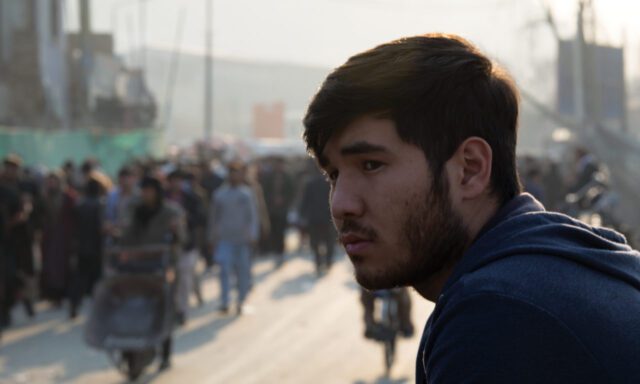
Imagine you’re a young man living and working in Sweden. Suddenly, you’re told you can’t stay in the country. You are deported almost overnight to Afghanistan where you know no-one. You have no papers and so no obvious means of escape. You don’t seem to belong anywhere. This is the fate of Abolfazl, the subject of Swedish-based Kurdish-Iranian filmmaker Yasaman Sharifmanesh’s documentary Aboli’s Journey, screening in Nordisk Panorama.
Sharifmanesh began working on the project at the start of 2018. This was two years after Sweden had started deporting Afghan refugees back to Afghanistan.
“I am originally from Iran and we have more than three million Afghan refugees in Iran,” the director notes. ”They have a lot of problems and issues there as refugees. When they come to Sweden and other European countries, they have other problems. More than 80% of these Afghan refugees in Europe and in Sweden, they are originally born in Iran, not in Afghanistan.”
The refugees often face a Kafkaesque situation in which they are required to prove their identity but have no means of doing so. The Iranian authorities never gave them papers or passports. Officially, they don’t exist. Their plight is largely ignored in the mainstream media.
“I was familiar with their problem. I have a lot of Afghan friends here in Sweden. That is why I decided to be their voice,” Sharifmanesh reflects. “I just thought it was very important and that someone should say something about this problem in our society.”
The director started meeting refugees who had received their third and final rejection letters from the Swedish authorities and were therefore facing immediate deportation. Eventually, she came across Abolfazl. He had been hugely unlucky. The Swedish police had arrested him instead of one of his friends and had put him in a detainment centre.
“We didn’t mention it in the movie but the police came and asked for someone else who was living at that address before,” Sharifmanesh remembers. The person the cops was looking for wasn’t there. They asked Abolfazl some questions. When he didn’t give satisfactory answers, they arrested him instead. He hadn’t received any prior notification from the immigration authorities.
The decision was then taken to deport the unlucky youngster. On the spur of the moment, Sharifmanesh decided to accompany him to Afghanistan. She had only a few days to pack, get her visa and gather together her equipment.
“We were on the same plane. We went to Afghanistan together. It was the first trip to Afghanistan for both of us.”
Three different cinematographers worked on the documentary, Two were European, one was from Iran. However, the director herself did the shooting on that initial trip. She was dressed in Afghan costume. Her face was covered with a scarf. She was therefore far less conspicuous than an outsider would have been. “They couldn’t realise I was not Afghan. I had only one small GoPro camera behind my dress. That was why it was safer for all of us if I followed him, not a man.”
Even so, Sharifmanesh was running a huge risk. If her identity had been discovered, she would have been in extreme danger.
The director films her subject fly on the wall fashion and is rarely visible herself, although she was with him. “I don’t like to be that much in my movie when I am making a documentary,” she says. “Sometimes I have to appear in the movie but I hate that to be honest.”
Unlike many other Afghans deported in similar circumstances, Abolfazl refused to accept the role of the passive victim. He had a very clear mission, which was to get back to Sweden as quickly as possible. “He had a really strong reason why he wanted to come back to Sweden. He wanted to do something to change his life and situation. It was inspiring for me.”
As they endured many hazardous situations together, a strong bond soon grew up between the filmmaker and her subject, as she chronicles his attempts to return to Sweden (no spoilers).
Sharifmanesh herself arrived in Sweden five years ago. She started studying media and communications but describes herself as a photographer and documentary filmmaker. “I wanted to continue my original profession,” she says of why she left her homeland. “It wasn’t easy working in Iran since we have a lot of censorship in my country. I couldn’t stay in that system.”
Aboli’s Journey was produced by Antonio Russo Merenda, one of the best known producers in the Swedish documentary field (previously involved in Oscar winner Searching For Sugar Man). Broadcaster SVT is one of the main backers and will be broadcasting the film later this autumn. Its previous festivals include Tempo (Sweden, March 2021).
No, it wasn’t easy for her to start a new life in Sweden but her career as a documentary maker is blossoming. She already has another new project, I Am An Olive Tree, set in Afrin, a town in Syrian Kurdistan that was occupied by the Turkish army in 2018. “It is not about a war. This movie is a very romantic film…” she ends.





