

With the intimacy of a personal diary, director Nina Hobert films her friend Julia and their beautiful friendship. They share parties and anxieties, courage and despair, through thick and thin. Together, they find ways to live through the meaninglessness of life.
And as a self-portrait, which it also is, Julia&I does something altogether different. Director Nina Hobert mostly stays out of the frame. But that doesn’t mean she’s not there. Because her voice definitely is. When we don’t see the face, a voice we hear lives inside our head.
The experience of distance disappears. Having only the voice makes it that much more intimate. Especially when that voice dares to be as personal and vulnerable as Hobert’s. Already in the opening monologue she tells us that her seemingly successful life feels totally meaningless to her. She feels like a fake, continuously hiding a desperation that boils inside of her. “What if people knew there’s a devil inside me?” It motivates her to seek out her best friend Julia Werup again, with whom she used to go partying all night long before Hobert settled down – and Werup went on partying.
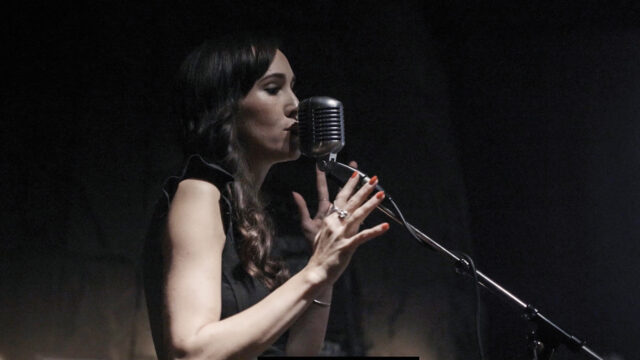
Maybe Hobert wanted to see how her life could have been had she stayed with Werup. But that’s not how the documentary turns out. Julia&I has no credited scriptwriter and that’s how it feels: as if Life wrote the script. Because yes, Werup is a force of nature, always on high alert, always open to a new adventure, a new man, a new party. She is a poet and a singer and the idea of having any kind of routine suffocates her.
But just like Hobert, Werup is experiencing a deep meaninglessness to her life. And while Hobert turns that feeling inwards, shutting off, Werup turns it outwards, living louder.
Life happens. People die, others change, some break down. Werup goes into rehab, Hobert gets psychotherapy – and keeps filming. If Hobert wanted to help herself through filming Werup, she also achieves the converse and, more than that, in the process has made a heart–warming portrait of friendship through thick and thin. Which makes Julia&I a vivid, life-affirming film, even though both friends experience intense existential anxieties.
I wrote earlier that although Hobert mostly avoids being in the frame, she is very present with her voice. But that’s not the only way Julia&I is a self-portrait. It is also the gaze of the film. Often hand-held, loosely during the earlier party times (when Hobert was already wedded to her camera), attentively when she is filming Werup up close, when they are having their intimate conversations. We see the world as Hobert sees it.
There is a reason this self-portrait is, so to say, disembodied. During one sudden outpour of emotional openness, searching for words for what she can barely describe, Hobert shares the deep hatred she feels for her female body. It has led to severe anorexia in the past, which is something that still tempts her. She wishes she had been born a boy – but does not, she says, want to go through years of medical transition. She does not feel at one with her body; she does not want to see her body; how she feels on the inside does not fit the body she sees from the outside. And thus this self-portrait, as a representation of what it’s like to be her (and I use ‘she’ and ‘her’ as Hobert’s pronouns, following the film’s official website), becomes more truthful when that body is disregarded.
Next to the voice and the gaze, there is a third aspect to Hobert’s self-portraiture in Julia&I, the most spectacular one: its design. The visual design, which is associative, fast cutting, impressionistic, sometimes dreamlike, but always flowing, sweeping us along. And the sound design: Hobert is a composer and Julia&I not only uses a lot of her own music, but is also edited musically with great artistry. There is a rhythm to the film’s sounds and images, a balance between the wild and the thoughtful. As if we’ve entered Hobert’s mind and are dancing with her thoughts, associations and emotions. What a privilege it is to be invited in, and what strength Hobert must possess (and Werup as well, who gives herself to her friend’s camera with total confidence) to dare to be so vulnerable.
Sweden/Denmark, 2021, 80 minutes
Director Nina Hobert
Production Nina Hobert Universe AB, Film I Skane
Producer Nina Hobert
Cinematography Nina Hobert
Editing Nina Hobert
Sound design Nils Olsson
Music Nina Hobert
With Julia Werup, Nina Hobert





