Cecilie Debell and Maria Tórgarð were open for discoveries when co-directing their feature documentary Skál. The story started with Tórgarð, then an aspiring filmmaker (now aged 24) from the Faroe Islands who had the idea in 2019 to make a documentary about Trygvi Danielsen, a popular local hip hop artist.
She pitched the idea to producer Heidi Kim Andersen at Made In Copenhagen, who loved Tórgarð’s instincts but wanted to pair her with a more experienced filmmaker to get the feature made. Enter Danish documentarian Cecilie Debell, now 33, with credits including Cecile and Cecilie and My mother is pink. She brought her fresh eyes to Faroese society, while Tórgarð gave her “the inside knowledge.”
Their openness started by trusting each other as collaborators during the 18 months of making the film. “The most important thing is we gave each other space,” says Tórgarð. “We had to accept this was an intense process and always think about the movie and not about ourselves. The most important thing was never saying ‘no’ to each other, being really open and honest.”
Debell describes their guiding principle. “There was only one rule: we didn’t want to use interviews or talking heads. But that meant we could play with it a lot.”
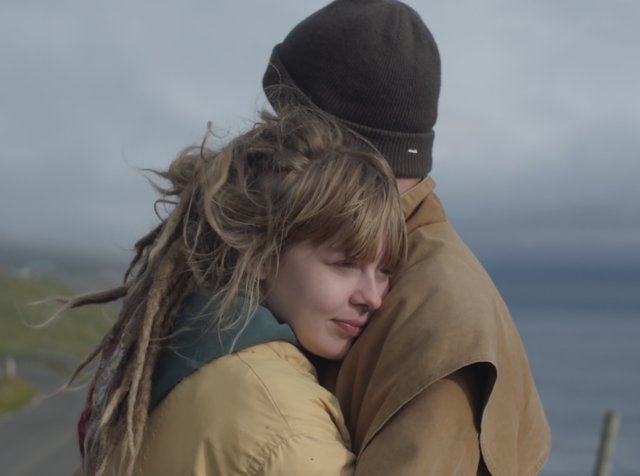
They were so open to discovery that the musician whom they first set out to document as their main protagonist soon became a supporting character as the film became more about his girlfriend, another musician named Dania O. Tausen. Dania grew up in a Christian family in the Faroe Islands’ Bible Belt village of Toftir, but when she moves to the city of Tórshavn and starts dating and making music with hip-hop artist Trygvi, she has to figure out how her Christian faith fits into her new world.
Debell says the switch of protagonists came naturally as they were filming. “In the beginning, the camera was just turning in Dania’s direction. We were just drawn to her.”
They caught Dania, then age 21, at a pivotal time in her life. “Trygvi had figured things out and he knew his place in the world. But she (Dania) was still in the middle of this existential crisis. She is caught between her family and the congregation, and the life she wants to live,” Debell says.
Dania was also a young woman ready to express her emotions. Tórgarð was living with Dania in a shared house when she gave the budding filmmaker a letter about why she wanted to be a part of the film and why it was important to her to get out her thoughts publicly. “She wanted to find her own voice,” Tórgarð adds. “She is so reflective and so smart but at the same time she is young and has this free spirit and can be playful.”
Debell adds that the filmmakers didn’t want to push their subjects too far, rather letting their stories unfold organically. “It was about creating a safe space for them to get their ideas out, we just made the frame for that.”
They shot the scenes with the characters in a very intimate way, getting the camera physically close to them not just using zoom lenses, and working handheld. And then around the city of Torshavn, they shot more on tripods to offer a contrasting steady visual style.
They never pushed Dania to do anything just for the cameras, in fact they did the opposite. “Everything came from her, we would have so many conversations where we said ‘don’t do this for the movie, only do it for yourself,’” recalls Tórgarð, for instance with the publication of Dania’s poetry collection that gives the film its title.
Debell comments how, with a young subject still finding her place in the world, the filmmakers felt special responsibility. “We were asking what the consequences were going to be (of filming her). Dania was really reflective about it, she said, ‘I need so say things out there, I need to get my words out there.’”
Convincing Dania’s religious parents to be filmed wasn’t a hurdle. “They wanted to support Dania and they were happy to be a part of the film,” says Tórgarð. “It also meant they could get their voices heard as well….We were trying to receive them with open arms. Even if we don’t share all views with them, it was important for us to make the film as nuanced as possible. And we could recognize the beautiful things about growing up in this congregation and the care they have for each other.”
While telling the story of Dania and her circle of friends and family, Skál also offers an intimate portrait of the communities in the Faroe Islands who are not often seen on screen. This North Atlantic archipelago has a total of 53,000 inhabitants across 18 volcanic islands, self-governing but part of the Kingdom of Denmark. “For me it’s fascinating that it’s such a small community, everybody knows everybody, and that’s an interesting frame for a story of young people,” says Debell.
As Tórgarð adds, “It’s so important for me to show a real version of the Faroe Islands,” not just the glossy images seen promoted to tourists. “Yes we are surrounded by beautiful nature but it was also about a beautiful honesty of Torshavn, pointing the camera in these places where I recognize, showing more of the fishing industry or the rough weather.” Made in Copenhagen brought on Faroese producer Jón Hammer of Kykmyndir as co-producer and financed the film with support from NORDDOK at The Danish Film Institute, DR, VGTV, SVT, KNR, and KVF.
Debell hopes one young woman’s story can inspire others. “I hope young people can take Dania’s bravery and use it for themselves, to be who they need to be.”
Tórgarð is proud of the way the younger generation of Faroese can be seen on screen. “I hope it gives people an insight into the place where we are coming from.”