Endlessly fascinating, and equally recognisable to a Western audience, and following in the footsteps of Abbas Kiarostami’s classic Homework from 1989, Tonight’s Homework, world premiering at IDFA, shows Iranian primary school children being interviewed about their lives.
Towards the end of Tonight’s Homework (Mashgh-e emshab) by Ashkan Nejati and Mehran Nematollahi, which has its world premiere at IDFA, two of the primary school children from Abbas Kiarostami’s similarly titled 1989 documentary Homework (Mashq-e shab) turn up – now thirty years older. Briefly, the documentary turns into an Iranian version of 7 Up. Just like in that classic British documentary series by Michael Apted, which kept returning to the same individuals between 1964 and 2019, there’s an immediate fascination in seeing how the young children from the earlier documentary have turned out as adults. Answering the question that so many documentaries leave us with: what will become of them?
And also: how will they look back on their younger selves? In the case of Tonight’s Homework, the two male adults confirm Kiarostami’s main argument: that the amount and type of homework they were given as children, and the kinds of punishment and lack of encouragement, were counterproductive. “The homework we did was all out of fear,” says one. “It had nothing to do with learning. We would get punished and have to rewrite pages 1 to 40 of the book. There was no educational content.”
In 1989, Kiarostami started from a personal issue – the problems he was having at home with his child’s homework – and used interviews with other primary school children to subtly arrive at a far more general critique of the school system and, implicitly, society. He called it “not really a film, more a piece of research.” In 2021, Nejati and Nematollahi return to Kiarostami’s questions with a documentary which isn’t so much a sequel as it is a remake.
Which is a fascinating idea in itself: take the well-thought-out, time-tested approach by an acknowledged master, and simply reuse it, in another place, at another time. Why not? Just as Apted returned to his subjects, Nejati and Nematollahi return to Kiarostami’s concept (with a little Apted thrown in). So, like Kiarostami, they put children in front of a neutral background and ask them similar questions from off-camera, pressing them lightly if they do not immediately answer – Kiarostami was a master of that gentle prod, and Tonight’s Homework manages to come quite close.
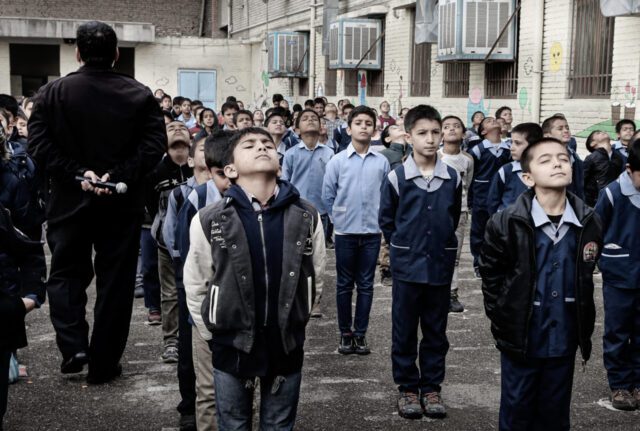
The first thing that strikes viewers who are familiar with Kiarostami’s classic (which is also being screened at IDFA) is that the children seem just as polite and respectful as their predecessors thirty years earlier. The second, as the filmmakers soon found out, is that homework isn’t really an issue anymore – the title of their documentary is therefore a bit misleading. “Oh, about half an hour,” the children reply when asked how long their homework takes. Next question please!
The filmmakers state in the press notes that “the issue of homework as a problem of the educational system has been replaced by greater and more significant challenges.” Which they, like Kiarostami, begin to reveal through gentle prodding. The central issues are growing income inequality, and the fact that parents don’t spend enough time with their children because both are working. Additionally, the filmmakers interview school principals who criticise parents’ lack of supervision and the government’s lack of planning. All, by the way, recognisable issues to a Western audience.
For the poorer children, however, less seems to have changed. They still end up doing their homework late at night – no longer because of the exaggerated amount, but because after school, they first have to support their parents by working. These parents are still often illiterate, and therefore unable to help with schoolwork, and regularly apply physical punishment, two important topics addressed by Kiarostami in 1989. For the other children, punishment mostly just means being sent to their room or not being allowed to play outside, and they talk about it cheerfully. They also talk about their toy collection, the countries they’ve visited or even the number of cars their dad owns. Some of the girls the filmmakers talk with – unlike Kiarostami, who only visited a boys’ school – just can’t stop giggling when they talk about their little misdeeds and punishments – we’re a long way from the tearful child in Kiarostami’s film who had been hit so hard with a ruler it broke.
Which is not to say something like that couldn’t or doesn’t happen anymore. The differences between poorer and richer children are enormous. What is something you’ve always wanted to know, ask the filmmakers. “I wanna know why my father makes so much money”, says one child, genuinely puzzled. “I’ve always wondered about it.” A poor child, who is asked the same question, is silent for a while, thinking, and then whispers quietly: “Nothing.” Do you know what poverty is, ask the filmmakers. One rich child simply says: “No.” “Yes”, a poor child answers. “It means someone who is in need, who is desperate. Someone who needs money or something.” Have you seen poor people? “Yes,” he answers matter-of-factly, “A lot. Like myself.”
As in Kiarostami’s film, one cannot help but wonder how often the children are being completely sincere and how often they are giving socially desirable answers. When asked by Kiarostami, all the children proclaimed they preferred doing homework to watching cartoons – which seemed implausible, to say the least. Here, children sometimes seem to be struggling between their frustrations and their sense of duty to their parents and the school.
It is one of the reasons why watching children talk about their lives remains endlessly fascinating. And, as Nejati and Nematollahi have demonstrated, there is no reason to stop doing that. So let’s hope that in thirty years, some filmmakers will return to Iranian primary schools for another remake. In which case, Business Doc Europe will duly report.
Iran, 2021, 78 minutes
Director Ashkan Nejati, Mehran Nematollahi
Sales Iranian Independents
Producer Ashkan Nejati
Script Ashkan Nejati, Mehran Nematollahi
Cinematography Hamed Fereshteh Hakmat
Editing Vahid Golestan
Sound design Seyed Reza Godazar
Sound Farid Pirayesh
With Mr Mousavi, Ms Torabi, Mr Bagheri, Ali Asghar Mirzai