Ask Meera Devi, the Chief Reporter at Khabar Lahariya (KL), the news agency in Uttar Pradesh in India, which of her publication’s many scoops and exposés she is most proud of, and she takes a few moments to answer. After all, there are plenty of stories to choose from. The reporting at KL has meant that remote villages in the region have been provided with electricity and health care. It has highlighted corruption and injustice.
During the pandemic, KL’s reporting has meant some communities which otherwise might have been ignored by government are receiving the food and medicine they need. “That gives me a lot of joy,” the reporter says.
However, the one incident which sticks in her mind is what happened in the village of Gobra several years ago. She had been visiting there and noticed a man in a poor physical state. She asked what was wrong with him. He had TB, she was told. So did many other people in the community.
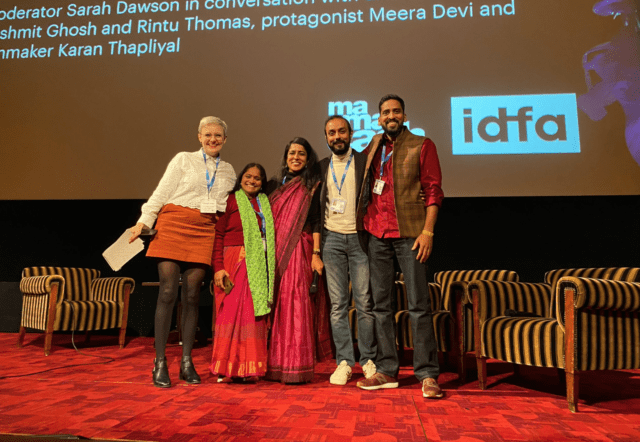
“This village had no healthcare, no hospital,” the reporter (2nd left in picture) remembers.
People in this village were dying. When KL published the news about their plight, the local authorities were furious. However, they also acted. The district administrators set up free health care in the village. The TB outbreak was stemmed. Patients recovered and went back to work. Lasting healthcare benefits were obvious.
That is just one of many similar stories about the publication which is run by women from the Dalit community, one of the lowest castes in India whose members are called the “untouchables.” The newspaper prides itself on being “real, rural and revolutionary.”
The story of this remarkable publication is told in Writing With Fire, the feature documentary directed by Rintu Thomas and Sushmit Ghosh which has been screening this week in IDFA’s Best Of Fests. (Sales are handled by Autlook).
The film comes to Amsterdam 11 months after its premiere in Sundance at the start of the year. However, as Meera says, talking to Business Doc Europe in the restaurant of the Schiller Hotel in Rembrandtsplein, she hasn’t been able to join in the film’s journey.
“This is the very first time that both of us are together to show the film to an audience,” director Thomas points out. The pandemic has meant that, again and again, the film has been screened virtually.
Writing With Fire won’t be released in India until next year. However, its international success has already boosted yet further the profile of the publication.
“From a global perspective, we have become a lot more popular since the film came out [in Sundance]. Both personally and professionally, it has really amplified the newspaper and its work. We have witnessed a completely different kind of popularity – and that is really good,” Meera says.
Looking back on the start of the documentary, Meera acknowledges that she didn’t, at first, expect that Thomas and Ghosh would be any different from the many other student reporters and news crews who’ve tried to tell the KL story in the past. She and her colleagues were so busy with their work that they didn’t pay much attention to the filmmakers in their midst. It was only when they realised that the filmmakers were still there after several months that they began to notice them. This, they saw, was a film on a far bigger scale than any of the previous documentaries about them.
Writing With Fire was made before Covid struck. Since then, India has endured one of the strictest lockdowns in the world.
“When everyone was told to go inside their homes, our jobs became more [demanding] and we had to step outside,” Meera says of how she and her team reacted to the crisis. This has been one of the busiest years in KL’s history. She and her journalists were reporting on what was happening to the millions of Indians who left jobs in the big cities to return home to the villages where they grew up. They wrote stories about the rise in the levels of violence against women and the issues that faced the villages.
“Because we were the only people reporting on the ground from Uttar Pradesh at that time, a lot of other media outlets were collaborating with us to get access to these stories…I can’t tell you how busy this has been!”
Meera’s young colleague Suneeta emerges in the documentary as a brilliant and fearless young reporter who would easily give Woodward and Bernstein a run for their money. As Meera explains, she is now training the next generation of KL reporters. There is a conveyor belt of young female journalists providing top level grassroots reporting.
Change is apparent. Old chauvinist attitudes are being challenged. However, as Meera observes, it’s not so easy to dispense with all the iniquities of the caste system overnight. She tells a story about her childhood when even her school teachers were wary about drinking from a glass of water she brought them because she was so low caste.
“I would say some things have changed but a lot hasn’t changed,” she reflects. However, thanks to her journalism, she has today earned respect from those who used to scorn her.
“Like everything sinister that exists in this world, caste has also managed to modernise itself,” director Thomas agrees. “Unlike race, it is not visible. You can’t see it on our skin but it’s in our name…if you go with a deeper X-ray vision, you see all sorts of discrimination. It [caste] works in favour of people in power and who have money. Many things have changed…but a lot more needs to change.”