An unsettling and powerful examination of both the background to long-held rumours of a large-scale massacre that allegedly happened in the Palestinian village of Tantura in 1948 when Israeli forces took over the village, and the plight of graduate student Teddy Katz whose research into the incident for his thesis was rubbished, his reputation left in tatters.
Director Alon Schwartz’s engrossing film re-examines what happened in Tantura as former soldiers recall unsettling acts of war while disquietly pausing at points they either fail to remember or refuse to speak of. The 140 hours of audio from Katz’s 20-year-old interviews powerfully exposes the narrative of how Israel sees itself and wants itself to be seen, and how this posturing can sculpt history.
The film opens with historical scene-setting text. In 1947 the United Nations voted to partition Palestine into separate Jewish and Arab states. The Jewish People’s Council accepted the resolution while Arab delegations rejected it. Local hostilities escalated to war in 1948. Israelis called this “the war of independence”, Palestinians called it “Al Nakba” (The Catastrophe).
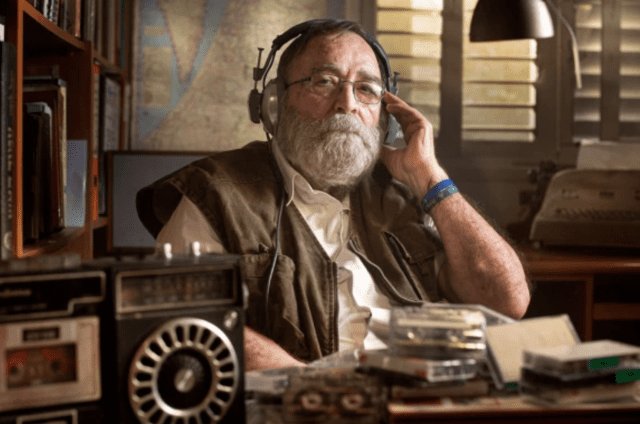
In 1948 the coastal village of Tantura was captured by Israel’s Alexandroni Brigade. Commenting on what happened there, the now wheelchair-bound Teddy Katz says: “To this day the vast majority of what happened in 1948 is not only hidden, but destroyed.”
The film juggles often emotional interviews with Katz as he recalls what happened to him after he wrote his thesis with striking archival footage and contemporary interviews with elderly soldiers from the Alexandroni Brigade – now mostly in their nineties – as they talk about what happened in 1948…some candidly, some obliquely and some still choosing to park their memories.
Former soldier Haim Levin says: “A state is seized by the sword…that’s what my father told me. A country you must take by force.” While former Alexandroni soldier Mulik Sternberg adds: “Of course we killed them…no qualms at all…the village was erased.”
Teddy Katz is clear about his take on what happened from his interviews 20 years ago. “People were killed there after the battle, I am sure. They told me and I have the tapes…140 hours-worth – I found seven Jews who said there was a massacre.” But he also has a warning for Schwartz: “If you want to make a movie about what happened you’ll be hunted down like I was.”
The film details how Teddy’s work was taken and published in a newspaper, causing controversy and placing his academic integrity into question during a defamation trial in 2000, and later as part of the investigation by the academic committees that ultimately rejected Teddy’s thesis and crushed his credibility.
But modern digital audio enhancement enabled Schwartz to hear what Katz and other transcribers couldn’t hear on the original noisy analogue tapes. As Schwartz wrote: “Many of the then 70-year-old military veterans told him directly or hinted about a story that was simply amazing. I also listened carefully to vocal nuances of some veterans that said ‘nothing happened’ or that they didn’t want to speak about what happened, and understood between the lines what had indeed probably occurred.”
He also features Palestinians who were there. Abu Saeed Rizek Ashmawi, a former Tantura Resident says 20 to 25 men were put up against the wall and shot, and three women shot as well, we are told. Hend Hawashe, who was born in Tantura, was 18 or 20 when the village was destroyed. “I remember everything,” she said. “There was gunfire and I saw people running…there is no tragedy like the tragedy of Tantura.”
Israel, 95mins, 2022
Dir Alon Schwarz
Production Real Peak Films, TIME Studios, Chicago Media Project
International sales UTA / Anonymous Content
Producers Alon Schwarz, Shaul Schwarz, Maiken Baird
Screenplay Alon Schwarz, Shaul Schwarz, Halil Efrat
Cinematography Or Azulay, Avner Shahaf, Yonatan Weitzman, Ilya Magnes
Editor Halil Efrat, Amir Sevilla
Music Ophir Leibovitch