

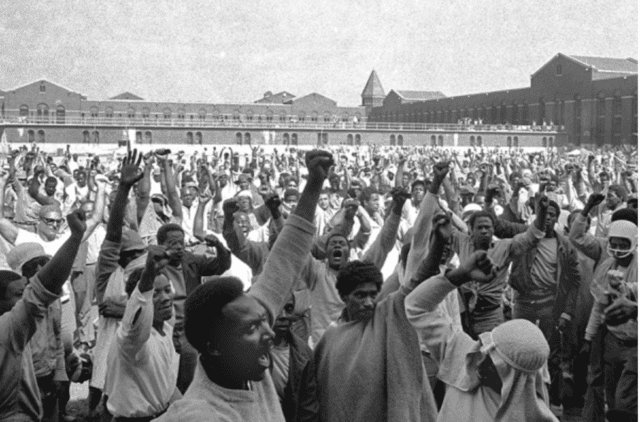
“All hell broke loose,” one observer remarks with what turns out to be understatement early on in Attica, the Oscar-shortlisted Showtime documentary directed by Stanley Nelson and Traci Curry. The film tells the apocalyptic story of what happened following a prison riot at the Attica Correctional Facility in New York State in September 1971. Prison staff were taken as hostages. Negotiations began. Then, tensions began to ratchet up.
50 years on, the scars on those involved (and who survived) have still not healed.
“People are not beyond redemption, right? That is part of the fullness of humanity,” Traci Curry notes of prisoners who were looking to be treated with basic dignity and respect but instead faced a slaughter. “I think you can see by the film that for anybody whose lives were touched by this event, it is just not something anybody ever gets over. It was profoundly traumatic…nobody received any justice and so there is not really any closure for what happened.”
Like many others, Stanley Nelson knew the broad outlines of the Attica story before embarking on the documentary. He was 19 or 20 years old when the incident happened.
Events inside the prison were covered exhaustively by the media at the time, but in a very superficial way.
“I felt like the story had never really been told. There had to be so much more to the story. Why did they [the prisoners] rebel in the first place? What was happening moment to moment, day to day, in the yard? Why did law enforcement go in with guns blazing in a situation where there was no good end in sight?” the veteran documentary maker touches on the many unanswered questions that still surround the siege.
“I didn’t know more than most people until we got into the film. Then, I realised it was a much deeper story than just the prisoners rebelling. It was a story of Attica the town; of the hostages and their families; of law enforcement…it was a really complicated story, a rollercoaster ride.”
The Attica siege exposed the racism and prejudice of everybody from New York Governor Nelson Rockefeller to the president, Richard Nixon, who was “pulling the strings” behind the scenes.
Nixon (“in all his paranoia” as Nelson puts it) did historians and filmmakers an immense favour by recording his conversations.
The filmmakers have also tracked down plenty of other archive material which illuminates the documentary in surprising and often disturbing ways.
Some of the material comes from the mainstream media who swarmed to Attica. Some comes from the state of New York. State troopers were on the rooftops filming from early on in the siege, collecting evidence which they anticipated would be used against the prisoners. In the event, this footage was utterly “damning” of their own reckless and homicidal behaviour.
In their interviews, the ex-prisoners describe the full horror of what they saw at the end of the siege. You would hardly believe such observations if it weren’t for the fact that the film material is there to back them up. For example, we see the large man with the American football wedged under his chin who has been told that he will be shot instantly if he moves.
“And one thing we did, which was really unique, is that we listened to all the sound,” Nelson says of how the audio recordings give a new, often chilling perspective to the imagery. This was how the filmmakers found the astonishing moments where the law enforcement officer chants ‘White power! White power!’
“Aljernon Tunsil, the lead editor on the film, is just really a genius in looking at stuff and finding those little nuggets and working them into the interviews. It’s like the footage and the interviews are talking to each other,” Nelson underlines.
When she was interviewing the former prisoners, Curry was very aware of the responsibility to make sure the documentary was as thorough going and as accurate as possible. “I hope it felt like something close to justice for them because, in asking them to participate in this film and to relive this trauma, the assurance I made to them is that we will do justice by their stories…we will allow the truth of what they experienced to come through.”
There are occasions when ex-prisoners and relatives of hostages break down on camera. “A lot more broke down in the interviews but I think you can go overboard. You can’t have a film where everybody starts crying. It just seems wrong,” Nelson says. Nonetheless, there is something startling in seeing a hardened, tough guy ex-prisoner express his feelings in such an open way, and it is also deeply moving to see a relative of a hostage still in such a fraught and emotional state.
Attica premiered at the Toronto Festival last year and has been on “an incredible journey” since then. Showtime had committed to backing the documentary on the basis of a sizzle reel. At first the filmmakers hadn’t even realised the 50th anniversary of the siege was imminent.
“When you’re making a film like this and you’re in the middle of it, I am not thinking so much about awards and the reception of it. I am just thinking about telling the story and being honest to the story. The story is so powerful that we wanted to try to get that power on the screen. That was all consuming,” Nelson suggests.
50 years on, the US still has a huge prison population – and an undue proportion of those locked up are black. Do the filmmakers feel there has been any progress in terms of racial justice since the massacre at Attica?
“I think it would be wrong to say there has been no progress in 50 years but we have seen an explosion of the prison population,” Curry reflects. “There is a direct connection [to Attica] because, of course, Nelson Rockefeller goes on to pass these drug laws which are then replicated all over the country and that helps fuel the growth in the prison population. Not only did we make this film in the middle of a pandemic but we made it as these protests about George Floyd are exploding all over the world…that says to me that what we saw happen at Attica, in terms of the State violence against people who were resisting abuses of power by the State, continues to this day…”





