Most of the so-called ‘hybrid documentaries’, combining elements of fiction and non-fiction filmmaking, end up in a kind of grey area, where the question of what is factual and what is not isn’t always easy to answer. This keeps the audience on their toes, which is one of the charms of the genre (if it can be called one). Think of the works of Werner Herzog or Ulrich Seidl and you know how dizzying the effects can be.
Seldom is a hybrid documentary as clear-cut as Une fleur à la bouche by French director Éric Baudelaire, world-premiering in Forum. The first part is an observational documentary about the world’s largest flower market in Aalsmeer, the Netherlands. The second part is, obviously, fictional: an interpretation of Luigi Pirandello’s 1923 short play ‘L’uomo dal fiore in bocca.’ The two parts differ in every aspect: one almost completely silent, observing, searching; the other dramatised, with old-fashioned sounding, literary dialogues.
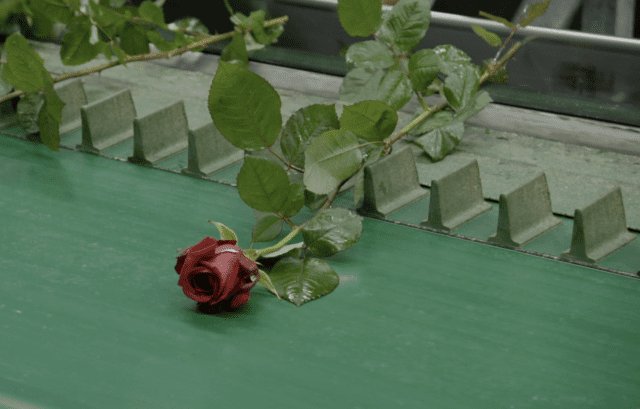
A short fictional scene from Pirandello’s play opens the film, before we move on to the flower market. We see a man (played by multi-artist Oxmo Puccino), looking through a shop window at an employee skilfully wrapping a gift. When we next move to Aalsmeer – a documentary world in which the man isn’t present – it is clear the camera, and therefore the viewer, is doing something similar: carefully observing people at work. Frankly, I would have thought the world’s largest flower market (a fact which by the way isn’t mentioned in the film, as there are no explanatory texts or voice-overs) would have been even more mechanized. But Baudelaire films many people working, doing paperwork, sitting at their computers, and driving around little carts full of flowers.
Afterwards, we return to the fictional world, where the man enters an all-night café and strikes up a conversation – although it’s closer to a monologue – with another man (Dali Benssalah, who recently starred in Bond-film No Time to Die by Cary Joji Fukunaga, 2021), who missed his train and has a few hours to spare. But now that we have been primed, we will keep the documentary scenes in the back of our minds while listening to Pirandello’s dialogue. Because although Baudelaire and co-screenwriter Anne-Louise Trividic (who was also a screenwriter on Patrice Chéreau’s Intimacy, 2001) have edited the piece (and rightfully removed some irrelevant misogynistic remarks from the original), much comes straight from the Italian master.
‘L’uomo dal fiore in bocca’ is a short play which, by the way, was also chosen in 1930 by director Val Gielgud (indeed, brother of John) to be the first TV drama broadcast live by the BBC. (It wasn’t recorded at the time, but a partial reconstruction in 1967, supervised by the original producer Lance Sieveking and using the same artwork, music and experimental 30-lines Baird system, can be viewed online.) The ‘flower’ in the piece – minor spoilers ahead – is a metaphor for a deadly cancer in the man’s mouth. For Baudelaire, this connects to the ‘frightening’ world of international flower trade. As he explains in the press notes: ‘[The] logic of globalisation makes it so that it’s more efficient to grow roses in Kenya, Ethiopia or Ecuador, refrigerate them at 6 degrees in a container for days or weeks, then fly or ship these 46 million flowers across the ocean to Holland where they’re sold at auction and then sent to other countries to be retailed. That’s what makes these flowers sickly.’
But that is not how I experienced these scenes. Perhaps it’s because I’m Dutch, but I’m not at all surprised by the size of the Aalsmeer market. Plus, simply observing isn’t the same as critiquing. And the impressive numbers mentioned in the press notes, which indeed might give one pause, are not included in the documentary itself. Which actually focuses more on the individuals working there, using many close-ups, than on the size and scale of the place.
No, my mind went in a different direction. Back to the man at the shop window. Why is he standing there, observing? And then: why are we observing? Why do we observe the flower market? Or any documentary, for that matter? In the play, the man with the ‘flower’ in his mouth has this explanation: “What I want is to stand at shop windows, admiring the virtuosity of salesmen! Because, you see, if ever, for one second, I’m not busy, if ever I’m aimless – know what I mean?” We know: he would be overcome by the thought of his impending death.
But the cancerous flower is a literary device, of course. All of us live with the doom of death at our doorstep. Whether it’s decades, years, or days we have left. And art, observation, beauty, even learning, can all be seen as diversions for a mortal mind. Even Pirandello’s play itself, short as it is, has, if nothing else, killed another hour for us. Why do we look at art – or artistry, in the case of the fictional shop employee or the factual people working at the Aalsmeer flower market? To keep ourselves occupied. It may sound cynical, but that doesn’t mean it’s untrue.
But then I remembered the other man. The man who missed his train. The man who listens. At first, he only seemed to be there so the other man had someone to vent to. But I reconsidered. This man can also be seen as a stand-in for a documentary audience. But in his case, he’s not simply killing time – he gets involved. He possesses what the other man lacks: empathy. The man with the flower in his mouth is self-obsessed because of his predicament: “Watching the lives of others gives me no pleasure. It doesn’t even interest me. On the contrary.” But the man who listens is interested. Getting more so, as the night progresses. Meanwhile, he is forgetting his own everyday troubles. Whereas the sick man tries to forget death, the listening man, confronted with death, is actually reminded of life. Real life, the one our daily annoyances so often keep us from.
This is also something that documentaries, good documentaries, do: remind us, often through the hardships of others, of the real value of life. Which turns Pirandello’s play, quite elegantly, into a discussion between two existentially different ways of looking at documentaries: as a means to ignore death or to celebrate life.
France / Germany / Republic of Korea, 2022, 67 minutes
Director Éric Baudelaire
Production Poulet-Malassis Films, Les Films du Worso
Producer Sylvie Pialat, Éric Baudelaire
Script Anne-Louise Trividic, Éric Baudelaire
Cinematography Claire Mathon
Editing Claire Atherton
Sound design Éric Lesachet, Philippe Welsh
Sound Éric Lesachet, Philippe Welsh
With Oxmo Puccino, Dali Benssalah