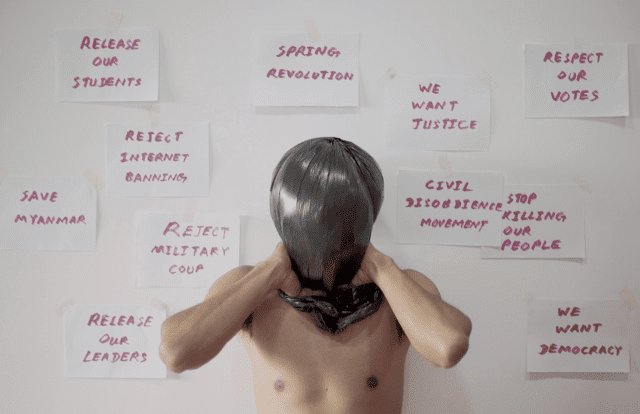
When he appeared on stage this weekend at the premiere of Myanmar Diaries, the filmmaker was in a mask and dark glasses. Even in Germany, he was still wary about the long reach of the Myanmar junta who took over the country in last year’s brutal military coup. He didn’t want his picture to fall into their hands.
Interviewed by Business Doc Europe in the Berlinale Palast, the filmmaker is showing his face but politely explains he can’t share his identity.
He is one of the members of the Myanmar Film Collective (MFC), the confederation of courageous dissident filmmakers in Burma who shot the film. That’s all he can say about himself. Nor, he adds, can he explain how and why he left Myanmar, or how he travelled to Berlin. He is the only one of the directors to attend the premiere. “At least I am here. Hopefully, next time round, some other members of the collective will be at other festivals.”
Sold internationally by Autlook, the doc is already picking up festival prizes. The MFC received production and editing help from Dutch-based outfit, Zindoc (run by Corinne van Egeraat) and her director partner Petr Lom.
“It is a very, very loose association, really. We do not have any formal structure. We do not have any membership structure or anything like that. It’s just a group of like-minded people who wanted to do something about the situation. We are from very diverse backgrounds. Not all of us are filmmakers,” the director says of the Collective. “The one thing we have in common is that we wanted to create a piece that reflects life after and during the coup. We got together and ultimately decided to make a film.”
Initially, there were many more than ten filmmakers involved. Some, though, weren’t able to contribute. The ten who ended up contributing collaborated on each other’s projects. And, no, he won’t reveal which part of the documentary he made.
The filmmaker knew van Egeraat and Lom from before the coup. “Way back, actually, because they spent some time in Burma,” he says of the partnership with Zindoc. “We said, OK, now we have the films. In order for us to piece it together and in order to show it, we need a platform…we naturally reached out to Peter and Corinne and they graciously agreed to help us out and also to put the finishing touches to the film.”
The Collective members have already watched the documentary online but Berlin is providing a first opportunity for the anonymous filmmaker to experience it on a big screen and with an audience.
The hope now is that Myanmar Diaries will draw attention to the appalling suffering the Burmese people are enduring. The filmmaker cites documentaries like Super Size Me and Bowling For Columbine that generated huge debate and led to change. Perhaps, he suggests, the MFC’s doc can do the same. “We are hoping to create some sort of impact which will turn into action. There are so many things outsiders can do to help Burma. You can petition your local government to take more punitive action against the junta, cutting their economic ties if they have any; expelling their military attaché; you can directly help the people of Burma by donating to the different organisations which are helping with the refugee situation.”
It’s early days but the Collective is thinking about setting up its own fundraising platform to help other filmmakers in the country, and possibly also to show their work.
The filmmaker gives a disturbing account of the threats he and his colleagues faced shooting their “diaries.” It’s risky to be out on the streets. “Of course, inside your house is a little bit easier but even then, you have to be careful…you don’t know who your neighbour is or what your neighbour will be doing to you. You have to be careful about that. It [filming] is about being discreet, being alert and just generally being smart about it. If it is very dangerous, just don’t do it because nothing is worth more than your life and your well-being. That’s why some of the filmmakers ultimately weren’t able to do it because they were in a very bad situation or a very bad neighbourhood with tight security. We told them, let’s save it for next time!”
The filmmaker acknowledges that the rest of the world isn’t paying as much attention to the suffering in Burma as might have been expected. “Of course, it is very frustrating on a personal level but we understand there is a lot of bad stuff happening all over the world. The Taliban has come back, we have three or four coups in West Africa and now Ukraine…”
The media has a short attention span. That is one reason for making films. They have far longer staying power than news reports.
Ask the filmmaker why young Burmese soldiers are capable of treating their fellow citizens with such contempt and he points to their lack of education. With no other opportunities for careers, they join the army and the police. That guarantees them hot meals as well as the chance of kickbacks and bribes. Some, he points out, moonlight as drug dealers. “Physically, they are more like gangsters than professional soldiers or police.” They have “almost unchecked powers” to use violence and even to kill.
Short-term prospects for the country look grim. The UN has predicted that Myanamar is headed fast toward economic collapse. Foreign investment has completely dried up. However, there are some reasons for longer-term optimism. The Generals are old and out of touch. Even the previous regime, “bad and evil as they were,” realised that they needed at least to give a civilian government a chance to rule, albeit under strict restraints.
“This regime, I just don’t think they have any idea. They are very impulsive, power-hungry and they are basically just clueless how to respond to the crisis. They were very, very short-sighted when they staged the coup.”
In other words, the Generals are suffering too. They’re faced with armed resistance and an economy in an utterly disastrous state. Unless they make reforms, the situation can only get worse.
The filmmaker points out that the Generals hate being the butt of the joke. “I totally believe in humour,” he says. Myanmar Diaries is very dark in tone but he promises that future films will include a lot more “creative flair and satire.”
Inevitably, viewers concentrate on the subject matter of the films and don’t always appreciate the artistry behind them. The filmmaker points out that a lot of ingenuity went into Myanmar Diaries.
“For us, we like the challenges,” he declares. “Of course, we have to make the actors [participants] anonymous. How are we going to cleverly hide their faces in a very aesthetic and artful way without resorting to cheap measures like having them wear a mask…we enjoy the challenge and each piece is made in complete creative freedom, as far as safety allows us!”