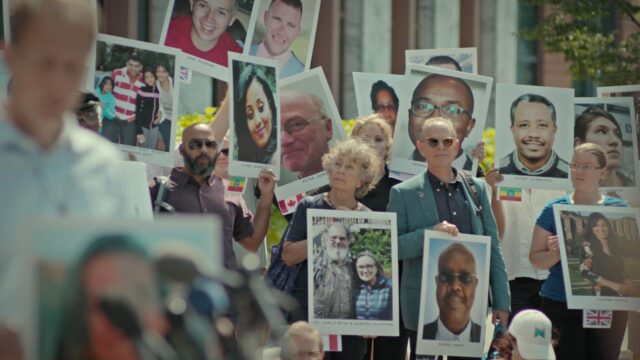
Rory Kennedy’s new film, Downfall: The Case Against Boeing, just released on Netflix, looks behind the two crashes of Boeing 737s. The first, in October 2018, was a Lion Air flight in Indonesia. All 189 people on board died. The second, in March 2019, was an Ethiopian Airlines flight taking off from Addis Ababa. Again, all those aboard, 157 people including crew and passengers, died.
In the wake of the crashes, Boeing tried to parry blame, suggesting pilot error may have been responsible. As Kennedy’s documentary reveals, the MCAS software put into the planes had a major role in the tragedies. Pilots weren’t trained in how to deal with a system which made their planes go into a nose dive against their control.
Kennedy was determined to ensure that audiences did not suffer from information overload while watching her film. “It was quite a complex issue both in terms of understanding what happened – the technological and aerodynamic realities of what the MCAS system was – and trying to explain that to audiences.”
As a filmmaker, and not a pilot, Kennedy reasoned that if she could understand the explanations, then spectators would be able to do likewise.
“Myself and my team are storytellers, right. So it was [about] trying to figure out what information needs to be communicated to have the story land.” She talks of reducing the information to its essential parts and of using visuals to convey the most complex ideas. The filmmakers attempted to “get into the cockpit and really tell the story from the perspective of the pilots and what they were grappling with.”
She pays tribute to her editor, Don Kleszy, with whom she has worked on such earlier films as Last Days In Vietnam(2014) and Above And Beyond: NASA’s Journey To Tomorrow (2018) for his help in “translating this stuff.” Her writers Mark Bailey and Keven McAlester were also key collaborators.
It helps, too, that the film has such compelling characters. Prime among them is Andy Pasztor, the dogged Wall Street Journal reporter who dug deeply into the story behind the crashes. As he wrote in an article last year, “over the past 12 years, US airlines have accomplished an astonishing feat: carrying more than eight billion passengers without a fatal crash.” That is why the 737 Max crashes seem the shocking…no-one expected them to happen.
Another of the film’s heroes is congressman Peter DeFazio, a veteran and relatively unsung politician who chaired the House Transportation and Infrastructure Committee which looked into the Boeing case – and who refused to be cowed or side-tracked in his pursuit of the truth.
Downfall is about a very specific case. Kennedy shows how Boeing, once one of America’s most trusted and admired companies, became fixated on profits after merging with rival manufacturer McDonnell Douglas in 1997. Throughout its earlier history, Boeing had defined itself through the excellence of its planes and its impeccable safety record. After the merger, all that seemed to matter were shareholder profits. Corners were cut. The obsessive and dangerous rivalry with Europe’s Airbus led Boeing to rush new planes into service far faster and more recklessly than it would once have done so.
Viewers are likely to be shocked that airline companies are prepared to put their customers’ safety at risk. As Kennedy acknowledges, what happened with Boeing also happened across many other parts of American business and culture. “It [the documentary] is also about something much bigger which is this idea of corporations being driven so much by profit at the expense of the public interest,” the director says. “It is a storyline we are deeply invested in because so many of us fly.”
Downfall premiered in Sundance last month. It was executive-produced by Hollywood heavyweights Ron Howard and Brian Grazer of Imagine Entertainment. Kennedy, the daughter of Senator Robert F Kennedy and Ethel Kennedy, has a documentary career stretching back more than 20 years. This was her first film with Netflix.
“It’s a pretty hard-hitting film and they [Netflix] never asked me to hold back in any way, shape or form,” Kennedy says. “I appreciate their courage and boldness to let me make this film.”
And, no, there has been no kickback from Boeing yet although the director assumes some representatives of the company must have watched the film.
Kennedy is now at work on another equally ambitious documentary, about refugees during the Second World War. This is being produced by Russian executive Alexander Rodnyansky and Scottish Oscar-winning filmmaker Kevin Macdonald. “It looks back into the story of the MS St Louis,” Kennedy says of the project, about the Jews who fled Germany aboard a luxury cruise liner but then were turned away in Havana and forced to return to Europe. This has the working title, The Global Refugee Project, and makes connections with the situation facing refugees today.
Look across Kennedy’s credits and you find deeply personal documentaries (for example, one on her mother), films about Vietnam and now one about Boeing. Ask how she chooses her subject matter and she suggests there is probably no “rhyme or reason” to her choices. “It needs to be a story that hooks me because it takes so much time and effort,” she says. “I have three kids that are my highest priority, and my husband and family – so I don’t take on new projects lightly…there is the story and what it can rise up to. What can it say that is bigger than itself? I have to feel passionate about it…I don’t ask people to watch films lightly.”