US director Matt Ogens has been developing his Oscar-nominated short Audible for almost 12 years in one way or another.
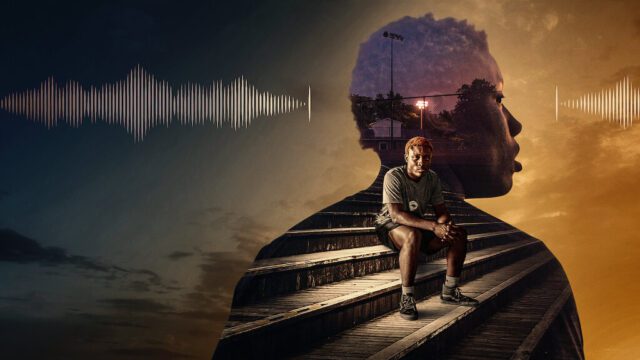
The film, available on Netflix, is a coming of age story following a teenage American football star, Amaree McKenstry-Hall, at the Maryland School for the Deaf. Now coming into his final year, he is one of the team’s top players but demons in his private life are gnawing away at him.
He is still grieving over the death of a close friend, Teddy, who committed suicide after being bullied. Amaree is also trying to make sense of his relationship with his father, a former drug dealer who abandoned the family when he was a kid suffering from the meningitis which made him deaf, but is now a reformed character, desperate to make amends to his son.
From the start, Ogens knew that he wanted to follow a senior from high school, about to “go out into the hearing world. It’s a really pivotal moment, going outside the bubble of your safe school.”
Year after year, the director would “re-cast someone else” as the main subject of the documentary – and then try to get the film funded all over again. For whatever reason, backers were hard to find.
“I am actually glad, surprisingly, it took that long,” Ogens says of the film’s very long journey to the screen. “I came across Amaree the year before we filmed, so it was his junior year. I felt his story was powerful. It hit all the marks of good storytelling in terms of goals and tension and conflict…I’d never say I want to take 12 years to make a film again but if I hadn’t, I wouldn’t have landed on Amaree and his group of friends.”
At the start of the documentary, Amaree is shown sitting on his bed, wearing headphones, looking defiant but lonely. As he explains, he can’t hear the music but he feels its reverberations. Ogens intercuts with night-time footage of the football team.
“I wanted to make it cinematic; to make it immersive,” the director says of an approach a long way removed from traditional observational verité. “I wanted to hit on all the senses – visually, sound…I wanted to do a really powerful cold opening that sucked you in but didn’t tell you everything.”
Ogens knew from the outset that he had the benefit of a “nice, linear structure.” The film was following its subjects over the course of a pivotal school year. That gave him the chance to be adventurous formally without losing the audience. “Let’s look at the thoughts in their head. They’re not always linear. They’re all over the place,” he says of the impressionistic interludes. “Let’s play with that a little and make it feel like the way he sees and feels and thinks.”
The doc is exec produced by Peter Berg, the director of the 2004 high school football movie Friday Night Lights (which spawned a very successful TV series) but Ogens is at pains to point out that Audible isn’t a sports movie. The football is just one part of a much richer story. “But football certainly gave us a good structure and what a great metaphor for the ups and downs and challenges of life.”
The director himself grew up in Maryland, 30 minutes from the school shown in the documentary. One of his closest childhood friends was deaf. “Maybe I made this film to empathise with, connect and understand him more,” he speculates of the influence his friend had on the documentary. The executive producer of Audible, Nyle DiMarco, is also deaf. Ogens talks of their determination to “get it right…this film is not only for a hearing audience. It is as much, perhaps more so, for a deaf audience. Everything has to be right on that end.”
Ogens is a very versatile filmmaker. His credits include a Harlem Globetrotters film for ESPN, commercials, work with brands and the 2007 festival hit Confessions of a Superhero, about four people who make their livings dressing up as superheroes on the sidewalks of Hollywood Boulevard. He doesn’t distinguish between the ass
ignments.
“It’s all a labour of love,” the director insists. ‘Yeah, different but, you know, to me, I look at films and genres as a spectrum…it’s all storytelling. Whether it’s 30 seconds or three hours, you need characters, you need goals, you need conflict.”
Audible has one intimate, very delicate scene in which Amaree is shown linking his little finger with that of a close friend. A director of a fictional film would be proud of such a tender moment. How did Ogens capture it in a documentary?
The response is revealing. “Being there,” the director replies. He adds that you can’t “schedule emotion” and that viewers don’t always realise the hard work that goes into filming such a moment. “I always say…when you’re looking at a National Geographic film on TV and you see a lion attacking a zebra, what the audience doesn’t see is that that cinematographer sat there for a week, shooting grass.”
You have to put in the time to earn the trust of the subjects. Sometimes, directors get lucky too. Another very moving moment in the film comes right at the end when Amaree and his friends visit the cemetery to pay tribute to Teddy two years after his death. They invited the filmmakers along. “It was pouring, cloudy. It was going to be this dark, grey scene. All of a sudden, the clouds parted ways and it was this most beautiful sunset. We had this moment where we were wrapping the film with his beautiful sunset coming down with Teddy’s parents and Amaree…it was very emotional, a beautiful moment,” he says of a scene that provided the perfect end note.
Now, Audible is up for an Oscar. Ogens doesn’t want to disclose too much about his future projects. “I can’t say too much but I am actually working on a feature documentary right now. I’ll say it’s about ballet, sports-adjacent, there is movement in it. It is set in Africa and England.”
And on this tantalising note, the interview draws to a close…