

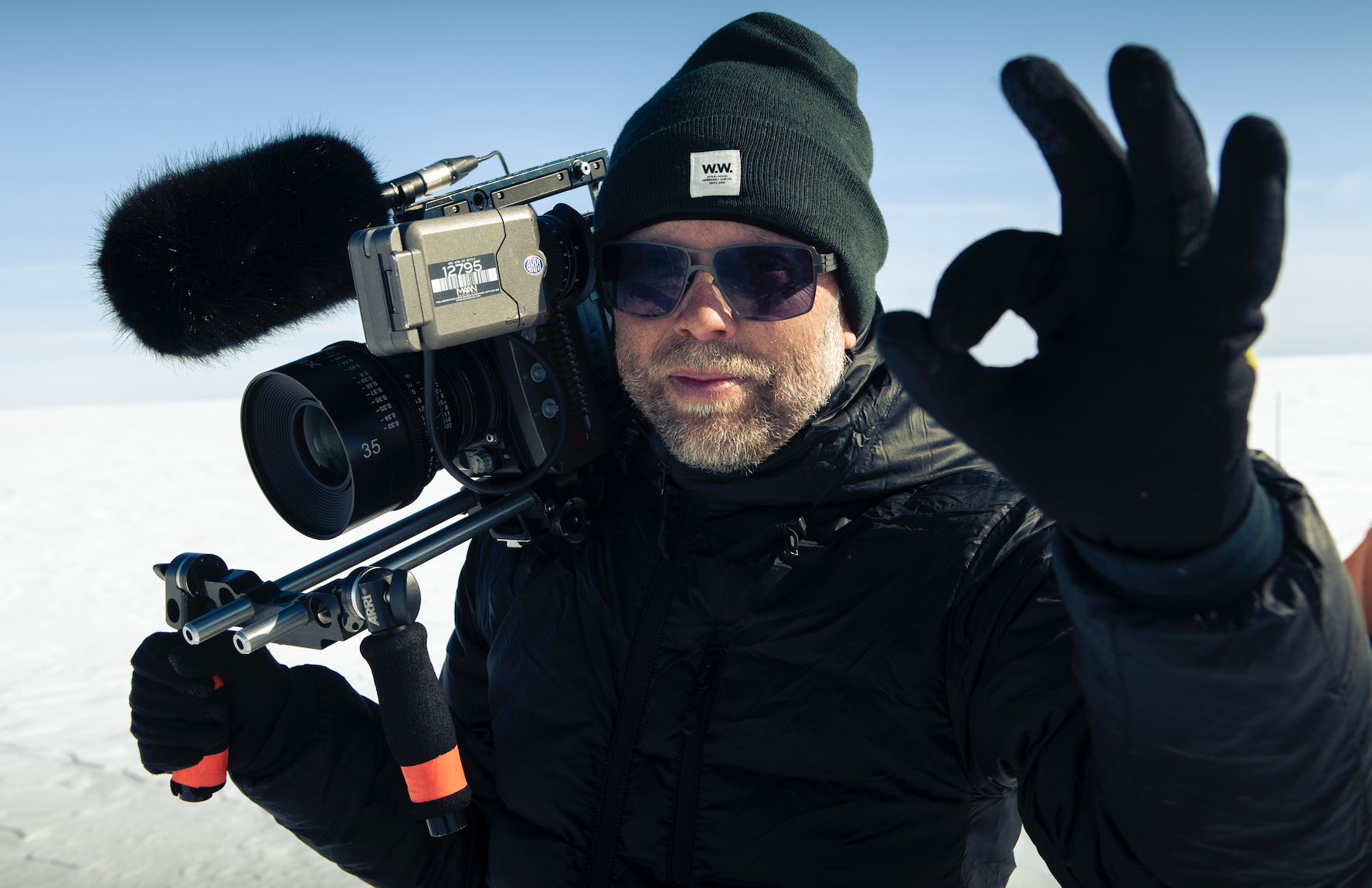
“I always dreamed about becoming an explorer,” says Danish filmmaker Lars H. Ostenfeld. His wish came true making Into The Ice, which premieres as the opening film of CPH:DOX March 23, as Ostenfeld found himself exploring the Greenland ice sheet, including climbing down a 180-meter meltwater hole.
Ostenfeld has already worked on a number of science and nature documentaries including Tracking The Wolf, DR’s Live from Space, The Polar Bear Live which screened at COP22, and Live from the Depths. He was first inspired to explore the world of ice after seeing a photo of a Danish climber scaling its depths.
“Every day we see something in the news about the ice melting, but we have no idea how fast it’s going,” says Ostenfeld. ”Instead of just telling people something is wrong with the climate, I wanted to discover where do we get these numbers?”
His search for the people behind the numbers led him to three of the world’s leading glaciologists: Alun Hubbard, Dorthe Dahl-Jensen and Jason Box – each of whom put themselves in severe danger in order to collect and analyse data to help the world understand climate change and the danger of rising sea levels.
Following scientists for a documentary can be a tricky business, as Ostenfeld notes from past experience. “They love to talk about science and facts. But when they start getting emotional they back off.” But Ostenfeld was able to impress this trio with his dedication. He didn’t just want to shoot an hour or two with them, he wanted to go on the expeditions with them. “They loved when I said, ‘I want to join you for 12 days on skis on the ice sheet. I want to follow you inside the hole. I’m going to stay with you every day.” In all, Ostenfeld made nine trips to Greenland – and indeed the longest single expedition was with Box for 12 days on the ice sheet.
Malene Flindt Pedersen produces for Hansen & Pedersen, whose credits include From the Wild Sea and the CPH:DOX 2021 opening film 70/30. The film’s backers include The Danish Film Institute, TV2, The Lundbeck Foundation, The Novo Nordisk Foundation, The Carlsberg Bequest in honour of J.C. Jacobsen, Aage V. Jensen Charity Foundation, Queen Margrethe’s and Prince Henrik’s Foundation.
Ostenfeld doesn’t take centre stage in the film but his presence can be felt – that was partly due to necessity, because there needed to be a constant across the three shooting periods with the different scientists. “I was going to be the only one going on all three trips, so I have to be there as a character. Also I wanted to help translate the science they are actually talking about. And I’m the ‘Bambi on Ice’ character – it’s not just these scientists being heroes, I wanted that human touch too.”
The film balances information with the more emotional side of the journeys. As Ostenfeld explains, “If you overload an audience with half an hour of science, they can’t take in any more. It’s a balance – we have some knowledge and we have scenes of fun or action or life on the ice, and then we have more science.”
His own drawings appear in the film. “I was trying to understand the science myself, and the drawings helped me do that, so my producer Malene said, why not include those drawings in the film? Normally you cut away from the story to get some science graphic, so this was a good way to blend it in like it was my travel notebook, it feels more personal.”
Even in cold conditions, it was important for Ostenfeld to use an ARRI AMIRA camera to get spectacular images. Sound was also vital to help the audience “feel the ice – it’s not just having beautiful images, it’s the crunch and the cracks and the booms, and hearing how the wind changes all the time.”
Especially for someone who isn’t an ice expert, there were some scary moments for the filmmaker, like a storm when Box told him their tents wouldn’t hold and they had to urgently build a snow wall to survive. And of course climbing down the 175-meter hole with Hubbard was nerve-racking. “No matter how much I tried to prepare on a climbing wall in Copenhagen, you can’t imagine how it is. It’s just this black hole without knowing where it ends.”
Ostenfeld is sticking with the theme for his next project, which he is researching now and which will take him back to Greenland – about what happens when freshwater melting from ice meets the ocean. “This can have a huge impact on life in the ocean and the gulf stream, this could be much more important to understand than even the melting.”
Meanwhile, he hopes Into The Ice can inspire people to think differently and take action. “I hope people will start thinking about the ice sheet in a new way. Next time they read that temperatures are warm this summer, I hope they have a better understanding and have some feelings about this ice – it’s not just numbers.”





