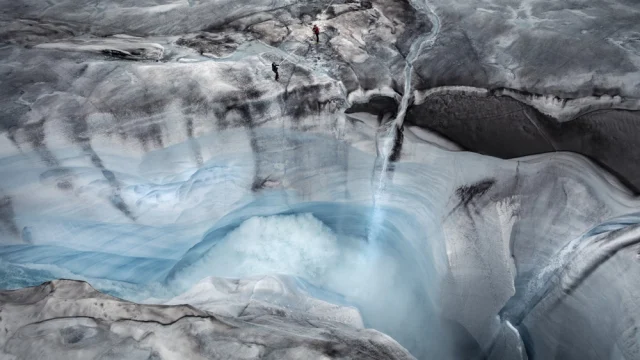
Into the Ice, pic courtesy of Lars H. Ostenfeld
The world is burning and CPH:DOX is launching with a documentary about glaciologists investigating the ice sheets in Greenland. It would be a huge mistake, though, to mistake the choice of Into The Ice as opening film for evidence that the festival is out of touch with events in Ukraine.
As the war continues to rage, a special programme, Ukraine – A Sovereign State, has been compiled and features both new and older Ukrainian docs, for example Iryna Tsilyk’s The Earth Is Blue As An Orange (which screened digitally at the 2020 festival but can now be seen by a physical audience).
“Any decision you make gets coloured when big events happen. Of course, our decision to open with Into The Ice was made long before anybody had the idea of a real full-scale invasion by Russia in Ukraine,” acknowledges Niklas Engstrøm, Artistic Director of the festival.
That said, Engstrøm argues that recent events in Ukraine could make Lars Ostenfeld’s spectacular new film yet more relevant.
UN Body The Intergovernmental Panel on Climate Change (IPCC) published its latest, depressingly bleak, report on climate change three days after the Russian invasion began.
”It got overshadowed by the war – right now everything gets overshadowed by the war,” Engstrøm continues. “But in respect of the war, I think the film’s climate focus is even more important [than before].”
Ostenfeld’s documentary follows three scientists as they investigate the secrets that ice reveals about the earth’s climate, its past and possible future. Engstrom sees the film as being a timely reminder of the dangers of the West’s continuing dependence on fossil fuels. “We should have learned the lesson years ago that staying in that fossil fuel mode will keep you too close to autocrats. Whereas fossil fuels are in the ground where somebody can claim ownership, the sun and the wind are everywhere. Now it seems that we finally understand that energy politics is security politics and that therefore we have to act fast – but that is also closely connected to the climate crisis. And this film shows we need to act even faster than we thought to save the climate.”
Russian President Putin’s decision to invade Ukraine has seen fuel prices rocket. It could also be a catalyst for politicians to act more decisively in weaning their countries away from their dependence on oil and gas.
“When we selected this film, [we thought] it was a brilliant example showing how documentary has three ground pillars, three great values which are also the values of CPH:DOX as a festival. These are the values of knowledge, art and social engagement,” the artistic director notes. “Art has the ability to make people reflect; science has the ability to bring out new knowledge, and there is the ability of social documentaries to engage people.”
Into The Ice, produced by Malene Flindt Pedersen for Danish outfit Hansen & Pedersen, is, therefore, a perfect example of a film which covers all three bases.
This is Engstrøm’s first festival as artistic director (although he has been an intimate part of CPH:DOX since it started in 2003). He took over from festival founder and CEO Tine Fischer last summer when Fischer left to become Director of The National Film School of Denmark.
“It’s not easy!” the new artistic director says of the challenge of following a figure like Fischer, who has been so closely associated with the event for so long. “The reason I was asked and the reason I said yes was to continue in the direction we laid down many years ago…I was not planning a revolution and our board was not expecting a revolution.”
In her time at the helm of Copenhagen festivals, Fischer came to oversee not just CPH:DOX but fiction event CPH PIX and kids’ event BUSTER. She dealt with the financial and administrative side of the festivals as well as setting the artistic direction. Now, though, Engstrøm has divided the jobs. He is working closely with Katrine Kiilgaard, recently appointed as Managing-Director at CPH:DOX having previously worked as Deputy Director and Head of Industry & Training.
“That was my very small revolution, if you want, saying we need to split up the management team…I am so glad she [Katrine] has said yes. Just like myself, she knows the festival very deeply. She knows our values and she knows how to manage it [the event].”
Engstrøm also makes it clear that the festival is continuing to evolve and won’t just stand still.
“Even though we haven’t planned a revolution, we are of course highly aware of the constant need of any festival to change in light of new developments in the world and in the film business. We’re not planning for ‘business as usual’ in the coming years – and one of the first things planned for the aftermath of this year’s festival is a “development trip” for the whole team to come together and discuss where we are and where should we go (something that we haven’t really managed to do during the vivid years).”
Some high profile guests are expected to attend the festival this month. John Wilson, the HBO star behind doc series How To with John Wilson will be in Copenhagen, giving a talk and screening out-takes from his show. Revered Belgian political scientist Chantal Mouffe for a special discussion about the rise of the far right in Europe linked to a screening of new documentary The Voice Of The People, directed by Andreas Wilcke.
Meanwhile, Julia Navalny, wife of the inspirational but still jailed Russian opposition leader Alexei Navalny, will be at the festival for the screening of Daniel Roher’s new feature doc Navalny. (“She is the big name when it comes to the social political sphere of the festival and I am really looking forward to having her here.”)
Between them, these guests also embody the festival’s holy trinity of values: Science, Society and Art.
And, yes, Engstrøm and his team are looking forward to welcoming back audiences into cinemas after two Covid-affected years, when the festival was obliged to take place entirely online.
“Back in December, we actually thought we would have a digital edition for the third time in a row,” Engstrøm says of the flexible approach he and his team have had to take as they have waited for Covid regulations to be relaxed. “With this year’s festival, we are actually doing an experiment which we haven’t done before. For many, many years, we had a classic physical festival. Then, for two years in a row, we had a purely online festival. This year, we will have our first ever hybrid festival.”
CPH:DOX as a physical event runs March 23-April 3. The digital version lasts from April 1-April 10 and films will be available across all of Denmark.