

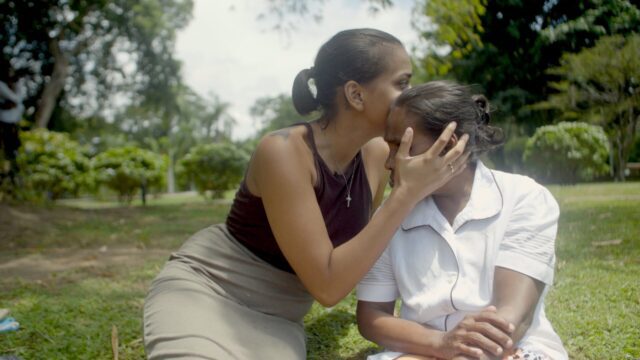
Five or six years ago, when Norwegian filmmaker Emilie Beck met Priyangika (“Priya”) Samanthie through a mutual friend, she was immediately fascinated by the stories Priyangika told her about her upbringing. “She [Priya] knew one of my best friends from when I was young. My friend was, like, ‘you need to meet this girl. She’s cool, she is different. She is very outspoken, very opinionated and cares about the same subjects you do.’”
Priyangika had been born in Sri Lanka but was brought to Norway as a very young child where she was adopted and raised as a Norwegian. When she was three, she started to ask searching questions about her birth mother and where she was from. When she was 21 she finally found her mom. She was helped by people doing detective work on Facebook and Instagram, and looking on her behalf in the slum areas of Colombo.
The adopted daughter is now the subject of Beck’s feature documentary No Place Like Home, screening in the Nordic:Dox Award strand at CPH:DOX.
“I had been growing up with those TV shows where adoptees meet their parents, they run toward each other, everything is fine and then they end the show,” Beck says of the romanticised vision of adopted children and their biological families favoured by the mainstream media. Priyangika’s story was far more complicated. She did eventually track down her mother in Sri Lanka but it wasn’t happiness ever after. “There were a lot of cultural differences, a language barrier.”
In 2017, Priyangika told Beck that she was planning visit to Sri Lanka “to meet her mom and to tell her she was pregnant with a child. She said ‘you can tag along if you want.’” That was how the filmmaking started in earnest.
This may well be an uncomfortable film for Norwegians to watch. It doesn’t paint a very idealised picture of Priyangika’s childhood in the Norwegian municipality of Molde. As a brown-skinned outsider, she was bullied at school. As the film revealed, the adoption process which brought her to Norway in the first place was shady and possibly even corrupt. Her real mother never realised her daughter was going to be living on the other side of the world. When the mother gave her up for adoption, she assumed her kid would remain in Sri Lanka. That wasn’t the case.
No Place Like Home is a deeply personal story. However, it also taps into a growing debate in Norwegian society about adoption practices. There are over 200 other Sri Lankan children adopted by Norwegian families in equally opaque circumstances.
“This debate around adoption is very slow in Norway. It started just a few years ago. In a lot of other countries, they’ve been talking about this for years. It’s about time we talk about the shadow side of adoption,” says the director.
The Norwegian couple who raised Priyangika are clearly devoted to her and had no knowledge of any irregularities surrounding the adoption process. “They’re incredible people and they’ve been extremely supportive of her. They’ve been talking about adoption since she was starting to ask the questions. They’ve been very open with her about it.”
Her parents had felt they could trust the authorities. While they are “very disappointed” about the flawed process which took Priyangika away from her homeland, they said at the Q&A after the film’s premiere that they’ve always been very grateful for having her in their lives – and that she has “broadened their world view and taught them so much.”
Priyangika’s birth mother died a few years ago. Since giving up her daughter, she had lived a tough life, sleeping on the streets for many years. There was also the shame and regret she felt, because of the adoption. “It’s not easy to give away a child because you are poor, so of course she felt a lot of guilt meeting her,” the director notes.
One of the mother’s consolations was that her daughter was in a secure situation. “I think her mother was great. She was very kind [but] she had big temper…what they told us, which is not in the film, is that she quit schooling at the age of 12 to work in order to get money for the family,” says Beck. “What I feel is the culture clash between them. For Priyangika, what she wanted her whole life was for her mother to take good care of her…but, for the mother, I sensed that she wanted her daughter to take care of her…the culture differences were fascinating but it was also sad to see the gap between them.”
Beck’s intention originally was to make a documentary about the “lost years” in which mother and daughter had lived apart. “I knew that whatever she [Priyangika] found during the journey, I want to follow her emotions, her existential travel…[but] the further we went, the bigger the story got. This is my first [feature] film, right. It was very overwhelming. All of a sudden, we had all these different layers. We’ve been editing this film for two years now because it has been so hard to feel and know what is the focus,” the filmmaker reflects on a story that went off in many different directions she hadn’t originally anticipated.
“I hope this will be an eye-opener to a lot of people,” she adds of the documentary’s revelations about the inner workings of both Norwegian and Sri Lankan society. The same material could easily have been used as part of a journalistic investigation into corruption in the Sri Lankan adoption system. Beck, though, was determined to keep the focus on her subject.
“Sri Lanka is a beautiful country, with so many colours…the scenery is incredible. It is also a very big contrast to the cold, grey Nordic sound and feel. I wanted to express those two worlds and also merge them together in the end. It was also very clear to me from the beginning that I wanted to tell the story through Priyangika’s voice and that she was the one carrying us through the whole story,” Beck ends.
No Place Like Home was produced through Oslo-based Indie Film. It will screen later this year on Norwegian TV channel, NRK, who backed the project alongside DR and SVT.





