

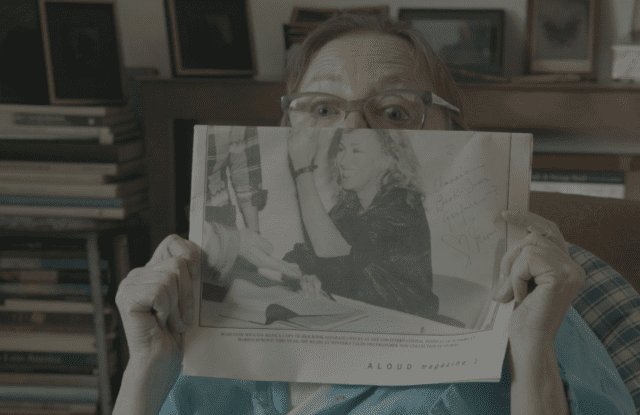
Pulitzer Prize nominated US novelist Marianne Wiggins is the subject of the new doc world-premiering this week in the International Medium/Short competition in Nyon. This, though, isn’t the typical biographical portrait of an important writer. It’s more of a story about creativity in the face of illness; an intimate study of an artist trying to recover her full faculties after a devastating personal setback.
Wiggins suffered a major stroke in 2016. As her recuperation began, she moved in with her daughter, artist Lara Porzak.
Filmmaker and documentary researcher Rebecca Ressler has known Porzak for many years, “but very peripherally. She had a relationship with my parents but we rarely saw each other, maybe only every couple of years.” By chance, they ran into each other just before the pandemic. Porzak mentioned what had been happening with her mother who had been trying to complete a new novel. Porzak had been chronicling her mother’s struggles.
“She [Porzak] said ‘you know, I have all this footage but I don’t even know how to put it onto my computer. I would love for you to come over and see if we can do something together.”
Eventually, Ressler visited Porzak at her home. The artist gave the filmmaker a big box of memory cards and films. This started the process which led to the documentary, which Ressler has co-directed with Porzak.
Ressler has now read all of Wiggins’ novels. “She just synthesises things really well. Her language is really flowery but it’s not difficult to make sense of or understand,” she says of the author. “Sometimes, when people use really long and winding sentences that have lots of descriptive words, it can be hard to follow. But with Marianne, she can have a really long sentence which feels like just a couple of lines. She does that when she speaks as well. Everything is really clear and concise but she is using really beautiful language.”
Most of the footage in the documentary was filmed by Porzak but Ressler shot the interview sequence and the moments in which mother and daughter are looking at slides of old photographs together. “When I went to their house, they showed me the slides and they were so beautiful that I had this idea to shoot them together going back into their lives.”
Cinematographer Gemma Doll-Grossman helped with the extra footage. Ressler also came up with the idea of 8mm sequences showing Marianne waking up. “It’s kind of a mixture. Some of the footage is from before and some of the stuff is kind of pieced together from interviews that I took with Marianne,” she says of how the documentary brings different types of material together.
At certain times, when the Covid pandemic spiked, Ressler would stay away from Wiggins and her daughter, instead communicating with them by FaceTime. She was working with editor Emily Drummer cutting the film together even as shooting continued. There was already a cut of the film completed when, for example, Wiggins received a box from her publishers with early copies of the new book she had been working so hard to finish. “We got really lucky,” Ressler says of what becomes a pivotal scene in the documentary.
The film is screening at Hot Docs as well as Visions Du Réel. It is also destined to travel to other international festivals as the publication date for Wiggins’ novel looms closer. “I would love for it to live somewhere that will find an audience that will find people who love literature because that is so so important for Marianne and such a big piece of who she is,” the director says, suggesting that platforms like The New Yorker or New York Times might provide an ideal home.
Ressler acknowledges that the film shows only part of its subject’s life, as the novelist fights back after her stroke. There is plenty of scope for other films about Wiggins, a charismatic figure with an eventful and colourful private and creative life.
“I hope there is still room at some point to tell Marianne’s story on a bigger canvas. Wh
o knows, maybe the book tour will provide a structure for that…there are so many things that are untold.”
It is clear, though, that the novelist doesn’t want to talk much about the period between 1988 and 1993 when she was married to the British-American novelist Salman Rushdie. This was the time when there was a fatwa issued against Rushdie by the Ayotollah Khomeini in Iran and he had to go into hiding.
“Marianne also published one of (I believe) her best books at the time ‘The Satanic Verses’ was published. She was famous for being in hiding with her own husband which, for a person who takes her own work very seriously, must have been difficult,” Ressler notes of the period over 30 years ago when her own life and work were overshadowed. “That’s why we chose not to focus on that in the film. Also, their relationship did not work out. The reasons for that are hers to share, not mine.”
Porzak is known for her fine art photography. As Ressler notes of her co-director, “only she could have shot her mum with that type of tenderness and love.”
The co-directors had over 150 hours of footage to draw on. During the pandemic, Ressler spent three months sorting and cataloguing the footage while “getting to understand Lara and Marianne’s world.”
There was a very tight knit group working on Marianne. “I think that having a really small team where I knew everyone and we all trusted each other was so helpful. I actually don’t think I would ever have gotten to make this project had it not been for the time the pandemic afforded me,” Ressler concludes.





