

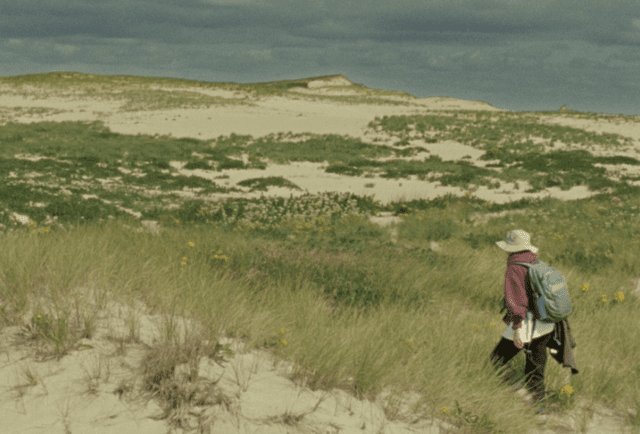
When she was “four or five years old,” Nova Scotia-born filmmaker Jacquelyn Mills watched a TV news programme which included a story about Zoe Lucas, the conservationist who even then was developing a reputation for her research into the wildlife on Sable Island.
“She [Lucas] was this researcher with a herd of wild horses and the largest colony of grey seals in the world,” Mills remembers. The island was remote and very intriguing – famous for its shipwrecks as well as its flora and fauna. Mills was fascinated. “It stayed with me,” she says. As an adult, she was still as curious as ever about the legend of Sable.
Through a friend, Mills was introduced to Lucas, the subject of Mills’ new film Geographies Of Solitude (screening in Hot Docs Canadian Spectrum and which premiered during Berlinale Forum earlier this year). She explained her ambitions to make a film which would “intimately involve Sable Island.” Lucas, who had seen Mills’ previous documentary In The Waves (about the director’s grandmother), quickly agreed to participate. “I was on the island within a few months…once we were together, everything just clicked.”
Director Mills describes making her film on Sable Island as fulfilling “a life-long dream.”
She made three separate visits to the island, in December, June and September. “So I got to be there all different seasons.” On the first two visits, she as there won her own, as a “one person team.” (Mills shot and edited the film as well as directing it and working on the sound design.) On her final trip, she brought a collaborator who helped with the camerawork, allowing her to focus completely on the creative side of the project. She did eventually have help across all the roles she took on but found it “very natural” to take on multiple tasks herself on what she regarded as a complete “labour of love.”
On one level, Mills was emulating her subject. Lucas is also a “one woman show,” hatching and working on many different research projects at once. “She tends with such care to her work,” the director notes. “It made it so easy for me to do the film in the way I did it because I had her as an example.”
Mills further describes the experience of making the film as “a bit of a mysterious process…one long journey from beginning to end.” She was shooting on 16mm and would generally only have her camera rolling for around 10 minutes a day. “I had very little material and the material I had was very precise.” She edited in an intuitive way, bringing in trusted collaborator Pablo Alvarez-Mesa to help her in the final stages.
Why 16mm? “The first reason is I learned on 16mm at film school, and so I had a relationship with shooting on film,” Mills explains. She adds that there is a “ritual to shooting on film” that you don’t get with digital. “You physically have to touch the film. It’s an object, a beautiful object. You hold moments in your hand…”
Mills talks of the “mysterious pull” of Sable island. When she was at a high vantage point, she would film “all the way around because there was ocean completely in every direction.” She was determined to capture the sense of “being so remote and so isolated.”
The director was astounded by the creative energy of the subject Zoe Lucas, whose presence suffuses the film. “Even if she is not in it, she is there,” the director says of how the conservationist inspired and guided her. “It was a total collaboration, a wonderful surprise…in that sense, I owe the film to her because she was such a key part of the creative process. She really embraced the film, shared her studies, shared her way of life and shared the island.”
Lucas even showed Mills the places “with the most unique soundscapes.” (One sequence of the film features music made by the movement of beetles.)
But, not, they didn’t spend much downtime together. “We would do these film sessions during the day, many
hours together, and then go our separate ways. We spent a lot of time together but none of it was downtime,” Mills laughs. “We were always creating and working on the film when we were together.”
The film sets out to portray “the mystery and profound experience” of being on the island. Words are kept to a minimum. “Sable Island is quite a timeless place. I have experienced that from various times being there in different seasons and having many conversations with Zoe,” Mills says. She talks of the “spirit of the island, how unchanging it is – permanently impermanent…this constant cycle of life and death, seasons, horses, fields, birds, shadows of birds. It is all just this one constantly changing permanent experience!”





