

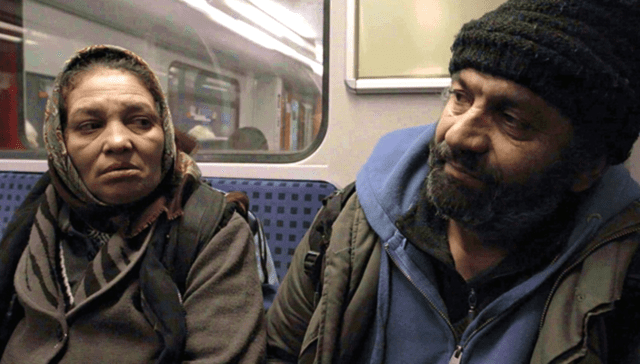
To passers-by on the Hamburg streets, they were simply beggars. Maybe you would give them a coin or two as you were rushing for a train or heading home after work but you wouldn’t think about them again. To filmmaker Andrei Schwartz, however, they were fellow humans with compelling stories to tell.
In his new film Europa Passage, shot over a period of six years, Schwartz follows various different Romanian Roma as they shuttle between their homeland and the German city where they’re forced to keep on returning in an attempt to make a living. The title comes from a famous shopping centre in the city but obviously reflects the transient nature of the subjects’ lives. It reflects “the migration between the poor side of the European Union and the rich side.”
Schwartz regards the film, a world premiere this week at Dok Fest Munich and produced through Wueste Film, as a natural successor to his 1997 documentary Wasteland (Auf Der Kippe) about a group of Roma men, women and kids eking out an existence by recycling what they find in a garbage dump near the Romanian city of Cluj.
“Thirty years later, more or less, these people are now in Germany…I was just quite curious about how they survived,” the filmmaker states. He speaks fluent Romanian and was able to communicate with them. After a short period, he no longer regarded them as beggars. They were “just people,” with “good and bad stories” about their experiences.
Schwartz visited his subjects in their home village in rural Romania. He was a “bit surprised” to discover they were treated as outsiders (“like foreigners’) there too, just as in Germany.
“They were always been the chairs,” is how the director puts it.
The village itself is very quaint, with thatched roofs and horses and carts. “With full pockets, it looks beautiful,” Schwartz observes. It doesn’t seem that way, though, when you are desperately poor.
The director (who was born in Bucharest himself and moved to Germany in 1973) wasn’t trying to preach to audiences. “I didn’t want to do the film [to communicate] some special message. I did it because of a sort of identification with these people. So many things happen quite similar in my life,” he reflects.
As a documentary maker, Schwartz was aware that his presence made the lives of his subjects “completely different.” He therefore decided to shoot them for a few days at a time and then ‘leave them in peace to have their own lives” before coming back again.
At first, some of the subjects were reluctant to be filmed. They were afraid that participating might lead to problems with the authorities. (In the event, this happened anyway).
Hamburg is a wealthy town but not a generous one toward the Roma visitors. They’re forced out of shelters and then compelled to leave the city if they don’t have somewhere to live. As EU citizens, they have the right to be in Germany but the city authorities use petty bureaucratic regulations to make their lives as difficult as possible.
Begging is legal – as long as it isn’t aggressive. It is therefore up to the individual police officers to decide what constitutes aggressive begging. As gypsies, they’re often the victims of open racism. In one scene, we see the subjects in an abandoned apartment where they hope to sleep. The windows are all smashed. “Later, I learned it was the police who broke the windows to make it impossible for them to come back.”
The director had no qualms about paying small stipends to his subjects. They were giving up their time. (“They don’t earn too much if we film them.”) Th
ey would therefore receive around €60 a day. Covid slowed down the production process, which was one of the reasons the film took so many years to complete.
A black humour runs through the doc. Although their lives are grim, the protagonists still have the ability to laugh at their own plight.
Schwartz has already shown some of the subjects the film. They were initially apprehensive and asked the director to make sure he didn’t show the documentary in their home village. “They were afraid people would laugh about them.” Their attitude changed rapidly once they had watched it. They all felt it was an honest representation of their lives.
As the film hints, the Roma people are victims of historical circumstance. They grew up in a part of Romania that, during the Ceaușescu era, had thriving and heavy industry. Manual work had been easy to find. Then the factories all closed. They had little education. Many were illiterate. They couldn’t find alternative jobs. Begging became a necessity in order to survive.
“A lot of them are not able to read and write and so they try to send their children to school,” Schwartz explains their efforts to ensure the next generation doesn’t share their predicament.





