

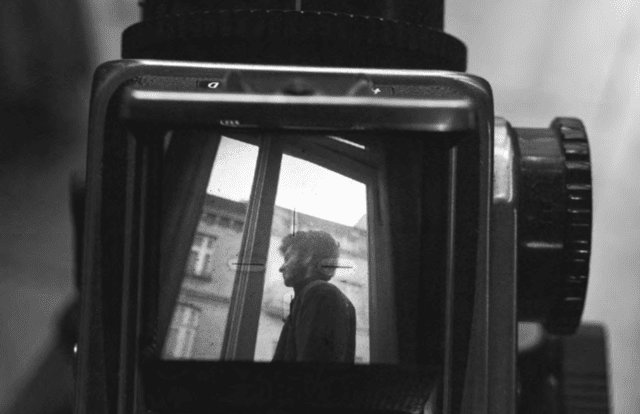
A Hole in the Wall by Arjun Talwar
After eight Polish documentary projects approaching completion were presented at KFF Industry to the international finance, sales, distribution and festival sectors, another 10 brand new Polish doc projects ready to start their careers were presented this week. All are in development or are currently shooting, and range in subject from a renewed investigation into a family death, an outsider’s observation of the people living on his Polish street and how a director sets out to find the man of her dreams using astrology.
In HOLE IN THE WALL, filmmaker Arjun Talwar, born in India, observes the street he lives on through the eyes of an immigrant, looking at today’s Poland, encountering stories of migration, past and present.
“I came to Poland 10 years ago to study film together with my best friend from India. We were really into mathematics, like good Indian kids, and suddenly we decided we’d go to Poland and become artists, and our parents really didn’t like that.” Talwar told the KFF audience. “Anyways, so what happened is that my friend died recently and that hit me quite hard and left me feeling very alone in this country. So those feelings actually are what led to this project. A Hole in the Wall is a story about me trying to establish a deeper relationship to Poland. And I do this by filming the street I live on and trying to befriend the people around me.”
The street of Wilcza in central Warsaw is just over a kilometre long, but within that space lies an entire universe: a police station, a squat, seven barbershops and a 19th century ƒchurch. Arjun has now spent many years in Poland. But somehow, he still feels a distance between himself and the country. To find a deeper understanding of this estrangement, he turns his camera towards his neighbours – the old‐timers, immigrants and drifters whose lives intersect on Wilcza.
The project, produced by Karolina Śmigiel of Uni-Solo Studio is in development with a budget of €180,000 and a mooted delivery date of November 2024.
“I feel that these are really weird times. On one hand, we have all these Ukrainians coming here with nowhere to go. On the other hand, there are people who want to leave this country because of the right wing government. There seems to be a general vibe of rootlessness and homelessness. And this is the atmosphere that I want to convey through this film.”
Małgorzata Goliszewska’s THE PERFECT DATE follows a protagonist in search of love and her ideal man. She knows her main character very intimately and understands her dilemmas, recognizing very easily her highs and lows, her moments of happiness and misery, because Małgorzata herself is the heroine of her film.
“When she tried dating apps encouraged by her married friends, it also didn’t bring much success. And she’s trying to understand this through various therapies , and also through astrology,” she told KFF Industry of her protagonist. Now she and her astrologer (actually her dad) have hatched a plan that cannot fail. “The astrologer will design the date of birth on which the man with the horoscope perfectly compatible to hers was born. Now all she has to do is to find this man, go on a date and, uh, live happily ever after…”
The 75-minute project is produced by Agnieszka Skalska who is looking for co‐producers, fund support and broadcasters. Goliszewska, a self-proclaimed devotee to love stories, made the Oscar-longlisted doc Lessons of Love in 2019.
“The Perfect Date is a difficult and demanding adventure for me, which is where I have to face and confront my fears, my past choices, and this astrological experiment is just a pretext to try to find answers for questions like what does it mean to be in a relationship, and why is it so hard nowadays and what’s wrong with being single in the first place?” commented Goliszewska. “And can we escape our mental patterns from our earlier upbringing? And in my case, for example, the pattern of an absent father in the time when a little girl needs her father.”
“The voices of my ex-partners will serve as a Greek choir, because in the end this is a tragedy, right?” Goliszewska signed off.
Agata Baumgart’s YOUNG BLOOD is a vital documentary project about older girls who want to tell how and why teenagers feel they don’t want to live anymore, and how they enter adulthood battling depression.
It addresses the “worldwide and very burning problem of increasing mental health crisis among young people, caused not only by private and personal issues, but also by this very, maybe even dramatic, historical moment and also an uncertain future.”
Emilia is 16 when she decides to die for the first time. Fortunately, a watchful psychiatrist manages to send the girl to a child psychiatry ward in time. Since then, Emilia will end up there several more times and meet girls who, like her, experienced a mental health crisis at a very young age. Today Emilia is 20 years old and is still fighting for her life trying to control the relapses of severe depression. Along with several other girls, she decides to break the taboo and speak out about her experiences. Each story is different, but the aim is the same: to show solidarity and support to others struggling with a mental health crisis, and to help healthy people understand what lies at the root of their problems, how they can be helped and what they really feel.
“I want to follow my protagonists through the very difficult transition into adulthood when they face great challenges like moving out of their family, choosing studies or their first job, starting first vital relationships. And at the same time, constantly struggling with mental health issues. In my film, I would like to use three narration layers. First is documentary observation combined with interviews. The second one is material shot by my characters…video notes, video messages…And the third narrative layer is represented (as in her trailer) by the image of the desert island. The desert island is a metaphor for self-isolation in the inner world, which is on one hand a safe place to escape, but it could also be a trap with no way out.”
The doc is made by a director who herself has suffered severely from mental health issues. “Because this is also my own history. When I was at age of my characters, I also used to suffer from very severe relapsing depression,” she said. “I’m standing here in front of you with my anxiety disorder but full of hope that you will help us to tell a wonderful story about empowering friendship, full of empathy and a heroic struggle for their lives.”
The 75-minute film is produced by Grzegorz Pacek. The budget is €169,940 with a mooted delivery date of December 2024.
TOWARDS THE SUN, directed by Agnieszka Kokowska, tells of the idealistic decision on the part of Kasia and Robert, the parents of three boys, to sell their house, quit their jobs, and board a camper van in order start a new life journey that would bring them closer to each other.
In the story, the family members live through moments of happiness and fulfilment, but also of friction and conflict. The real challenge is met by the boys who are growing up but held hostage by their parents’ decisions. The changing horizon is the background to the emotions that accompany the family. The film speaks about the closeness with others we so desperately need, but which at times might lead to denial of personal freedom. Every decision has consequences and has its price. What is the lesson to be learned in order to stay together?
Produced by Justyna Ziemkiewicz, the €200,000 project is half way to budget completion, thanks in great part to financing from the Polish Film Institute. Ziemkiewicz is looking for co-production support and further financing for the Polish/English-language film. Delivery is expected in December 2023.
“What drives me to make this particular film and tell this story, because my engagement is partly personal, [is] I’m a mom of a 13-year-old son. We have [the] experience to live out of Poland and to start from the beginning,” explains director Kokowska. “Also I know that no matter how far you’re gonna go, you can’t escape from yourself. In this situation, you can’t escape from the family as well. Because you’re carrying all your past experience, all your problems with you. But also you have this inner wisdom which helps you to find yourself in a new situation, and that’s the real inner transformation happening. That’s what I want to show in the movie.”
INSURANCE AGAINST METEORITES, directed by Natalia Śliwowska and Jorik Amit Galama, comprises a challenge on the part of co-director Śliwowska to her mother Wanda to prove the allegations surrounding the tragic death of her son Bartek (Natalia Śliwowska’s brother) 20 years before.
Since Bartek died in a mysterious car accident, Natalia grew up under the weight of her mother’s obsession with the boy’s unresolved death. Now, as a filmmaker, she searches for the truth.
Wanda’s years of unsuccessful legal battles have kept the rest of the family in a state of frozen mourning, so Natalia asks Wanda to detail, once and for all, her version of the truth. In her home office Wanda recites a PowerPoint presentation with 14 slides listing her accusations against the police, prosecutors, forensic medics and villagers’ gossip.
To find further answers within this evidence, Natalia and co‐director Jorik leave no stone unturned in interviewing the witnesses, examining the analysis by forensic car crash experts, even talking with the fortune‐teller who allegedly predicted Bartek’s death in 2002.
As Jorik explains, “together they form a kind of Rashomon-like collection of perspectives that show the ripple effects that this specific night had, from [the] passenger who suffers from survivor’s guilt to a journalist who investigated illegal organ transplant at the time, the fortune teller who predicted Bartek’s death, a Dutch expert in car crash simulation, the flower shop owner who was visited by Bartek’s spirit and who gave her orders to a friend of Wanda, and a former head of police […] who threatened to beat [Wanda] up when he heard about our story.”
Natalia added: “We want to tell the story of a family…being torn apart by different versions of the truth. For this project, we received a research grant from the Netherlands Film Fund. We are finalizing the research phase and we are currently looking for producers and co-producers to go into production in 2023.”
In MIREK, MACIEK AND THE THIRD ONE by director Adela Kaczmarek, Jesus suddenly enters the lives of long-time gay lovers Mirek and Maciek. But will the men be able to reconcile their two very different worlds?
After ten years together Mirek and Maciek split up due to Maciek’s infidelity. But soon afterwards Maciek discovered Jesus and religion and joined the Adventist Church. Eventually, the two men decided they couldn’t live without each other, but there was one stipulation. Theirs was now to be a sexless relationship.
After a while, Maciek feels uncomfortable with this situation and turns to his Adventist pastor for support on his personal situation, at which point he is expelled from the Church.
“This is also a very personal theme for me because I also had this experience of converting to Christianity some years ago – unexpectedly also,” says director Kaczmarek. “So it is important for me to show that religious commitment doesn’t have to result from traditional upbringing, but also from some deep experiences.”
“I want it to be an intimate portrait, but I also would like to explain some social background,” she adds. “We have this hate campaign against LGBT people for some years [in Poland] and unfortunately the Church also takes a part in it. And me, personally, as a new member of the church, I feel like I wanted to do something about it and invoke a discussion based more on real people experience and not about stereotypes.”
“I hope that it will also help the audience to understand what actually is the experience with this relationship with God. And how is it possible that [Maciek] really wants to be a part of a religion that makes some problems for him personally,” adds Kaczmarek. “And I want to add that now our protagonists are in Jerusalem today and following in the footsteps of Jesus, but also they will join the LGBT parade in Jerusalem today.”
The €120,000 (€112,000 still needed) Polish-language film shoots June 2022 to July 2023 ahead of a February 2024 delivery. “We are believers, so we believe that we will gather the budget,” said producer Marta Pielasz who is looking for co‐producers, financiers, festivals, a sales agent and broadcasters.
TENDERNESS OF TRANSIENCE by Mateusz Mularski is a story about the transformation process of three protagonists, Joanna, Katarzyna and Szymon, who go through various stages of mourning. In these challenging times, they are helped by Anja Franczak, who is the first certified ‘companion in mourning’ in Poland, a woman with exceptional skills in therapeutic, working with people who seek support after the loss of a loved one. How? Because seven years ago, Anja herself lost a child.
“The death of a loved one can turn our world upside down,” commented director Mateusz Mularski in Krakow. “This unusual state of mind, known as grieving or mourning, often forces us out of our comfort zone and we start to ask fundamental questions regarding our lives. Are we in a good place in life? What is the condition of the relationship with we have with others? We may even [question] the basic values that we believed up to this traumatic event. So as a result, we often go into transition phase that may bring radical changes into our life.”
“This was certainly true in my case. The sudden death of my mother in 2018, put me on a spiritual journey path that continues, with a virus intensity, to this day. In 2020, my fiancé introduced me to Anja Franczak who, at that time, was nominated for the woman of the year title for her pioneering work in Poland as a grief therapist. And after half an hour conversation, I knew that I want to make documentary about Anja Franczak’s work.”
Produced by Joanna Zielińska, the 55-minute project is budgeted at €130,000 and is scheduled to shoot June-November 2022. The mooted delivery date is November 2023.
“I don’t want to make a documentary about sadness, which will be obviously present in my film,” added Mularski. “I want to make a film about searching for a new meaning in life. And that with time, when we look deeply into our hearts, it’s possible to a create a new reality.”
The fashion industry comes under scrutiny in debutant Julia Kuzka’s GO AND SEE, about a model (Weronika) who takes on a final contract in Tokyo ahead of significant future life changes. Produced by Małgorzata Małysa (Future Film), the Polish/English/Japanese-language project is in development ahead of an August-October 2022 shooting period and an April 2023 delivery. Canal+ is a confirmed partner on the project.
The film will look to show the vulnerability of models and “humanize” them, showing that “they are not just beautiful, lucky girls who earn a lot of money,” said director Kuzka, herself a former model.
“They are normal people, young maturing girls who are searching, struggling, sometimes not knowing,” she continued. “And they experience all that alone thousands of kilometers away from home. I want to tell a complex story from inside of the fashion industry world based on my and other models’ experiences.” Main protagonist Weronika is a 23-year-old accomplished model who has worked for Gucci, appeared on Vogue covers and traveled extensively around the world.
“Weronika and Julia will take us to behind closed doors, to the places that you could never enter, such as closed castings for models,” added producer Małysa of the project, on which she is looking for co-producers, distributors and a sales agent. “We will be in the shared dormitories where the models live, eight or 10 in the room. We will go to the models’ parties with them. And we will ask a question. Is it more the high life for these girls? Or maybe a bitter lesson? We may also wonder and ask ourselves the question if we would let our daughter or our younger sister go so far away from home.”
DIARY OF A REBEL by Sylvie Derdacki will tell the story of the visionary Polish artist and theatre director Krystian Lupa. Produced by Mikołaj Pokromski the French/Polish-language project is currently shooting and earmarked for a November 2023 release.
Director Derdacki came to Poland during the time of Solidarity, she told the KFF Industry audience, thinking this would be just for a short period – but she stayed. “I would like to show you something very important for me because it is also my vision also of these years, my own experience,” she said of her new film.
The project notes stress how Diary of a Rebel begins at a small station on the Polish‐Czech border: the city where Krystian Lupa was born, where he grew up and from where he soon started to run away as a remedy for domestic violence. At first, he would flee to ‘Juskunia’, a fantasy land of his own invention. Then, to Kraków and Łódź: to the Academy of Fine Arts, then to the Film School and the Theatre School. His career, however, begins in Jelenia Góra. He is still searching for his identity – not only as a director, but also as a gay man.
The budget on the project is €200,000, with €62,000 in place. Right now the filmmakers are looking for co‐producers, finance and broadcasters.
This intimate portrait of Krystian Lupa will be composed of newly shot scenes from rehearsals, theatre shows, and the artist’s everyday life, continue the project notes, as well as archive footage from institutions such as the Institute of National Remembrance, and from Lupa’s personal archives. An honest, almost private relationship with the film’s director will slowly reveal Krystian Lupa as he has never been seen before.
In ON MY OWN TERMS, directed by Tadeusz Chudy and produced by Dominika Pałka, Paweł, a boy from an orphanage has a chance to fight for his future. But although everyone sees a future boxing champion in him, he is not sure if he is ready to start his adult life.
The 52/72-minute film is currently shooting ahead of an expected December 2023 delivery. Budgeted at €120,000, with a further €40,000 needed, producer Pałka is looking for further finance, sales representation, and festivals/ broadcast interest. “Boxing for Paweł is a tool which opens up world for him,” she says.
20‐year‐old Paweł is a ‘gentle giant’ type – tall, well‐built and at the same time sensitive, calm and overly polite, read the project notes. He lives at his own pace, which might be seen as a bit phlegmatic from the outside, but it is mainly due to his sensitivity and his careful observation of the world. Paweł’s passion is boxing. He came to training sessions basically by accident – it was one of the ‘activities’ suggested by the caregivers in the orphanage. It quickly turned out that he had both the conditions and a talent for the sport. This story transforms from a sport film to a wider tale about a man who will eventually be able to lead his life ‘on his own terms.’





