

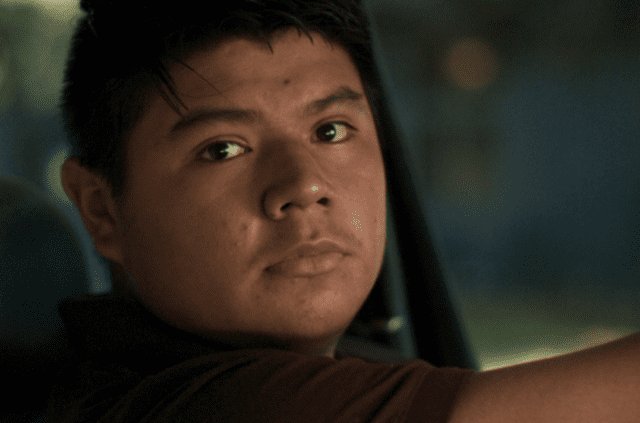
Pic courtesy of Grumpy Squared LLC
Back in 2012 director Rodrigo Reyes was the California court interpreter at the trial of 19-year old Sansón, accused of murder. After being found guilty he was sentenced to life in prison without parole. But Reyes was always troubled by the trial. “I never got to hear his story,” he says. “Everything was focused on a single moment, on the incident that brought him to court, but not on who he was or where he came from.”
Sansón always maintained that when he agreed to give his brother-in-law a lift he had no idea of the man’s murderous intent, nor that he was carrying a gun in the first place. But during the trial, these claims fell on deaf ears.
At the end of court proceedings, he graciously thanked Rodrigo Reyes for all his work. But as the director asks of Sansón in his notes: “Did he really deserve such a harsh sentence? Life without the possibility of parole? He was just a kid! And we didn’t know his story. Where did he come from? What did he live through? And what happened to bring him into this situation? I could not help but think that as a fellow Mexican, there but for the grace of God went I.”
Talking to Business Doc Europe, Reyes elaborates on the thoughts that were churning through his mind that day. “I felt very connected to him. I was the other Mexican in the room. I needed to know what got my countryman into that situation… When we talk about justice and about addressing issues in society we have to start looking at people as human beings, and tragically in the US we have these insane sentences that are just really inhumane, like what Sansón got, which was life without parole. In Europe, for instance, that doesn’t happen because there, there’s this concept of human rights.”
Reyes was determined to know more about Sansón, and after meeting him again decided to tell his story, which was one of poverty and discord in Mexico and a childhood lived ostensibly without a father. Even after his migration to the US the cards were always going to be stacked against him as an illegal immigrant. “Society had basically either ignored him or thrown the book at him—both Mexico and the USA had let him down. The idea for the film is really born out of the obstacles and limitations imposed by the criminal justice system,” notes Reyes, who was intent on “pushing the boundaries of cinematic imagination to rescue a young migrant’s story from oblivion.”
To tell the story of Sansón, Reyes cast a raft of actors. But, with one exception, none of these were professionals. Rather, they were the family of Sansón back in Mexico. His sister Débora played his mother, while his nephew Antonio played his younger self. His uncle Ramón played his father.
“I think there’s something really, really important in recognizing that Sansón’s story continues to exist in the world, that the conditions that took him into incarceration and broke his opportunities are still there,” says Reyes. “His family’s still living in that [place] where these problems exist.”
“At the same time to be able to celebrate his memories in his hometown with his family who are part of this history is so much richer than working with just actors who have no relationship to the story, who are trained and polished and taught to clean up the story. I think working with the family kept it very honest.”
The only exception was the professional casting of Gerardo Ryes (no relation to the director) who plays the adult Sansón.
Initially the business of shooting the film stirred up painful memories for the family, and for Sansón himself who temporarily called time on the project. But Reyes implored him not to lose faith in the film, assuring him that he would exercise extreme caution in future when dealing with family members. “Sansón was very generous about that. He taught me so much. I feel like he ended up mentoring me in this film, and taught me to be a better filmmaker,” admits Reyes.
In the film Sansón, the real version of whom we never see other than in a photo, is revealed as a writer of sensitive lyric in his letters to director Reyes. “My life is like a ballad that has already been sung,” he pens. “You keep going on your path, making other movies, and I’ll remain here in my cell. At least I know my story will escape, flying like a little bird.”
“I’m very, very proud of him” says Reyes. “He overcame some of the harshest obstacles. He has a terrible sentence. He’s been put in horrible prisons and yet he managed to rescue his own story and to transmit to me the poetry of his life. I feel like one of the reasons the film is so beautiful and poetic is because I wanted to honour him, to honour what he does in telling his story…He’s been an inspiration, and he rallied behind the film almost from the beginning.”
Before the world-premiere at Tribeca, the family saw the film at a private screening in their home town in Mexico, an experience that Reyes describes as “really wonderful.”
“They saw that Sansón had traversed all these borders and barriers to tell his story and to show them something really important about their family and about the potential for change,” the director stresses.
But Sansón himself will only get the chance to see the film once it airs on public television (Independent Lens) in 2023. “And all his friends and inmates in the block will watch it. And the same is gonna happen across hundreds of prisons in this country because there are so many Sansóns everywhere in the United States,” Reyes ends.
Sansón and Me is produced by Su Kim and is a co-production of Grumpy Squared, LLC Association with Latino Public Broadcasting, with funding provided by the Corporation for Public Broadcasting (CPB).





