

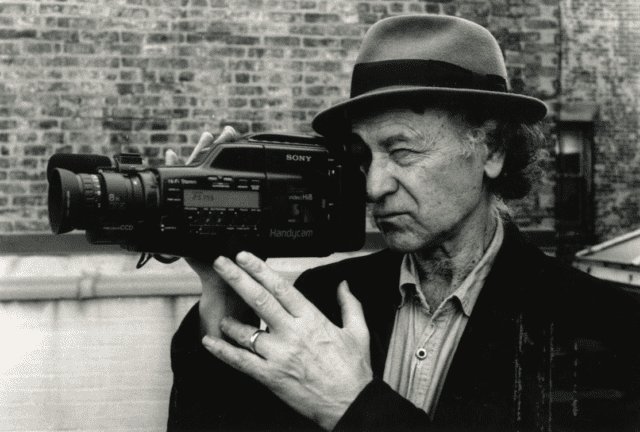
It’s the centenary of the birth of Jonas Mekas (1922-2019), US avant-garde cinema’s very own answer to Dick Whittington. The Lithuanian-born poet and his brother Adolfas arrived in New York in the late 1940s with nothing. They were young, near-destitute immigrants without obvious prospects and yet, within a few years, they had established themselves as key figures in the burgeoning New York underground arts scene.
Jonas was a networker and influencer extraordinaire. He met everyone. Having saved up to buy his first Bolex camera shortly after getting to the US, he began the prolific filmmaking career that would last the rest of his lifetime. While directing such personal works as Walden (1968) and The Brig (1964), he was also working feverishly as a curator and critic.
Merkas’ extraordinary story is told in KD Davison’s new documentary Fragments Of Paradise, world premiering in Venice Classics.
The documentary includes both excerpts from Mekas’ film diaries and interviews with some of the other directors and artists he inspired. John Waters, Martin Scorsese, the late Peter Bogdanovich, critic Amy Taubin, Jim Jarmusch and Marina Abramović are among the figures who appear.
Davison has been strongly influenced in her own filmmaking by Mekas. “I was born in Texas and I just escaped Texas as soon as I could when I was 18 and went to New York. I was studying political science and, in college, I decided I wanted to make films. I had no idea how to do that,” she recalls.
It was around this time Davison first visited the Anthology Film Archives, the film centre co-founded by Mekas in 1970.
“What should I do?” she asked him. “Don’t go to film school. Just make films,” came back the familiar advice which, she jokes, she “and thousands of people in the world who owe our careers to Jonas” also received.
Like many before her, Davison was completely won over by the sprightly and endearing guru of US underground film. Davison also met Mekas’ son, Sebastian, who became a friend.
The young director had been in working in LA in 2018/2019 and came back to New York just as Mekas, by then in his late 90s, fell sick. Friends pointed out to her that “there hadn’t been a proper biography done of Jonas’ life.” There had been various avant-garde films which touched on his life but nothing which told the whole story. “So we started trying to raise money for it and trying to work out how to do it.”
In the end, the film was financed by Kunhardt Film, the blue chip documentary company which has won multiple awards for previous projects like Lincoln’s Dilemma and The James Foley Story. Sebastian Mekas and his sister Oona Mekas came on board as executive producers.
“It has just been the opportunity of a lifetime,” Davison says of the project.
Not that this was a straightforward task. Mekas’ personal archive was vast. At one stage, he was making a new film every day. He kept everything – letters, diaries, contracts, tickets, film footage and videos.
“Shortly after he [Mekas] died, we went to his apartment to get a sense of the state of the archive and what the task at hand was…” she sighs as she remembers the “thousands and thousands of hours [of film], not to mention the photos and pieces of scrap [paper], materials from the time he arrived [in the US] and [about] the history of film that was happening in New York in that time.”
Mekas had even kept the scarf he was wearing when he left Lithuania during wartime. “He was just this incredible archivist and he kept all these handwritten notes in these reams of binders.”
At times, the director jokes, the project was more like an “archaeological dig” than making a conventional documentary. She spent “eight months consecutive, 12 to 15 hour days,” poring through the Mekas materials. In many of the films, the artist was speaking direct to camera. “I began to see that Jonas’s life work was about telling his own story.”
Davison has found one extraordinary sequence in which the normally affable Mekas is in shown in a state of existential despair, throwing his camera to the ground and then picking it up and continuing to film himself.
“I was so determined to watch everything we could get our hands on,” says Davison. “I had a sense that there was maybe a lot of stuff which didn’t make it into his pieces and I really wanted to show a side of Jonas that was complex and that audiences hadn’t seen before. I really did get the sense interviewing people over time that there was so many layers and that everybody got one specific layer…because he contained multitudes.”
It was typical of Mekas that he would record his own “dark night of the soul” in such a frank and uncompromising fashion. Davison saw this moment as “the emotional lynchpin” of the film. “It really highlighted to me how loss stayed with him over time.”
There had been huge emotional ruptures in Mekas’ life. He had to flee Lithuania in the war years. Years later, when he split up from his wife Hollis Melton in the early 2000s, he lost a home for a second time. He generally kept his feelings bottled up but, open this occasion, the raw grief and anguish are painfully obvious.
While making the documentary, Davison travelled to Lithuania, meeting both Mekas’ relatives and Vytautas Landsbergis, the politician credited as one of the founding fathers of modern, post-Soviet Lithuania. “His love and respect for Jonas was just incredible,” Davison says of Landsbergis, who knew Mekas’ poetry inside out.
Mekas’ yearning for his lost homeland was obvious. It was clear, though, that he also felt ambivalently about Lithuania. When Davison asked his friends and family why he didn’t come back to the country, they replied: “what would he come back to?”
“He had become a New Yorker. He really did embrace New York. One of the things he said throughout his life is that cinema became his home. That was how he created his roots. Art was that thing which gave him a sense of solidity and belonging,” Davison says.
The director points to the way that Mekas transformed not only the artistic scene in New York but also its property market. He was never wealthy himself and showed little interest in money. Nonetheless, in the mid-60s, he and his fellow Lithuanian emigré artist George Maciunas established an artists’ co-op in Wooster Street in Soho, New York.
“Jonas and George end up going into Soho…it’s just burned out industrial buildings in no man’s land. They get together $10,000 to buy this building. George is at the forefront of this and Jonas helps…they create what we know as Soho,” Davison says of their part in creating the area which became such a magnet first for artists and then for developers. (Nowadays, no artists other than the very richest can afford to live in those Soho lofts).
Mekas famously knew everyone from John Lennon and Yoko Ono to Andy Warhol. There was no sense, though, that he was drawn by their celebrity. “Again and again, when I talk to people about their connection to Jonas, it is really that he was so pure. It was clear that he was not a hanger-on…he wanted to help other artists and that just drew a community toward him. I think he was this incredible mixture of brilliance and authenticity,” Davison says of this magus of the New York art world whose story she tells in such sparkling fashion.
Fragments Of Paradise is sold by Cinetic. The documentary receives its world premiere in Venice on September 2.





