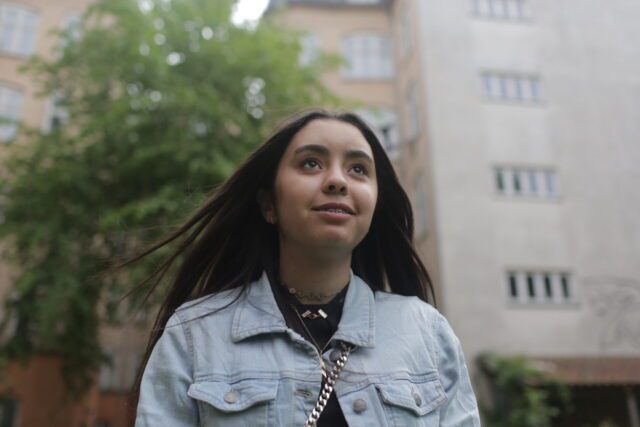
Rima, the protagonist of Louise Leth’s See Me As I Am, is funny, kind-hearted and relentlessly optimistic. She is also autistic. Leth’s film, screening in The New Nordic Voice competition at the Nordisk Panorama, will therefore surprise anyone expecting a downbeat documentary about isolation and suffering.
Leth first met her subject five years ago when Rima was singing in a music choir. The director remembers it seemed as if her “camera had a life of its own.” She had been researching a potential documentary about the choir but her attention kept on being drawn to the “smiling, charismatic” teenager with the big personality. She couldn’t help but notice that Rima’s mother, Fatme, waited for her every day after choir practice.
“That is when I realised the whole film should be about Rima,” the director says.
Rima didn’t conform at all to the stereotype of the loner with low social skills. “I thought someone with autism would not enjoy being with too many people. But very quickly I realised that Rima gets her energy and gets really inspired by being with other people,” Leth says. “When I met her, I didn’t think of her as a typical autistic young person. Also, I realised that in her picture of herself, autism wasn’t a big deal.”
That didn’t mean Rima’s life was easy. As the documentary shows, teachers and social workers aren’t sympathetic or imaginative in their approach to young people they perceive to be “different.” Her work as an intern at a nursery is cut short because the bosses think the job is “too much” for her.
The film isn’t just about Rima but about her mother, who is devoted to her. “They’re very open-hearted, Rima and her mum.”
Over the five years in which she made the documentary, Leth became part of the family too. She had many coffees with Rima, her mum and sister, “sitting talking to them about life,” sharing thoughts and experiences. “It was a relationship which built over those five years. Really, I became very good friends with them and their family. They really let me in, not only into their house but their lives and their hearts…it’s an ongoing friendship which hopefully will be for a lifetime.”
In order to get an “authentic view” of Rama’s life, Leth sometimes had to step back. For example, if Rima got lost on a bus journey or couldn’t find her way home, the director wouldn’t intervene to help her. “Of course, I was always keeping an eye [out]. If there was something dangerous, I would never let anything happen to her.”
During the time that Leth was making the documentary, Rima endured several “big bumps and setbacks.”
“It was important to let her experience life…of course, my presence might have helped her,” Leth observes. She was there as “a witness” who could intervene only if it was strictly necessary.
During the early stages of shooting, Leth envisaged the film would be shot “hand-held and very close” as she and Rima “hung out” together. Over time, the storytelling style developed. Cinematographer Maggie Olkuska had ideas about how the film could use “a more poetic language.”
The documentary shows many very intimate moments, for example the mother being taken to hospital. “To be so close to a mother/daughter relationship is really inspiring for me as a filmmaker,” the director says.
This is also a coming of age story in which audiences see the girl maturing and learning how to cope in an adult world. “Now, she [Rima] is very much stronger than she was five years ago.”
Leth has a background as a photojournalist. She is used to capturing “authentic” moments on camera. Nonetheless, she admits she was very nervous when she finally showed the film to Rima and her family.
“They were so quiet watching it. I was very nervous what Rima’s reaction would be but she looked at me, she cried and she said ‘thank you for making this film!’ And then she gave me a big hug. The family were sitting together and they gave each other a big family hug, holding each other for a long time.”
Since the documentary premiered at CPH:DOX in the spring, the feedback has been strongly positive. There has been an acknowledgement that Danish society needs “people with different diagnoses and different disabilities” to be integrated into the workforce and education system. “We have to open our eyes and hearts to what other people have to contribute,” the director states. “That is my main goal with the film, to make people realise that we can all contribute.”
See Me As I Am was produced through Elk Film with support from New Danish Screen and DR. In the early stages, Leth was working on the project entirely on her own. She had spent around 500 hours on the film before bringing in outside support. “I had filmed for two years before the producer and the Film Institute decided to collaborate.”
Leth works as a cinematographer on other filmmakers’ work, for example on the documentary TV series, Scandinavian Star. She also teaches and organises workshops about “how to integrate young people with disabilities” into the work and education system.
See Me As I Am screens in Malmö on Sunday, 25 September.