

Norwegian director Gunhild Westhagen Magnor remembers her profound shock when she watched television footage of Anders Behring Breivik, the deranged mass murderer who shot and killed 69 people at a summer youth camp.
“This trial against this person was actually running when I got my first child. I was sitting there with my new-born child and I was sort of desperate to find some answers. How can a person who once was an innocent little child like this end up doing something horrible like that,” the director asked herself.
In a very roundabout way, her questions about Breivik eventually inspired her documentary Budding Humans (screening in Best Nordic Documentary Competition at the Nordisk Panorama and sold by CAT&Docs).
Charming, playful and funny, the documentary is very far removed from the nightmarish world of Breivik. Nonetheless, it is asking searching questions about how little kids develop empathy and kindness; how they learn to cherish other human beings.
“After becoming a mum I have thought a lot about that in this turbulent world that we live in, I believe that the most important things we can teach our children is to build strong relationships, respect other people and develop empathy. And the fact is that in today’s society, we give so much responsibility for this to the kindergarten.”
In Norway, 95% of young kids go to kindergarten, most for five days a week and often for eight hours a day. “At least it is important to have enough resources to follow up the children in a good way, with enough skilled kindergarten employees,” Magnor notes.
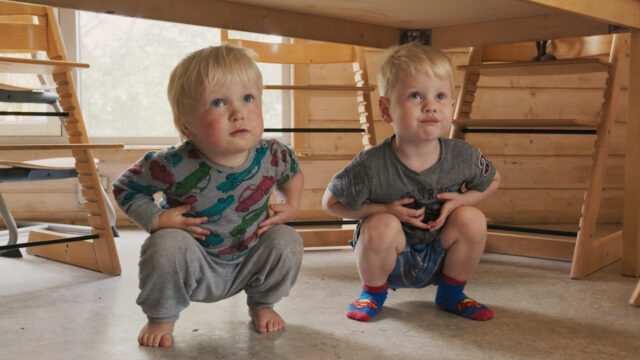
Her film follows two little boys at the same nursery who’ve become firm friends. The two-year-old kid, Balder, is the director’s son. The slightly older boy is called Haakon.
Staff at the kindergarten told Magnor that it was very unusual for children to develop such close bonds of friendship at such a young age. She immediately thought this could be the subject for a film.
“The very small steps they take in the kindergarten are so incredibly important. I am not sure if we, as a society, actually take this seriously enough. That is what I wanted to investigate and show through this friendship story.”
The boys are “very different in a way” but “have so much fun together” that they always want to be in each other’s company. When they were separated, Balder quickly grew bored and restless.
“When they are together, they are a bit partners in crime in a way.”
The first step was “all about trust.” Magnor had to convince the parents and workers at the municipal kindergarten to allow the cameras in. “This was quite a lot of work because they are very strict about filming in the kindergarten but since I had two children there, I knew the manager and I also knew some of the parents. There were about 70 children at the kindergarten at the time we shot the film and so I had to do a lot of work to inform them [the parents].”
Magnor began by shooting a pilot to give the parents and staff a sense of her intentions. This was well received and she was allowed to go ahead.
No, the director wasn’t the one filming her own son and his pal. As a mum, she knew she would feel an overwhelming urge to “interrupt” if the kids did something naughty. The idea was to study their behaviour, not to influence that behaviour. Her friend and colleague Gunhild Asting therefore shot the documentary alongside a sound recordist. Magnor, meanwhile, did all the planning.
“What was interesting was that the children very quickly accepted the fact that they [the crew] were just there, observing.”
It was a point of principle that the filmmakers would never intervene. The kids quickly accepted that they couldn’t ask them for help. Mics were hidden in discreet places to pick up sound, for example in the nappies.
There were times when, as Magnor puts it, “it was quite difficult” to be both the mum and the director. “Of course, my son is quite different at home than at the kindergarten and so, in a way, I felt I got to know him better. I was also quite proud because I think he is a good boy…[but] what surprised me the most was how little I know him. We think that we know everything about our children. We give away so much of the time that we could spend [with them]. I turn up at the kindergarten to pick them up and I don’t know anything of what they have gone through during the day – and they don’t have the language to tell me. Did I take the time to really see them and understand what they were going through. I don’t think we as parents really do that.”
200 hours of material were shot between 2016 and 2018. The director sometimes found it hard to watch the material. “In a way, I feel I have lost something about my children’s childhood.”
Friendship between two-year-olds turns out to be remarkably similar to friendship between adults, with the same tensions and misunderstandings.
Magnor hopes her documentary will be “an eye opener” which will encourage viewers to respect the children and to “take them more seriously.” Not that Budding Humans is intended to be too solemn. As in The Optimists, her 2013 film about elderly female volleyball players, the director uses plenty of humour. “For me the aim is always to inspire improvement. To achieve this, I put a lot of faith into the value of telling warm-hearted, often with humorous situations, and intimate stories that touch us and make us reflect on things,” she says of her upbeat approach.
The two boys are now eight-years-old. They’re still in touch although Manor and her family have now moved home. “Every time they meet, they still have this connection.”
And what does her son think about the documentary? “He thought it was funny and cool. He was quite proud but…in a way quite embarrassed, especially when he is acting badly toward others. Haakon had the same reaction.”





