

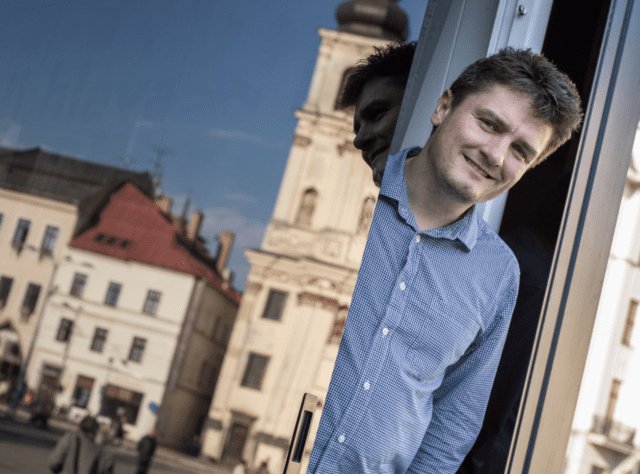
Ji.hlava IDFF director Marek Hovorka is very clear about why he and his team have chosen Oksana Moiseniuk’s The 8th Day Of The War as the opening film of the 26th edition, running from the 25-30 October. The festival always looks to back local filmmakers. “Oksana is Ukrainian but living in the Czech Republic,” Hovorka says of the film, which takes place on the eighth day of Russia’s war campaign in Ukraine.
The film looks at the lives of eight Ukrainians based in the Czech Republic. “I think it’s important not to forget what is happening,” the festival director reflects. “There were many films shot about the war and during the war, [but] this one is unique.”
As Moiseniuk commented at a recent press conference, at the time she started the documentary, she expected the war to end very quickly. Peace talks were under way. Nine months later, though, the war continues. Ukrainian emigrés and exiles struggle to make sense of the continuing catastrophic violence.
Ji.hlava IDFF is happening toward the end of a frantic month which has also included Doclisboa and DOK Leipzig. “It is obvious that October is a month for documentary!” the festival director quips.
Ji.hlava has stuck to the same dates in the calendar which are linked to school and university holidays. This year, there has been breathing space between the three festivals but Hovorka won’t be surprised if they again overlap in future editions, as they did in 2021. (Next year, Ji.hlava will run from 24-29 October).
One key theme of this year’s event – and the subject of a special conference later this week – is “Ethics in Documentary.” It’s hardly a new discussion. From the days of Robert Flaherty’s Nanook Of The North (1922) onward, there has been fierce debate about how documentary makers mould and manipulate reality.
“It’s nothing new…but in a way it’s very new in the context of our society after the pandemic,” Hovorka explains the decision to look again at the ethical dilemmas the doc makers face. “Much has changed in the discourse of society and also in professional communities. Before the pandemic, we were over oriented on success and growth. During the pandemic, we realised that is not the only thing we are living for.”
Well-being, the festival director continues, is “very much linked to ethics.” He believes that after #MeToo, “much has changed in thinking about responsibility and respect for those in front of the cameras.” There has been a reckoning for those in power positions. The debate has been further complicated by the economic crisis.
“Many institutions are cutting their budgets. Film funds are not supporting so much films…what does that mean?” Hovorka asks. Will technicians see their pay rates decline? Will ambitions to make the industry more diverse and inclusive be abandoned as everyone tries to cut costs?
These are some of the knotty questions that the ethics conference will be trying to untangle.
At the start of the Ukrainian war, Ukrainian filmmakers called on festivals not to show Russian movies. This, Hovorka believes, “opened a huge discussion but it also showed the power of curators.” Another question which will be hotly debated throughout this year’s Ji.hlava event is the “position of curators during times of conflict.”
What is Hovorka’s own stance on the Russian question? “We discussed this of course and we decided we are open to screen Russian films if it brings something new in our context.”
The festival director notes that Ji.hlava is far closer to Russia and Ukraine than western European festivals. This gives the discussions an added intensity.
Ji.hlava is not frightened to deal with taboo topics. Back in August, the Toronto International Film Festival pulled its planned screening of Austrian director Ulrich Seidl’s Sparta after allegations of child exploitation were levelled at Seidl.
In spite of the controversy at TIFF, Hovorka and his team still plan to show Sparta this week. “In the end, we decided we do not want to ban the film but we want to screen it and use it as a continuation of the discussion [on ethics].”
The programming of Sparta also points to another dimension of the programming strategy. Seidl’s film isn’t strictly speaking a documentary at all. However, Ji.hlava has also been ready to blur lines and to include experimental and dramatic work alongside more traditional verité elements.
“We try always to find the documentary aspect in art in general,” Hovorka says of the festival’s approach. He cites competition titles like US director Emily Kaye Allen’s Cisco Kid, set in a ghost town in the desert, or Mattia Petullà and Giulia Angrisani’s Terra In Vista, a Belgian doc about seasonal farm workers, or Jaro Vojtek’s The Shift, about Slovakian workers taking employment opportunities across the EU, as examples of other documentaries structured very like fiction films.
The festival received over 3000 submissions this year, a higher figure even than pre-pandemic.
“It’s not only about numbers but the quality of films submitted was really high. The reason I think is that some filmmakers postponed their films; they didn’t rush their post-production and they took the time to edit. Also, I think the pandemic was a time for developing their ideas and shooting them afterwards. There are the two reasons why documentary now is so strong. I think documentary is the most vivid part of cinema at the moment.”
Ji.hlava remains “very much orientated on first and second-time filmmakers and on those who are trying to be brave and to experiment with cinema.”
Hovorka describes his festival as “a documentary Woodstock.” It may now be 26 years old but it still has the same freewheeling idealism that characterised the event when it was launched in 1997. As René Kubášek, head of International Relations, observes, the atmosphere in town during festival week is unique. “It’s the very informal atmosphere of the festival which many people talk about. There is no red carpet, no exclusivity. You meet famous filmmakers right in the centre [of town]. Filmmakers have dialogue over a glass of beer and wine…”





