

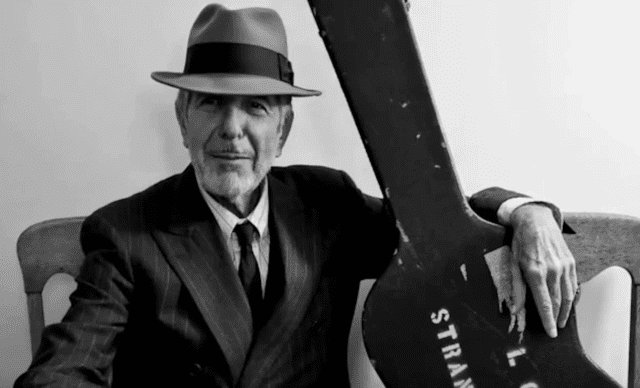
‘Hallelujah’ was a song seven years in the making, filling numerous notebooks that are, in themselves, replete with corrections and alternations, line by line, stanza by stanza. The version we all know is creatively audacious, telling of a baffled King David who pleases the Lord with a song whose ascending musical notation is described in lyric – the fourth, the fifth, the minor fall, the major lift. And that’s just the first verse. After that comes the ‘naughty’ stuff, the kitchen chair, the bathing on the roof, the tying up et al.
In Dan Geller & Dayna Goldfine’s Hallelujah: Leonard Cohen, A Journey, A Song (sold by Dogwoof), journalist Larry ‘Ratso’ Sloman describes the song as one part biblical, one part the woman that Cohen slept with last night. Cohen himself places the song into more temporal, cultural, even linguistic, contexts. ‘Hallelujah’ is a word both rich and abundant in resources, he suggests. “People have been singing that word for thousands of years just to affirm our little turn here,” he says in the film.
“Within every couplet of the song, there are indications that contradict one another or build on each other, really from the beginning,” says co-director Geller. “Because that song is so complex and it’s such a reflection of the man, but also a gesture to everyone’s passage through life, of certainty and doubt,…we knew from the very beginning that it [the film] would be a twin study of Leonard the spiritual seeker and the song as a spiritual rorschach [a kind of test] for those who encounter it.”
The initial idea for a documentary about a song was suggested to the filmmakers by critic and academic David Thomson over dinner one evening. On the way home, Geller and Goldfine, themselves avowed fans of Leonard Cohen whom they had seen twice on his world tour, knew instinctively that ‘Hallelujah’ could sustain a feature-length doc, a view confirmed by their discovery of Alan Light’s 288-page book on the subject: ‘The Holy Or the Broken: Leonard Cohen, Jeff Buckley, and the Unlikely Ascent of Hallelujah.’
“Leonard Cohen as a topic is so rich,” adds co-director Goldfine. “We deeply believe that he was the only human in the universe who could have come up with that particular song and then continue to revise it and address its themes for umpteen years.”
In the film we are told of Cohen’s career in music, an industry he entered at the ripe old age of 30, having cut his teeth as a poet and novelist. Coming from a bourgeois background in Westmount, Quebec, his Jewishness [referred to in the film as a ‘tradition created by words’] informed much of his work despite his embrace and espousal of secularism. At the beginning of his career he formed a close friendship with folk doyenne Judy Collins (interviewed in the film), who both recorded his classic song ‘Suzanne’ and encouraged him to overcome initial stage fright.
But all the time, he was embarking on a spiritual quest. Life for him was both a purgatory and an experiment, tells a friend in the film, and there was always ‘something inside him that could be mended,’ we are further told. He was also a ladies man who had a certain effect on female interviewers, as we see regularly in the film.
Ironically, Various Positions, the album that contained ‘Hallelujah’, was rejected by Columbia, Cohen’s publishers. “We know you’re great, but we don’t know if you’re any good,” said the company MD by way of explanation.
Cohen was crushed but maintained “an unshakeable belief in his strength.” But after the album was picked up by a small label (Passport Records) the song ‘Hallelujah’ found the ears of no less a musical deity than Bob Dylan, who played it in his live set.
Yet all the time Cohen tinkered with his masterpiece, adding and subtracting lines and verses, seeking improvement, at times veering away from the divine into the realms of the secular. Journalist Ratso Sloman estimates that the eventual number of stanzas totals 180, although director Geller disagrees.
“It’s an accounting question because he had many versions of the same line,” he says. “In that sense there are easily several hundred lines, and of course we’ve seen a tremendous number of them through [Cohen’s] notebooks that we were privileged to have
access to.”
A 1991 tribute album to Cohen [I’m Your Fan] heralded a new version of the song, recorded by The Velvet Underground’s John Cale using just voice and solo piano, which opened it up to wider audiences. In 1994 it was picked up and recorded by Jeff Buckley whose angelic version is still considered the industry standard (although Buckley feared Cohen hearing it as he felt “like a little boy singing it.”)
A highly sanitized version of the song featured in the motion picture Shrek, whose soundtrack sold 2.5 million copies, at which point its popularity was assured. ‘Hallelujah’ subsequently became the go-to ballad for aspiring songsters on the likes of X-Factor and American Idol, with Alexander Burke and Jeff Buckley’s versions going to numbers one and two respectively in the US Billboard chart in 2008.
Are filmmakers Geller and Dayna Goldfine themselves fans of the song? “I guess it’s a more complex way of answering your question to say that I love the song, but not every performance of the song,” responds Goldfine. “I think so much depends on the motives for singing the song and the sincerity of the person. I find the song fascinating because it did shapeshift over time and it was amazing to get to look at Leonard’s notebooks and see, as he even says in the film, that he wanted it to become a secular song after a certain number of years had passed with the King David version.”
“Maybe the true question should be, is it a song that, at the end of six years of working with, I still like, and the answer is yes, from the beginning and all the way through, because it just keeps offering itself up,” adds Geller. “Different by the day, by the performance…or whatever’s happening in my life, there are different stanzas that reach out. Musically, it seems like a simple song, but it has this almost cantatorial power of a Jewish prayer that becomes beautifully hypnotic. And then of course it ascends in that chorus, which…hits in such a deeply felt emotional way that I never get tired of hearing [it].”
Geller further points out that the process of making the film dispelled the popular misconception (one that he had originally harboured) of Cohen as a dour depressive.
“Watching him perform, there’s such a lightness and enjoyment in what he was doing. And interestingly, [there is] his really devilish wonderful sense of humor,” he adds. Geller cites a passage in the film where Cohen is being asked about his wife Suzanne, who is not the same Suzanne who inspired the famous ballad. “It’s such a Leonard way of answering, that little bit of drawl rejoinder, where he says, ‘Ah, I must have summoned her.’ I mean, that’s just Leonard in a nutshell.”
Astonishing attention to detail is something you might be able to get away with a song, but can you apply the same method to documentary? “I’m not embarrassed to say it took us two years to edit this film. It’s a lot of trial and error, and I felt gratified every time I saw one of Leonard’s words scratched out and then another ten put in,” answers Goldfine. “That’s kind of where our Leonard Cohen-like revisions and super revisions take place.”
“We refine, refine, refine but once it’s done (because it’s not a performance form of art) it’s out there and that’s it,” concludes Geller. “And we don’t go back – and that’s both the blessing and the curse.”
This interview was first published in Business Doc Europe before the film’s world premiere at Venice 2021.





