

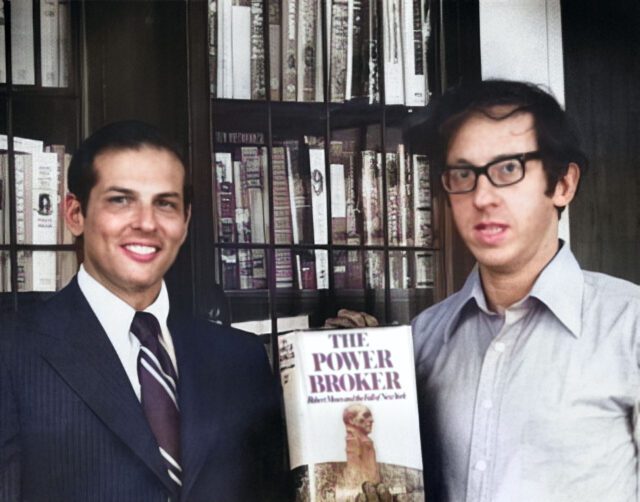
One man is in his 80s. The other is in his early 90s. They’re one of American literature’s great double acts. Robert Caro, 87, is still labouring to finish his monumental, multi-volume biography of Lyndon Johnson. Robert Gottlieb, 91, is a former editor of the New Yorker and an acclaimed author in his own right but he is most celebrated for his work in publishing. Gottlieb has edited many modern-day classic books from writers including Joseph Heller, Toni Morrison, Doris Lessing, Nora Ephron and John Le Carré. For half a century, he has been Caro’s editor.
Caro and Gottlieb are both passionate about their work. They have strong opinions and sometimes fall out over such matters as punctuation and adjectives. Nonetheless, their partnership has assumed a near legendary status. The story of their collaboration is told in Turn Every Page, the award contending feature documentary directed by Gottlieb’s daughter, Lizzie Gottlieb, and which premiered at the Tribeca Festival.
When Lizzie Gottlieb was growing up, world famous authors were regularly passing in and out of the house. “So many of my father’s writers were close, close family friends,” the director remembers the constant dinners, Christmas and Thanksgiving celebrations which these world famous writers would attend.
“In retrospect it was incredible, but at the time it seemed normal,” she says. “Not to be name droppy, but Nora Ephron came for Christmas every year; Joe Heller gave me my favourite teddy bear and I remember Sidney Poitier coming over and lying on the floor when my mum read me bedtime stories. I remember going to the beach with Toni Morrison but it didn’t seem unusual to me. These were just my extended family.”
Caro, though, never turned up at any of these social gatherings. Lizzie didn’t meet him for the first time until a decade ago, when she threw an 80th birthday party for her father.
“At this party, a man came up to me. I live in Brooklyn. He asked me about this giant new development, the Barclays Centre, and how it was going to change the neighbourhood. I started spouting, I don’t know what, really uninformed opinion,” Gottlieb remembers. “Suddenly, mid-conversation, I thought ‘I think I’m talking to Robert Caro!’”
Nobody knows more about urban planning than Caro. His classic 1974 book ‘The Power Broker,’ about New York town planner Robert Moses, goes into forensic detail about all the dirty deals cut to get roads and bridges built in the Big Apple – and about the thousands of families who lost their homes as a result.
Gottlieb later heard Caro give a speech at an event where her father was being given an award. The author paid tribute to his editor, reflecting on the [then] 45 years that they had been “working and fighting together.” Someone in the audience asked what they fought about. Caro replied sternly: “we have very different feelings about the semi-colon.”
This was the inspiration for the documentary.
“It was really that moment when I thought, oh, this is fascinating. I don’t know anything about this and I don’t think anybody else knows anything about this,” Gottlieb says.
When Caro was working on ‘The Power Broker,’ Robert Gottlieb famously helped him cut 300,000 words from the original manuscript. The book was over a million words long and needed to be trimmed for the simple reason that it would have been too heavy to bind properly. Lizzie Gottlieb was a toddler during this period. “I may have drawn pictures on the back of some of those manuscript pages,” she says of the material that was excised. “Our house always had drawers with discarded manuscript pages in them to use for art projects.”
Gottlieb was in her early 20s when she finally read ‘The Power Broker’ and was “completely blown away” by it. She confides that she hadn’t read the Johnson biography when she started the documentary but she has caught up on it now. “They are just page turners. Once you start reading them, you’re completely gripped and you can’t put them down,” she enthuses about Caro’s books.
This may be a film about literary heavyweights but it has a light and playful quality.
“I did not want to make a homage. Of course, I have unbelievable respect for them [Caro and Robert Gottlieb] but I wanted it to feel like a buddy film, an adventure story with these two guys,” Gottlieb reflects. “And I wanted it to be appealing to huge Caro fans and people who had never heard of Robert Caro or Robert Moses, or knew little about Lyndon Johnson and had certainly never heard of my father.”
It helped that her father had an obvious sense of humour. “Bob Caro is more serious and has a gracious quality but I thought that the difference between them is charming and irresistible…and they’re funny men. They are fun to be around.”
The two men may be old but they’re as busy now as ever. They are in a race against time to finish their lives’ work. That means the film has “a forward momentum.” It’s not an exercise in nostalgia.
Gottlieb produced the documentary herself with her producing partners, Joanne Nerenberg and Jen Small. She describes the project as “a kitchen table film…we plunged into this film with absolutely nothing.” Her cinematographer, W. Mott Hupfel III, a close friend, agreed to shoot it for free. Work began seven years ago. “You can’t make a film about Robert Caro quickly,” director Gottlieb jokes of the author who has spent more than 40 years on his Johnson biography. Eventually, she cut a “sizzle reel.” This was enough to attract Topic Studio as financier and producer. At around the time of the Tribeca Premiere, Sony Pictures Classics took worldwide rights to the film.
“I seem to make films very slowly,” Gottlieb again refers to the length of time it has taken to complete Turn Every Page. She is a theatre director and teaches documentary filmmaking at New York Film Academy as well as making her own films.
Gottlieb didn’t show Caro or her father “cuts along the way.” However, she was keen to find out if they would be upset by anything. She therefore arranged for her father to watch it on his desktop computer as she sat behind him. She was terrified but he “loved it.” She sent Caro a link. That created challenges in itself. Caro still writes long hand and on his typewriter. Eventually, he worked out how to open the link. He too gave the film his blessing but asked her to come out to the Hamptons to do an additional interview about his writing.
“Of course, he’s Robert Caro. He knows exactly what he is talking about when it comes to storytelling. He was right. We ended up adding a few minutes but it was wonderful…,” Gottlieb signs off.





