

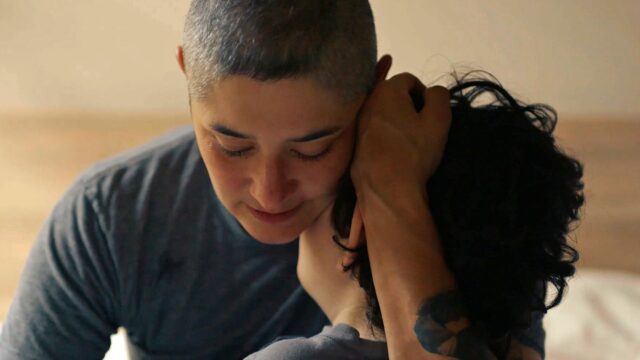
Holding Moses, shortlisted for the Short Documentary Oscar, is a deeply personal project for filmmaker Rivkah Beth Medow, she explains to Business Doc Europe. It follows Medow’s partner, dancer Randi Rader, as she learns to live with her young son’s severe disability. Medow directed the film alongside Jen Rainin with whom she founded Frankly Speaking Films.
“Jen and I are really, really collaborative. We have an incredibly deep trust,” Medow says of the collaboration with co-director Rainin. “This project started from a really personal place. I am still going through a grief that is difficult to manage and so I was looking at Randi’s experience as a possible guide as to how I might navigate it.”
The first step was to record an audio interview with Randi. At that stage, Medow wasn’t sure whether she would even go on to make a documentary. Her intention was simply to discover how Randi had coped after she discovered her little boy Moses was suffering from Phelan-McDermid Syndrome, a life-changing genetic disorder.
“As soon as I put that together, the first person I sent it to was Jen because I needed some perspective on it.”
Co-director Rainin remembers that this was early during the first 2020 Covid lockdown, “a very, very strange and tense time in the world.” The two women were in different bubbles. That meant they couldn’t meet up. However, when she received the audio recording and listened to Randi with her eyes closed, she was deeply moved.
“I started crying and I thought, oh my god, this is a really powerful story. And I started imagining how we could turn this into a really powerful film.”
Rainin immediately called Medow. “We then spent the next year, talking [it] through and creating visuals that would help bring the audience into Randi’s internal experience.”
Covid prevented Rainin from attending the early shoots. Medow and the cinematographer Clare Major would film and send the dailies to Rainin. They would then talk through the material together. They were helped in moulding the story by their award-winning editor, Greg O’Toole.
Movement is central to the film. Randi performed as a dancer for several years in the Broadway musical, Stomp. “When I looked at the transcript, it was so clear that Randi’s dance training was what she leaned into in order to connect with Moses. Moses is largely non-verbal but he communicates so clearly,” Medow observes.
Mother and son move in harmony together. They have a natural physical rapport. “When I met Moses, I guess he was 5, almost 6. I saw them a few years after they had found some of their rhythms together,” Medow says. “We needed a device to reflect Randi’s inner emotional experience. We wanted this film to be very experiential.”
Rainin talks about the way Randi “experiences the world through her body.” There was a “dramatic shift” in the patterns of her life after Moses was born. She became a caregiver.
“It left her in a place where she wasn’t stable, she wasn’t on her feet,” Rainin adds. Gradually, though, she was able to overcome her misgivings and despair and to find joy in her relationship with Moses.
This is not one of those earnest documentaries which bombard audiences with facts and figures about disability. The film takes a poetic and emotional approach to its material.
To show the passage of time, the filmmakers concentrate on the changing seasons. One of the most striking sequences in the film shows Randi dancing in slow motion in the rain. The scene was shot on the day of Medow’s birthday. She happened to have a camera with her. They were getting ready to leave Randi’s house for a birthday lunch when, all of a sudden, a freak hailstorm began. Medow asked Randi to go outside and dance. At first Randi was startled by the request but she quickly agreed. “She’s game for just about everything. She went outside and danced for about an hour in hail. We were so lucky to capture that.”
Frankly Speaking Film was set up by Rainin and Medow in 2020 as a queer activist film production company. Its feature doc Ahead Of The Curve, which they co-directed, profiled Franco Stevens, founder of Curve, the “best selling lesbian magazine in the world” (as Rainin describes it). Stevens also happens to be Rainin’s wife.
“Her story hadn’t been told. Not only had her story never been told, most people in the mainstream media had never heard of her. She’s a bit of a celebrity in the lesbian community but most folk haven’t heard of her,” Rainin says of Stevens. “And most folks haven’t heard of most lesbians in history and queer women and non-binary people. We often are ignored or invisiblised or just peripheral characters in the service of men generally.”
Stevens has devoted her career to “lifting up queer women’s voices” and telling their stories. Now, Rainin and Medow are striving to do the same with their film projects. As they also point out, it is very rare for “a non-binary queer mother “ like Randi to be the subject of a film.
Holding Moses is available for anyone to watch on the New Yorker platform. It qualified for the Oscar hunt by winning awards at various festivals. “It was hard to get people to programme the film but once they did, it seemed to be a beloved experience,” Rainin says of the warm response the documentary has received wherever it has played.
The two filmmakers have various new projects in development, among them a fiction feature called American Dog, about a lesbian cop, which they will produce and which will be directed by Tom E. Brown.
“It is a project that is very aligned with the Frankly Speaking Films mission to tell mesmerising stories that centre on queer women and non-binary people because there aren’t enough of those stories. There just are not,” Rainin emphasises a situation that she is determined to change.





