

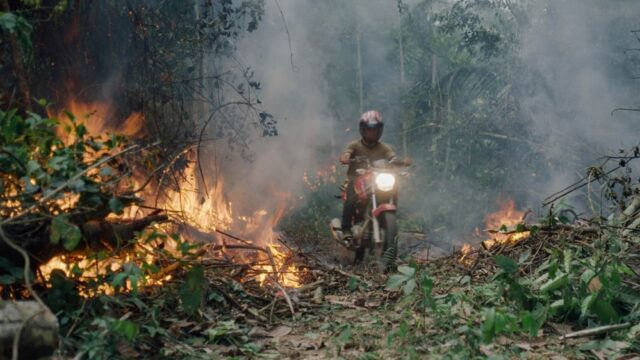
It’s a year now since US director Alex Pritz’s Oscar contender The Territory premiered to rave reviews at the Sundance Festival. The film, which was picked up by National Geographic, explores the conflict between the indigenous Uru-eu-wau-wau people in the Brazilian Amazon rainforest and the settlers who want to cut down the trees and seize their land.
Back in January 2022 when the film was first seen, the right-wing populist Jair Bolsanaro was still President of Brazil – and he was no friend to the Uru-eu-wau-wau people. Now, the leftist Luiz Inacio Lula da Silva is back in power. That, one imagines, ought to make life much, much easier for the indigenous communities.
As Pritz explains, it’s not that simple.
“The tone has changed really dramatically, In Lula’s first few days in office, he has reversed a lot of Bolsonaro’s most harmful policies. He has set up a ministry for indigenous people led by an indigenous woman,” Pritz lists the many positive changes at the Federal level. However, at the local level, for the Uru-eu-wau-wau characters we see in the documentary, many problems remain.
“For people like Bitaté and Neidinha in our film, the fight is as real as ever. 80% of people in their home state voted for Bolsanaro.”
The settlers may have guns but the Uru-eu-wau-wau people now have cameras and know how to use them. They shot part of the documentary and are still continuing to film.
Anyone who has watched an old Hollywood western will recognise the dynamic at play in The Territory. The settlers are the equivalents of the old pioneers in their covered wagons. They feel it is God’s wish for them to be allowed to build homes in the forests.
“We tried to incorporate the fact that these settlers see themselves as an extension of the American colonial project, the ideas of manifest destiny, divine right to the land, the Christian doctrine of discovery set 400 or 450 years ago that led to the Portuguese originally colonising Brazil. All of these ideas have their roots in this colonial apparatus,” Pritz argues. “We wanted to take that visual language, that aesthetic, and to incorporate it into our film wherever possible.”
Pritz talks of “flipping” the problematic parts of the western genre on their head. “The indigenous people are not naive. They are politically aware, technologically savvy and the naive people are the settlers who don’t understand the consequences of the action.”
Not that the settlers are demonised. They’re portrayed in depth and allowed to express their visions and goals.
“We built a very real relationship with these settlers. I see them as real people. They aren’t storybook villains, they’re not cartoon characters,” the director reflects. “These people have been dealt a wretched hand. They’re poor, landless people, fighting to create something better for their families. I was actually quite sympathetic to them. I think it has been the success of these populist governments in Brazil to convince poor disenfranchised people that other poor, marginalised people are their enemies.”
There are some cruel ironies here. The settlers see themselves as heroes and think they should be celebrated for going out and developing the rainforest. They seem oblivious to the destruction they are leaving in their wake.
The settlers who’ve seen the film, or parts of it, have generally been happy with the accuracy in which Pritz represented their lives.
There were obvious ethical dilemmas for Pritz himself in coming to the forests to make The Territory. He’s a white filmmaker. As the documentary reveals, the whites have brought death and disease to the Uru-eu-wau-wau community since they arrived in the early 1980s.
Is this even his story to tell? “It’s a question I welcome,” he responds. “The film deals with representation and the idea of narrative sovereignty – who is telling whose story, that is part of our film.”
When he first embarked on The Territory, Pritz encountered scepticism wherever he went. In the end, though, he won the Uru-eu-wau-wau people over. “I don’t think I have any right to their story. There’s no part of me that feels I deserve to be able to tell this story. What we did was come in, do a lot of listening and spend a lot of time trying to understand the community and their priorities and their needs.”
The project turned into a co-production with the community. The indigenous people not only helped make the movie. They were given their fair share of the profits.
Among the producers were some very big names, notably Darren Aronofsky, director of such movies as Black Swan and Requiem For A Dream.
“We made the film totally independently. We went to Sundance without a distributor,” Pritz notes. “We wrote hundreds of grants applications. The team was built slowly, piece by piece. Darren Aronofsky was actually the first of those bigger people to come on. When he came on, he was the only person in our team who had ever made a feature film before.”
Trying to raise finance, Pritz had done the round of documentary pitching events, visiting Sheffield MeetMarket and IFP Week in New York. It was at the latter that he first met members of Aronofsky’s team.
Pritz is at pains to point out that this isn’t a polemical movie. Alongside the ongoing story about the fight for the land, he includes stunning imagery of the rainforest. We see many varieties of birds and insects.
“The forest is incredibly beautiful. It’s one of the mist biodiverse areas in the planet. What struck me about it is how much we still don’t know about it. They discover a new species in the Amazon rainforest every two days,” he marvels.
The score was built out of the sounds of animals calls and indigenous instruments. (The composer was Katya Mihailova). “We tried to make it a warm, enveloping hug to be in the rainforest…a lot of the time, the rainforest can be depicted in film as dark, mysterious and dangerous…we wanted it to feel like home!”
But yes, Pritz does admire Werner Herzog films like Aguirre: The Wrath Of God and Fitzcarraldo about mad explorers and visionaries. There’s actually a Herzog link in The Territory. The archive 16mm footage of the first contact between the Uru-eu-wau-wau people and the Brazilian government in 1981 is also used in the German director’s 10-minute short, Ten Thousand Years Older.
The director pays tribute to Bitaté, the young prodigy who became leader of the Uru-eu-wau-wau as an 18 year old, “the youngest leader they have ever had.” Not only is he one of the doc’s main protagonists, he was to become the first member of the community to go to university, studying journalism. He also became an expert filmmaker.
Since its Sundance premiere, the film, produced by Aronofsky, Will N. Miller, Sigrid Dyekjær, Lizzie Gillett and Gabriel Uchida, has travelled to over 120 festivals. It was screened theatrically in Brazil a few weeks before the election – and so became part of the national debate around Bolsonaro’s legacy. It has even showed in Brussels to 150 members of the EU Parliament.“It’s an emotional film, it’s a character-driven film…but it is able to enter these political spaces and open up conversations in a way that I didn’t expect it would,” Pritz concludes.





