

Give credit to NASA [The National Aeronautics and Space Administration]. Every time there is a new space programme or mission to Mars, the organisation will make sure there is someone with a camera filming the scientists and engineers at moments of maximum stress and excitement in the control room.
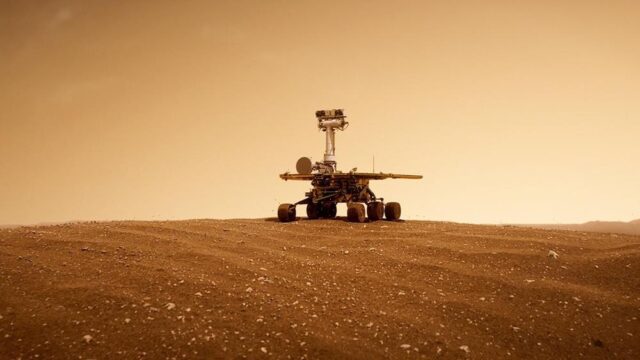
This footage is crucial to US director Ryan White’s new feature documentary Good Night Oppy, released by Amazon. The film tells the story of the two robot rovers, Opportunity [“Oppy’] and Spirit sent to Mars in 2003 on what was originally intended to be a 90-day fact-finding tour of the red planet. They were there for very much longer than that.
“They [NASA] are smart enough to understand the importance of future storytelling about their missions. They often have embedded camera crews on these missions,” comments director White, who began making his film in 2020. It was pitched to him by Peter Berg’s Film 45 and Steven Spielberg’s Amblin. “They had got access to the archive of Spirit and Opportunity’s life which is almost 1000 hours of footage,” White explains.
The director’s previous films, which include documentaries about sex therapist Dr Ruth and tennis star Serena Williams, had been very different. However, as a self-confessed “space geek” whose favourite film was Spielberg’s ET, this was a dream project. He’d be working both with Spielberg’s company and with George Lucas’ Industrial Light & Magic (who provided the extraordinary visual effects for the film).
Spirit and Opportunity stayed “alive” for years. “I think as they [the robots rovers] continued to outlast the odds, NASA started to realise they can’t have a camera there every day. It might have ended up being decades. They were bringing the camera back for pivotal moments.”
There’s a poignance to the film because it’s not just the robots who are ageing. Audiences also see 20 years pass in the lives of the NASA staff members. Teenage observers who were allowed in two decades ago to witness the scientists at work are now mothers with their own children. Some have gone on to become lead scientists in the programme.
The scientists and engineers can’t help but anthropomorphise the robots. They regard them with the same pride and apprehension that parents show to their kids. Did White himself have the same affection for two robots. And, if so, did he prefer one over the other?
“I love Spirit!” White protests at the very idea that Opportunity was his favourite. Oppy, though, stuck around for longer (by several years) and tended to be less troublesome. She also communicated in a heart-tugging way which is likely to remind viewers of Pixar’s Wall-E. “My battery is low and it is getting dark,” was one of her forlorn final messages.
“That went viral on Twitter. I remember seeing that and being really emotionally impacted by that,” White remembers a period long before he came on board to direct.
The director acknowledges that his earlier documentaries have been “all over the place” in terms of story and style. “But they are all character-based films. I can’t make a film unless I establish a connection to the characters at the centre of that. This was the first time my film was about non-humans but it was the same – I treated it like any of my character-based films.”
The robot rovers are both gendered female. “I think that is derived from exploration, the history of ships,” the director says. “At least when I’ve asked people at NASA, that is where they think it comes from.”
Good Night Oppy is in the running for awards this year. So is Margaret Brown’s Descendant, telling the story behind the last slave ship to carry African captives to the US. White is given a “special thanks” in the credits to Brown’s film.
“Margaret is one of my best friends,” White explains the connection with his fellow Oscar contender. “She would get a ‘special thanks’ in most of my films because she watches most of my films – and vice versa. We’re a small community of documentary makers so we have to rely on one another for notes or advice or to share our sob stories.” They are cheerleaders for each other movies. Both are southern. Brown is from Alabama, White from Georgia. They first met at a bar around a decade ago when they were on the awards trail. “We both hated talking about our own films and made a deal that we would talk about each other’s films as we went around the room.”
Steven Spielberg wasn’t directly involved in Good Night Oppy but, at one stage, did send White notes. “They were wonderful and he loved the film. But he is a director and I think he understands other directors,” White says. “But the fact he loved the film makes me very proud. In its tone, it is very Spielbergian. I think that is why Amblin wanted to make this film.”
The director pays tribute to the work done by George Lucas’ Industrial Light & Magic in creating “a photo-real Mars.” “The biggest compliment has come from the people at NASA who’ve said they’ve never seen Mars on video look so real,” the director says.
As a kid, White also liked Stars Wars and Star Trek but was more “into real missions.” “I was a total space nerd in that I followed all the missions and I wanted to be an astronaut growing up,” he says.
As a boy in Georgia, he felt that going to Mars wasn’t a viable career option. He didn’t have any contacts working in space exploration. So making the documentary has been the next best thing. “My favourite part about my job is that it allows me to get in rooms where I should never be in because I am not an expert in these things,” White says. “I always knew I wanted to make a space film.”
The director was heartened too by the characters he encountered at NASA. Many were outsiders from backgrounds not that much different to his own. “It was not just Americans but people from all over the world who end up on these missions. It was very important to find faces and stories that were representative of the entire world.”
White had a “preconceived idea that scientists would probably not be the most compelling storytellers.” As it turned out, though, his NASA protagonists turned out to be colourful, eccentric and highly opinionated.
His hope now is that little girls in far flung places might see the film and decide that they want to work on space missions. It’s not an impossible dream after all. They can emulate the woman from India in the documentary who was given a book about space exploration when she was five and now is head of robotics at NASA and spends her days driving rovers on Mars.
“We weren’t making a kids’ movie for sure but we wanted to make a film that children could watch and be inspired by,” White says.
The emotion in the documentary comes as a surprise. Opportunity and Spirit are (as White puts it) “just a box of wires.” Nonetheless, the NASA scientists behind the mission and the audiences watching Goodnight Oppy form a huge attachment to the robots. They project their own hopes and fears on to the two rovers. The film therefore turns into an unlikely tearjerker, one which awards voters may found hard to resist.
But, no, White won’t be making a sequel about Perseverance, the robot currently in residence on the red planet. “I would love to make another space film and I would love to go to space,” he says. “With Perseverance, I am definitely following her mission but her life expectancy is very different because Perseverance and Curiosity [the other robot] are not solar powered. They have nuclear batteries and they could last a very long time; they could outlive us…”





