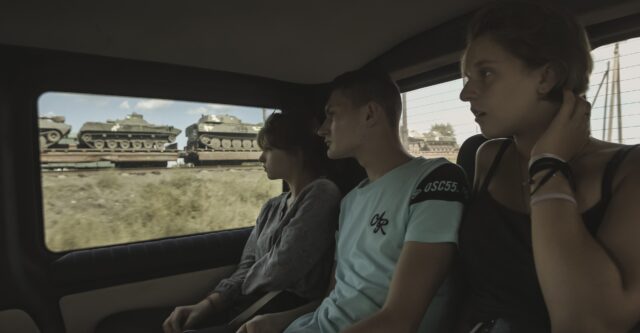
Back in 2018 Ukrainian filmmaker Alisa Kovalenko met with explorer Valentyn Shcherbatzhen who told her of his “incredible dream” to elevate five teenagers out of the war zone in Eastern Ukraine and send them on an expedition to the Himalayas.
The five teenagers, three boys and two girls, that the project settled on are diverse in outlook and interests, but united in setting their sights beyond than their immediate horizons.
Andrij could be in a boy band, but is instead sent down the mine to dig for coal. In his spare time he raps. “I will not fade away, and burst into the glowing sunset,” is the line that suggested the film’s title. Illia is gentle and wants to be an actor. “If not, you’ll be a policeman,” his grandmother gently chides him.
Ruslan, meanwhile, is obsessed by motorbikes and adores Elon Musk. That said, he gets little sympathy from a father who continually calls him “stupid” and a “moron.” Lera wants to get away from the area as soon as is possible, and spray paints her dissatisfactions on walls. She wants to live in Kyiv as a photographer. Likewise, Liza has an artistic, bookish, hippy vibe and speaks with a high degree of lyricism of the dreams she harbours.
The film’s soundtrack is filled with distant gunfire and shelling, and columns of smoke are always seen blocking the sunlight. There is little to do by way of fun for the youth. Military vehicles drive past incessantly, and the whole population of the region awaits an escalation in the conflict.
But the kids have a goal for which they train and prepare, their imminent journey to the Himalayas, a trip which proves physically exhausting but emotionally and spiritually transformative. Liza says how she feels sorry for the rest of the planet which can never be as beautiful as where they are right now. In the Himalayas it is clouds they can see above their head, not the smoke of war, and the rumbles they hear is distant thunder above the mountains, not shelling of the frontline.
“[The journey] became something very metaphorical,” says director Alisa Kovalenko. “Because I saw how these teenagers were fighting for their dreams in Donbas, how they tried to illuminate their lives. And for me it became this metaphorical thing, how to conquer a mountain, but this mountain is not always a physical mountain.”
But the kids must inevitably return to Donbas, at which point Putin launches an all-out invasion, and the lives of the five teenagers are, in a fundamentally different way, once again changed forever, as we read in the desperately poignant final credits.
Kovalenko tells how she woke up on a train in Donbas in February 2022 to discover that the war had started. She tried to locate some of her characters, such as Liza who was “under bombs” in Kharkiv. And it was at this moment that she felt she had to postpone work on the documentary. “I thought I cannot film anything anymore…so I left everything behind and I went to fight. I joined a military unit and I spent four months on the frontline.”
When she returned to edit her film, she was a changed person. “I saw everything with a different lens completely. It gave another context to everything. Before that we were thinking that it’ll be a very upbeat film about real kids realizing their dreams, fighting for their dreams, and that these dreams can actually become real, but this invasion, it killed many dreams.”
“Even when I watched first time the rough cut, like five months after we made it, I was just crying. It was emotional, so hard to edit this film because so much places, where I filmed, they were completely destroyed, bombed,” she continues.
“But still, we didn’t want to make a sad film. We wanted to show that this light can actually fight against darkness and that there is a strong power in dreams and inside our characters. That’s why we will not fade way. It’s also about this light inside all Ukrainians.”
International coverage of the war has been intense but, as is always the case, other news agendas take centre stage, and the battle for Ukraine gets pushed to the inside pages. “So many teenagers stayed in occupied territories and I know about many cases when they were tortured and interrogated, and they’re suffering so much there,” Kovalenko tells of the countless tragedies that go unreported.
Storytelling, she suggests, can therefore deliver the emotional permanence that news coverage can’t. “With film, you can deeply feel the story, and that story goes through you and stays in your heart. We want to talk about this in this emotional way to as many people as possible. Long-term feelings can stay visible and our fight can stay in focus.”