

These have been tough years in Lebanon. Political corruption, inflation, economic problems and the 2020 explosion in the port in Beirut have made the lives of Lebanese citizens increasingly difficult.
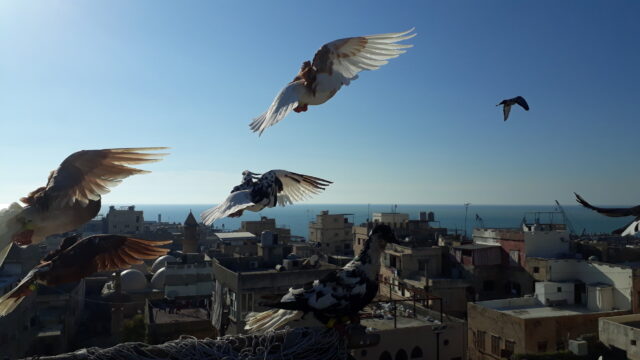
However, as Lea Najjar’s debut feature Kash Kash (sold by MAGNETFILM and which has been screening this week in Perspektive Deutsches Kino at Berlinale) shows, for some city dwellers in Beirut, there is one way to forget the daily struggles. They find respite by entering pigeon competitions. From the rooftops, the aim is to lure their rivals’ birds into their lofts. When the pigeons soar into the sky, they feel as if they are with them.
As Najjar explains, the inspiration for the documentary came on “a random Sunday afternoon” when she saw the pigeon fanciers on the rooftops. She realised there was a “network branching throughout the entire city” of these bird lovers.
The director’s original intention was to make a film set across all of Lebanon that would also look at how the birds were smuggled across the border from Syria.
“But then, when the revolution [of October 2019] started, we had to focus on Beirut. We had to reshuffle our cards and decide on all the characters who lived within the city because it wasn’t possible any more to move in a car around the country freely,” the director recalls of the challenges facing her and her co-writer Alia Haju. “We wanted to make a movie on the birds but slowly the country was collapsing around us and so we had to concentrate more and more on the city.”
The subculture of the Beirut pigeon owners is a very masculine one. “This made it difficult for us but it also gave us an advantage because we weren’t a threat to them. We weren’t opponents.”
Najjar and Haju spent a long time researching. Only when they turned up with a crew did their subjects realise they were making a proper movie. By then, though, they had won everybody’s trust.
“We were always honest with them, and genuine, having coffees, having dinners, hanging out,” Najjar says of how they established such a strong rapport with their characters. “We were interested in them as people. The whole team was super sweet. No-one was there to steal footage from them. We even let our characters hold the camera sometimes. And the shooting was really scattered [in time]. We had much more time to get know each other because of the political situation.”
Rivalries “between the roofs” can become very intense. There are stories of feuds that have lasted decades. Pigeon owners can behave very spitefully, killing their rivals’ birds. Ask the director what she feels about pigeons having made the film, however, and she speaks of their “beautiful symbolism.” At a time of political and social unrest, they represent peace and freedom. They’re beautiful visually. (That doesn’t mean the birds are “easy on the nose.” She is not sure she’d be keen to clean up their cages on a regular basis).
The documentary was shot in many “blocks.” The catastrophic explosion in the port happened relatively late during the process.
“Many of my friends and family had their apartments shattered,” the director remembers. “It felt at this point, I don’t know, not the right point to make a movie about birds.”
For a while, Najjar contemplated abandoning the project but then she realised that the men were already resuming their pigeon games, sometimes playing from on top of destroyed buildings, she decided then that it made sense to continue.
The film is Najjar’s graduation project from Filmakademie Baden-Württemberg in Ludwigsburg, Germany. She received backing from the MFG Baden-Württemberg Film Fund. SWR and from the Doha Film Fund. Magnetfilm came on board to handle sales through one of the producers, Matthias Drescher.
“It was really a student film…a passion project,” the director says.
Kash Kash has led a charmed life, winning the NEXT: Wave Award at its world premiere at CPH: Dox Festival 2022 and picking up many other prizes since then, including the Golden Frog at Cameraimage (rewarding the cinematography by Jonas Schneider).
“I am so surprised, so lucky, so humble,” Najjar says as she contemplates the many awards the doc has been awarded over the last year. “We were making a film about bird keepers in Beirut. I didn’t expect it to be something that especially a European audience would connect with this much.”
And, yes, the director organised a screening in Beirut which was attended by all the pigeon fanciers. She was worried that they might not enjoy it, especially as she didn’t have any footage of one of the main protagonists, Hassan Harb, ever winning. “I thought, oh no, I hope he is not pissed off because we don’t have him like as a hero, winning all the time…but he was really cool. He was like ‘sometimes you win, sometimes you lose.’ And the fisherman came with 23 members of his family.”
Najjar herself is now looking ahead to future projects. “I’m hoping to make another documentary. I am testing the waters,” the Berlin-based director says but won’t divulge any details of what the next film might be.





