

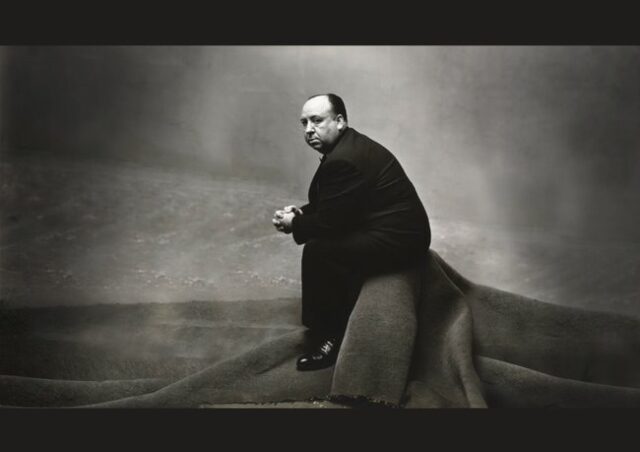
When prolific documentary director Mark Cousins was approached by his producer John Archer to make an Alfred Hitchcock documentary, his initial reaction was: ”holy fuck, there are, like, a million Hitchcock films.”
“We’ve all been fans of Hitchcock. Everybody feels they know Hitchcock, and that they own Hitchcock,” he adds. Cousins knew from the outset that he wanted to make a “first person” film, in which audiences would be given the sense that they were listening to the director speaking in his own words.
My Name is Alfred Hitchcock, made through Hopscotch Films, is screens at the Glasgow Film Festival following its world premiere last autumn at the Telluride Festival. Sales are handled by Dogwoof. (The UK release is set for the end of the year).
When he started work on the project, there were certain key themes Cousins wanted to explore. He wrote these down in a notebook, listing subjects such as desire, loneliness and fulfilment.
“I thought I’ll take these themes and then I’ll watch the films with these themes in mind,” Cousins recalls. He viewed the films in order, taking copious notes. The notes were placed in separate lunchboxes.
“I always work that way, with bits of paper and boxes, things like that, I like working that way,” Cousins says of his low-tech approach.
Some biographies of Hitchcock have portrayed the director of Vertigo, Psycho, North By Northwest and Rope as an ogre-like neurotic with a very dark side. That isn’t Cousins’ perspective. His Hitchcock is playful, ingenious and profound, a brilliant storyteller always probing with his camera.
“I think he was a great visual thinker and I identify with that. I was never good at school [or] at writing. I was an extremely slow reader but I had a strong visual memory…this film I have made about Hitchcock is very much about his visual thinking.”
In approaching Hitchcock, Cousins drew on books about neuroscience as well as more familiar film scholarship. He doesn’t just talk about Hitch’s camerawork but about neurophysiology. He watched several Hitchcock interviews before starting to write the monologue which runs through the documentary, picking up on the director’s little verbal tics (for example, his habit of ending sentences with the phrase ‘you see.’)
Cousins’ next step was to find someone who could speak in Hitchcock’s voice. His friend, actor and author Simon Callow, advised him that impressionist/comedian Alistair McGowan had “the best ear” in the business. His producer contacted McGowan’s agent. At first, there was no response but then Cousins received a message on his phone that seemed to come from Hitchcock himself. (Of course, it was McGowan showing what he could do).
“I immediately said yes, Alistair, please, I want you,” Cousins recalls.
During the recording of the voice-over, McGowan gave a virtuoso performance. The film lasts for around two hours but the impressionist didn’t make a single “fluff”.
Over the years, Cousins has worked with some very big-name actors, Jane Fonda and Tilda Swinton among them, but was still astounded by McGowan. “It was remarkable…to watch Alistair McGowan almost dislocate his jaw and bring this phlegm up into his throat. I remember him saying to me do you want a little more Leytonstone [the London birthplace of Hitchcock] in this. He could really calibrate…there is something extraordinary in the relationship between this man’s ear and his vocal chords.”
In the film, Cousins speculates as to how Hitchcock might have adapted to the cellphone age.
“One of the many things cellphones do is they increase our anxiety levels. There is always this sense of being ‘on.’ It’s as if we have downloaded our consciousness into our phone in our pocket. Hitchcock would have been very interested in the anxiety-creating function of a mobile phone. A mobile phone is in some ways like a ticking clock,” the director suggests that Hitchcock would have revelled in the storytelling opportunities afforded him by new technology.
In the film, Cousins analyses many of Hitch’s most familiar movies but gives equal weight to lesser known works. among them The Ring, The Pleasure Garden, Torn Curtain and Juno And The Paycock.
“The conventional wisdom about Hitchcock is that the British stuff was funny and light. Then, when he got to America, especially in the 50s, it [his work] became more Freudian, about desire, and dream-like,” the director says of how his subject has often by pigeonholed by critics and historians. He argues, though, that some of the silent films of the 20s are very dream-like themselves and you can find echoes of them in later classics like Vertigo.
“I wanted to take the road less travelled,” he says of his route through the Hitchcock oeuvre.
One title Cousins pays particular attention to is Rope (1948). “It really shook me. Its moral seriousness really shook me,” he says of a film famous for its lack of cutting. He also talks up titles like The Farmer’s Wife (1928) and his 1942 Hollywood movie Saboteur.
Hitchcock’s grand-daughters have now seen the documentary and have given it their blessing.
As for the idea that Hitch was a monster and misogynist, Cousins says his own research simply doesn’t bear that out.
“I am a passionate feminist and have been [so] all my life. Also, in my career, I’ve pushed the films of women as much as possible. I am very alert to this subject but I am also evidence-based,” Cousins says.
He accepts that Hitchcock did “terrible things” to Tippi Hedren, star of The Birds and Marnie. “But I was friends with Janet Leigh and she loved him. Carole Lombard loved him. Ingrid Bergman loved him. I met Teresa Wright and she loved him. Jay Presson Allen, who wrote Marnie, loved him…so many of the women he worked with loved him,” Cousins reels off just some of Hitchcock’s female collaborators who revered the East End auteur. He adds that the evidence of inappropriate behaviour by Hitchcock is skimpy at best. “In this film, I was not going to address something that basically was not true. I just didn’t need to go there.”





